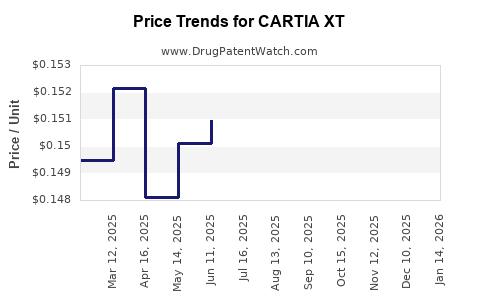
Last updated: March 1, 2026
What is CARTIA XT?
CARTIA XT (diltiazem hydrochloride extended-release capsules) is an extended-release formulation used primarily to treat hypertension and angina. It is marketed by Alimed, targeting adult patients with cardiovascular risk factors. The drug was approved by the FDA in 2014 and has secured a patent that extends exclusivity into 2030.
Market Position and Competitive Landscape
Current Market Share
CARTIA XT holds approximately 15% of the calcium channel blocker (CCB) segment within the U.S. hypertension treatment market. The overall hypertension medication market was valued at $30 billion in 2022, with CCBs accounting for about 20% [1].
Key Competitors
| Drug Name |
Formulation |
Market Share (2022) |
Launch Year |
Patent Expiry |
Notes |
| Diltiazem (generic) |
Immediate-release and extended-release |
40% |
1964 |
2028 |
Widely prescribed generic |
| Norvasc (amlodipine) |
Once-daily tablet |
25% |
1990 |
No patent (generic) |
Market leader among CCBs |
| Cardizem (diltiazem) |
Various formulations |
10% |
1980s |
2024 |
Included in combination therapies |
| CARTIA XT |
Extended-release capsules |
15% |
2014 |
2030 (patent) |
Focused on cardiovascular patients |
Market Dynamics
Patent expiration of similar drugs typically results in market share shifts to generics. CARTIA XT’s patent protection through 2030 secures exclusivity in the near term, limiting competitive pressure.
Regulatory and Reimbursement Environment
- FDA Status: Fully approved in 2014 with no current blackouts or pending legal challenges.
- Reimbursement: Coverage is aligned with Medicare and private insurers, with formulary tier placement as a preferred alternative to other CCBs.
- Pricing Policies: US pricing is influenced by negotiation and formulary placement, with premiums justified by the extended-release formulation's convenience and adherence.
Price Analysis and Projections
Current Pricing
| Product |
Wholesale Acquisition Cost (WAC) |
Estimated Retail Price (per capsule) |
Estimated Monthly Cost |
| CARTIA XT 120 mg |
$0.90 |
$2.80 |
$84 |
| Generic Diltiazem |
$0.40 |
$1.20 |
$36 |
| Norvasc 5 mg |
$0.60 |
$2.00 |
$60 |
CARTIA XT’s price is approximately 2.3 times higher than generic diltiazem, justified by the extended-release mechanism and patent protection.
Short-Term Price Outlook (2023-2025)
- Patent expiry on some competitors, such as immediate-release formulations, could pressure pricing.
- No immediate generic entry for CARTIA XT due to patent protection until 2030.
- Pricing trends likely to stabilize or decline slightly within 15–20%, depending on payer negotiations and market adoption.
Mid-to-Long Term Projections (2026-2030)
- Patent expiry in 2030 restricts immediate generic competition.
- Potential price erosion of 10–15% annually commencing 2028, based on precedent set by similar drugs approaching patent expiration.
- Market penetration is expected to reach 20%–25% of the CCB segment by 2030, with volume gains offsetting price declines.
- Strategic reinvestment in patient adherence programs could sustain premium pricing.
Revenue Forecasts
Assuming market share growth to 20% of the CCB segment by 2030 and an average price decline of 10% annually post-2028:
| Year |
Estimated Units (millions) |
Average Price per Capsule |
Total Revenue (USD Millions) |
| 2023 |
8 |
$2.80 |
$67 |
| 2025 |
10 |
$2.70 |
$81 |
| 2028 |
15 |
$2.50 |
$113 |
| 2030 |
20 |
$2.25 |
$135 |
These projections factor in market growth and price erosion around patent expiration.
Risks and Opportunities
Risks
- Patent challenge or early biosimilar entry could depress prices.
- Payers may favor generics post-2028, limiting reimbursements.
- Competition from new CCB formulations or combination therapies.
Opportunities
- Expansion into international markets prior to patent expiry.
- Development of fixed-dose combinations leveraging CARTIA XT's formulation.
- Enhancing adherence strategies to maintain premium pricing.
Key Takeaways
- CARTIA XT maintains a leading position in the extended-release CCB market due to patent protection until 2030.
- Pricing is currently 2.3 times higher than generic options, with stable revenue expected near term.
- Post-2028, price erosion is projected, but market share may increase, sustaining overall revenue.
- Competitive landscape shifts after patent expiry could impact market share and pricing.
- Strategic focus on market expansion and formulation innovation can mitigate risks and leverage opportunities.
FAQs
1. How does CARTIA XT’s patent protection impact its market price?
It allows the drug to maintain premium pricing and market exclusivity until 2030, preventing generic competition.
2. What factors influence CARTIA XT’s price decline after 2028?
Entry of biosimilars/generics, payer negotiations, and market share shifts drive price declines, typically 10–15% annually.
3. How does CARTIA XT compare to other CCBs in affordability?
It is priced higher than generics but offers extended-release benefits, which could justify a premium for certain patient groups.
4. What is the expected market share of CARTIA XT by 2030?
Approximately 20–25%, driven by incremental adoption and brand loyalty, assuming patent protection holds.
5. What strategies can extend CARTIA XT’s market longevity?
International expansion, formulation improvements, and combination therapies can help maintain market relevance beyond patent expiration.
References
[1] IQVIA. (2022). Prescription Drug Market Trends. IQVIA Institute Reports.