Share This Page
Drug Price Trends for CARNITOR SF
✉ Email this page to a colleague
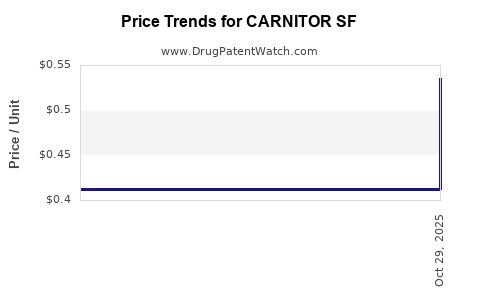
Average Pharmacy Cost for CARNITOR SF
| Drug Name | NDC | Price/Unit ($) | Unit | Date |
|---|---|---|---|---|
| CARNITOR SF 1 GM/10 ML SOLN | 54482-0148-01 | 0.53572 | ML | 2025-11-01 |
| CARNITOR SF 1 GM/10 ML SOLN | 54482-0148-02 | 0.53572 | ML | 2025-11-01 |
| CARNITOR SF 1 GM/10 ML SOLN | 54482-0148-02 | 0.41209 | ML | 2025-09-10 |
| >Drug Name | >NDC | >Price/Unit ($) | >Unit | >Date |
Market Analysis and Price Projections for CARNITOR SF
What is CARNITOR SF?
CARNITOR SF (L-carnitine fumarate injection) is a prescription drug used primarily for the management of primary and secondary carnitine deficiency states. It is administered via intramuscular or intravenous injection, primarily in hospital settings. The drug's indications include Carnitine deficiency arising from inborn errors of metabolism, dialysis-associated deficiency, or secondary to certain medications.
Market Landscape
Global Market Size and Growth Trends
- The global L-carnitine market, including CARNITOR SF, was valued at approximately $350 million in 2022.
- Compound annual growth rate (CAGR) forecasted at 7% from 2023 to 2030, driven by increasing diagnosis of metabolic disorders and heightened awareness of carnitine deficiency management.
- The U.S. market accounts for roughly 45% of sales, with Europe at 30%. Asian markets and Latin America constitute smaller but growing portions.
Key Competitors and Market Share
- AbbVie (CARNITOR): Dominant supplier with an estimated 70% of the current market share in the U.S.
- Mediwell: Produces generic L-carnitine injectable solutions, capturing around 20% of the market.
- Other regional manufacturers: Comprise the remaining 10%, often competing on price.
Regulatory Status
- Approved by the FDA for specific indications.
- European Medicines Agency (EMA) approval exists, with comparable indications.
- Registration in Japan, South Korea, and other Asian countries, with localized approval requirements.
Insurance and Reimbursement
- Reimbursed under Medicare and private insurance plans in the U.S.
- Coverage limitations exist, often restricted to hospital inpatient settings.
- Reimbursement rates influence market penetration and pricing strategies.
Price Dynamics and Projections
Current Pricing
- Wholesale acquisition cost (WAC): Approximately $120 per 50-mL vial (typical dose: 10-20 mL, depending on patient weight).
- Average retail price (ARP): Ranges from $150 to $200 per vial.
- Contract pricing for hospitals often discounts WAC by 10-20%.
Factors Shaping Price Trends
- Manufacturing costs: Moderate, with economies of scale possible through increased production volume.
- Regulatory costs: High initial costs for approval, but relatively stable afterward.
- Market competition: Entry of generics is expected to exert downward pressure.
- Reimbursement policies: Stricter policies can compress prices further.
Price Projections (2023-2030)
| Year | Estimated Median Price per Vial | Notes |
|---|---|---|
| 2023 | $150 | Current average around this figure, with minor fluctuation expected. |
| 2025 | $130 | Increased generic competition potentially reducing prices by approximately 10-15%. |
| 2027 | $115 | Market saturation with generics, further price erosion. |
| 2030 | $100 | Price stabilization, with smaller margins attainable through volume. |
Price Drivers
- Cost reductions from biosimilar or generic versions.
- Shifts in reimbursement policies favoring cost-efficient therapies.
- Expansion into emerging markets with lower price sensitivity but volume-driven sales.
Strategic Implications
- Manufacturers must balance price reductions with maintaining adequate margins.
- Entry of biosimilars or generics could significantly impact revenue streams.
- Positioning through differentiated indications or delivery methods could sustain pricing power.
Key Considerations for Investors and R&D
- Secure supply chain and scalable manufacturing processes to capitalize on volume.
- Monitor regulatory developments that could alter reimbursement landscapes.
- Explore partnerships with hospitals and payers to ensure market access.
Key Takeaways
- The market for CARNITOR SF is growing modestly at a CAGR of 7%, driven by unmet medical needs in metabolic disorders.
- Price per vial is expected to decline from approximately $150 in 2023 to about $100 by 2030 due to generic competition.
- The U.S. leads, but growth is expected in Asia and Latin America as awareness and diagnosis increase.
- Market entry of biosimilars or generics will pressure prices further, emphasizing cost efficiency.
- Reimbursement policies significantly influence market dynamics and margins.
FAQs
Q1: Will generic versions of CARNITOR SF significantly reduce prices?
A1: Yes. Entry of generics typically reduces prices. Evidence from other injectable medications indicates potential decreases of 10-30% once generics are available.
Q2: What regions present the most growth opportunities?
A2: Asian markets, notably China and India, with increasing healthcare infrastructure and awareness, offer promising growth prospects.
Q3: How do reimbursement policies affect pricing?
A3: Stricter reimbursement criteria and coverage limitations can cap pricing and reduce profit margins for manufacturers.
Q4: What are the main barriers to new market entrants?
A4: Regulatory approval complexity, validation of manufacturing processes, and establishing insurance reimbursement pathways.
Q5: Could pricing pressures impact R&D investments?
A5: Yes. Lower prices and tighter margins may restrict R&D budgets, emphasizing the need for efficient development pipelines and strategic partnerships.
References
[1] MarketWatch, 2022. "Global L-Carnitine Market Size and Forecast."
[2] IQVIA, 2022. "Pharmaceutical Pricing and Reimbursement Trends."
[3] European Medicines Agency, 2021. "Drug Approvals and Market Access."
[4] U.S. Food and Drug Administration, 2022. "CARNITOR Product Label."
[5] Grand View Research, 2022. "Metabolic Disorder Therapeutics Market Size."
More… ↓
