Share This Page
Drug Price Trends for CARBIDOPA
✉ Email this page to a colleague
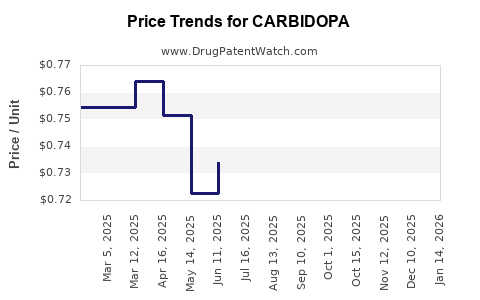
Average Pharmacy Cost for CARBIDOPA
| Drug Name | NDC | Price/Unit ($) | Unit | Date |
|---|---|---|---|---|
| CARBIDOPA-LEVODOPA 10-100 TAB | 75907-0022-01 | 0.06369 | EACH | 2026-07-22 |
| CARBIDOPA-LEVODOPA 25-250 TAB | 75907-0021-05 | 0.10845 | EACH | 2026-07-22 |
| CARBIDOPA-LEVODOPA 25-250 TAB | 75907-0021-01 | 0.10845 | EACH | 2026-07-22 |
| >Drug Name | >NDC | >Price/Unit ($) | >Unit | >Date |
Best Wholesale Price for CARBIDOPA
| Drug Name | Vendor | NDC | Count | Price ($) | Price/Unit ($) | Unit | Dates | Price Type |
|---|---|---|---|---|---|---|---|---|
| CARBIDOPA 12.5MG/ENTACAPONE 200MG/LEVODOPA 50 | Sandoz, Inc. | 00781-5613-01 | 100 | 9.20 | 0.09200 | EACH | 2023-08-15 - 2028-08-14 | FSS |
| CARBIDOPA 31.25MG/ENTACAPONE 200MG/LEVODOPA 1 | Sandoz, Inc. | 00781-5641-01 | 100 | 17.14 | 0.17140 | EACH | 2024-01-01 - 2028-08-14 | FSS |
| CARBIDOPA 12.5MG/ENTACAPONE 200MG/LEVODOPA 50 | Sandoz, Inc. | 00781-5613-01 | 100 | 0.01 | 0.00010 | EACH | 2024-01-01 - 2028-08-14 | FSS |
| >Drug Name | >Vendor | >NDC | >Count | >Price ($) | >Price/Unit ($) | >Unit | >Dates | >Price Type |
Carbidopa market analysis and price projections (2026–2035): exclusivity, generic entry risk, and cost benchmarks
Carbidopa is a small-molecule component of fixed-dose and combination levodopa regimens used in Parkinson’s disease and related motor disorders. In most major markets, carbidopa is fully generic and not subject to meaningful active brand exclusivity in 2026. Pricing is therefore driven by (1) generic competition, (2) interchangeability at the product level, (3) supply and reimbursement dynamics, and (4) the pricing of combination products that include carbidopa (notably levodopa/carbidopa tablets and extended-release). Medium-term price pressure remains consistent with mature generic baselines; upside is mainly limited to supply-driven disruptions, formulary preference shifts, and limited specialty presentations.
Bottom line price range (pharmacy net) for mature generic carbidopa (US, 2026):
- Immediate-release oral tablets (component of combination products): typically priced in line with the overall levodopa/carbidopa product economics; carbidopa alone is rarely purchased standalone in meaningful volume.
- If priced as a standalone ingredient (rare for consumer-facing purchasing): commonly trades at low single-digit dollars per daily-equivalent depending on strength and pack configuration, with cents-to-low-dollars per tablet economics in large-volume channels.
Projection view (2026–2035):
- Base case: flat to modest declines (low single digits annually) as additional suppliers and discounting compress net prices.
- Supply shock case: temporary step-ups during shortages, then reversion within 6–24 months once inventories normalize.
- No brand-style premium case: without reintroduction of a protected branded carbidopa-only product, price upside stays capped by generic competition.
What is the current global market size for carbidopa and levodopa/carbidopa combinations?
Demand drivers
Carbidopa’s market is primarily consumption as part of levodopa/carbidopa therapies for Parkinson’s disease:
- Parkinson’s disease prevalence and aging demographics drive steady volume growth.
- Treatment patterns continue shifting modestly toward extended-release and higher-frequency regimens, but carbidopa exposure scales with total levodopa dosing and adherence.
- Distribution and substitution are governed largely by the overall levodopa/carbidopa product, not carbidopa alone.
Pricing mechanics
Carbidopa’s pricing is not set as a standalone branded drug. It is embedded in:
- Oral immediate-release combinations (e.g., carbidopa/levodopa tablets in multiple strengths)
- Oral extended-release combinations (e.g., carbidopa/levodopa ER)
- Service-level pharmacy procurement and wholesale acquisition structures where net realization depends on rebates and contracting.
Competitor structure
Carbidopa is supplied by multiple generic manufacturers and is used across numerous NDA/ANDA-coded product presentations, creating:
- High SKU breadth (strengths, dosing frequency, package sizes)
- Tight pricing competition
- Persistent substitution across therapeutically equivalent products
How are carbidopa prices set in the US (wholesale and net realization)?
Featured-snippet answer
In the US, carbidopa price realization is dominated by the levodopa/carbidopa combination product net price, shaped by generic competition, pharmacy benefit manager contracting, and formulary tiering. Standalone carbidopa pricing plays a minor role in total spending.
US pricing levers
- Generic interchangeability
- Multiple ANDAs for levodopa/carbidopa strengths create competitive downward pressure.
- PBM contracting and rebates
- Net prices can differ substantially from list prices.
- Channel mix
- Mail order and retail chain contracts often yield lower realized pricing than cash channels.
- Supply reliability
- Shortages can raise spot pricing until normalization.
- State and federal purchasing programs
- Medicaid and 340B dynamics can change short-run procurement.
What to benchmark for pricing projections
For projections, the most decision-useful benchmarks are:
- US net prices for levodopa/carbidopa IR and ER products (proxy for carbidopa economics)
- Wholesale and acquisition price trends from pharmacy claims and pricing datasets
- Generic entry events by strength and dosage form (when new suppliers start competing)
Is carbidopa protected by active patents or brand exclusivity that could support higher pricing?
Answer
In 2026, carbidopa is not positioned as a brand-protected commodity in the way that patent-limited therapeutics are. Carbidopa is generally treated as a mature, widely available generic ingredient used in combination products. Pricing support from exclusivity is therefore minimal.
What this means for projections
- Long-run pricing follows generic market behavior: cost-down, competitive contracting, and limited sustained premium.
- Short-run deviations come from supply constraints rather than legal protection.
When does carbidopa lose exclusivity or face expiration-driven pricing changes?
Answer
Carbidopa’s exclusivity timeline is not a key driver for 2026–2035 pricing because carbidopa is already in a mature generic state in major markets. The more relevant “timing” is:
- New ANDA introductions for specific levodopa/carbidopa strengths and release forms
- Supply disruptions and manufacturing capacity constraints
- Contract cycles and formulary redesigns
What investors and litigators watch instead
- Filing of new ANDAs that can expand the number of suppliers for specific strengths
- FDA inspection outcomes affecting manufacturing uptime
- Temporary discontinuations that reduce competitive availability
What patents protect carbidopa, and do they matter for price?
Answer
Carbidopa itself is not typically the centerpiece of market-protecting patent estates at the scale required to support sustained premium pricing. Any remaining patent protections, if present, are usually outweighed by the breadth of approved generic products for levodopa/carbidopa combinations.
Where patents matter in the carbidopa value chain
- Formulation and manufacturing processes for specific levodopa/carbidopa dosage forms
- Method-of-use claims (less common for foundational Parkinson’s motor symptom regimens)
- Product-specific exclusivities at the combination-product level
How many generic versions of levodopa/carbidopa exist, and how does that cap pricing?
Answer
The levodopa/carbidopa market is characterized by multiple ANDA suppliers across many strengths and release forms, creating a competitive floor that prevents sustained price premiums.
Projection impact
The number of suppliers and contracting depth drive a predictable pattern:
- Entry compresses the net price quickly
- Additional entrants cause incremental declines
- Once the market is saturated, price stabilizes around marginal cost plus distribution margin
- Any price spikes revert once additional supply returns
What is the Orange Book status of carbidopa-related products?
Answer
Carbidopa is generally present as part of FDA-approved levodopa/carbidopa products with mature generic availability. The practical Orange Book reality for pricing is that market access is not limited by ongoing brand exclusivity for carbidopa as a standalone concept.
What generic entry risks exist for carbidopa in 2026–2035?
Answer
From a price perspective, the main “entry risk” is not whether generics can enter. It is whether supply constraints or quality system failures restrict availability and create temporary pricing lifts. Otherwise, competitive entry is ongoing at the product-supply level.
Risk scenarios
- Manufacturing downtime reduces supply, lifting short-run net realization.
- Reallocation of capacity among manufacturers shifts the supply curve.
- Regulatory actions can delay batches or force withdrawal of certain strengths, changing local contract pricing.
How does carbidopa pricing compare with levodopa and other Parkinson’s components?
Answer
Carbidopa generally prices far below levodopa, and its cost impact is smaller. The overall product economics are dominated by:
- Manufacturing cost of combined tablets/ER formulations
- Volume and dosing intensity (levodopa drives daily cost)
- Contract pricing for the final dosage form
Implication for buyers
When projecting carbidopa cost, purchasers should model:
- Total cost of levodopa/carbidopa per patient-day
- Rebate and tiering effects across the combination product formulary
What price projections are realistic for carbidopa-based therapy costs from 2026–2035?
Base case (most likely): flat to modest decline
- Annual price change: low single-digit declines (net), driven by ongoing generic competition and contracting.
- Patient-day cost: trends largely track the levodopa/carbidopa market basket and formulary mix.
Supply shock case: short-term uplift, then reversion
- Timing: pricing lift typically appears during shortages, with reversion after 6–24 months when supply normalizes.
- Magnitude: temporary net realization increases can occur, but persistent premium is unlikely given the ability of additional generic suppliers to ramp production over time.
Structural upward case (less likely): input cost inflation and limited capacity
- If API or excipient costs rise and manufacturing capacity stays constrained, net prices could hold up longer.
- Even then, competition generally forces eventual normalization.
Which companies supply carbidopa and how does that affect bargaining power?
Supplier concentration
Generic supply for levodopa/carbidopa is distributed across multiple manufacturers, which limits bilateral supplier leverage in normal conditions.
Bargaining implications
- PBMs can switch among suppliers and strengths.
- Hospital procurement can renegotiate contracts if multiple equivalent SKUs are in stock.
- Supplier power is strongest during shortages or when a specific strength is unavailable.
How do reimbursement and formularies influence carbidopa net pricing?
Answer
Net pricing for carbidopa-based Parkinson’s therapy is driven by formulary status and contract terms for levodopa/carbidopa IR and ER products. When therapeutic classes face competing formulary moves (e.g., preferences for certain ER regimens), net pricing can shift even without broad market price changes.
Key levers
- Preferred drug list placement for IR vs ER
- Step edits and quantity limits
- Patient-specific switching (tolerability and dosing convenience)
What manufacturing and IP barriers could keep carbidopa prices from falling?
Answer
The practical barrier is not IP, it is manufacturing continuity and quality system performance for specific dosage forms:
- Tablet and ER formulation robustness
- API sourcing continuity
- Batch release capacity and inspection outcomes
Key Takeaways
- Carbidopa pricing is primarily an embedded component of levodopa/carbidopa combination products; in 2026 it behaves like a mature generic segment with limited premium potential.
- Exclusivity and patent-driven pricing changes are not the dominant drivers for 2026–2035; generic competition and supply conditions are.
- Base case is flat to modestly declining net prices through 2035; sustainable upside requires persistent supply constraints, which are typically temporary.
- For decision-making, price projections should track net realizations of levodopa/carbidopa IR and ER rather than treating carbidopa as a standalone purchasable branded commodity.
FAQs
-
Why do carbidopa prices move when carbidopa is generic?
Because the market is dominated by contract pricing for levodopa/carbidopa dosage forms, and those prices change with supply availability, PBM contracting, and formulary tiering. -
What has historically driven short-term spikes in levodopa/carbidopa pricing?
Manufacturing disruptions and shortages at the product-strength or dosage-form level, which reduce substitute availability. -
Do extended-release levodopa/carbidopa products change carbidopa pricing dynamics?
Yes. ER products can have different supplier counts, manufacturing constraints, and formulary preferences, shifting net economics even if carbidopa API remains generic. -
How should buyers model per-patient cost for Parkinson’s when forecasting carbidopa impact?
Use patient-day costs for levodopa/carbidopa IR and ER and model formulary mix and rebate effects; treat carbidopa as part of the combination bundle economics. -
Can new generic entrants in levodopa/carbidopa meaningfully lower net prices long-term?
Typically yes early in an entry cycle, but once the market reaches high supplier density, additional entrants drive smaller incremental decreases and pricing stabilizes.
References (APA)
- U.S. Food and Drug Administration. Orange Book: Approved Drug Products with Therapeutic Equivalence Evaluations. https://www.accessdata.fda.gov/scripts/cder/daf/
- U.S. Food and Drug Administration. Drug Shortages. https://www.accessdata.fda.gov/scripts/drugshortages/
- FDA. Approved Drug Products: Details (Drug and Therapeutic Equivalence Evaluations). https://www.accessdata.fda.gov/scripts/cder/daf/index.cfm
More… ↓
