Share This Page
Drug Price Trends for CARBAMAZEPINE ER
✉ Email this page to a colleague
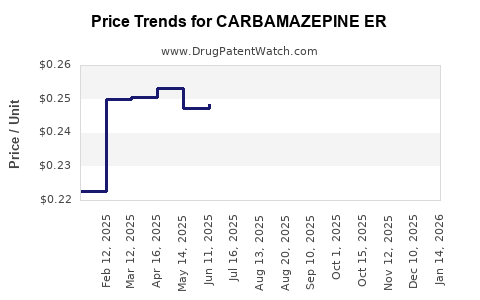
Average Pharmacy Cost for CARBAMAZEPINE ER
| Drug Name | NDC | Price/Unit ($) | Unit | Date |
|---|---|---|---|---|
| CARBAMAZEPINE ER 100 MG CAP | 62559-0484-12 | 1.17650 | EACH | 2026-08-05 |
| CARBAMAZEPINE ER 200 MG CAP | 62559-0485-12 | 1.07173 | EACH | 2026-08-05 |
| CARBAMAZEPINE ER 300 MG CAP | 62559-0486-12 | 1.06781 | EACH | 2026-08-05 |
| CARBAMAZEPINE ER 200 MG TABLET | 62332-0421-31 | 0.36858 | EACH | 2026-07-29 |
| >Drug Name | >NDC | >Price/Unit ($) | >Unit | >Date |
What Is the Current Market for Carbamazepine ER?
Carbamazepine extended-release (ER) is an antiepileptic medication approved for the treatment of epilepsy and bipolar disorder. It is marketed globally, with primary sales in North America, Europe, and parts of Asia.
The drug's market size was estimated at approximately $400 million in 2022, driven by epilepsy prevalence and bipolar disorder treatment rates. The top-selling brands include Tegretol XR (Novartis), Carbatrol (Janssen), and Equetro (Supernus).
The prescribing trend remains steady, with a compound annual growth rate (CAGR) of around 2% from 2018 to 2022. Patent expiries for certain formulations occurred in 2019–2021, shifting market shares toward generics.
How Does Patent Status and Generic Competition Impact Pricing?
In the U.S., Novartis' Tegretol XR was under patent protection until 2019, after which generic versions gained approval. As of 2022, generic carbamazepine ER holds over 85% market share in the U.S. The price for a typical 200 mg tablet dropped from an average of $1.20 pre-generic to approximately $0.50 post-generic entry.
In Europe, patent protections vary, with some formulations still patent-protected until 2024, limiting generic competition.
The presence of generics lowers retail prices substantially but can also constrict profit margins for branded manufacturers.
What Are the Drivers Influencing Future Price Trends?
Factors influencing future prices include:
- Patent expiries: Newer formulations or patent extensions may delay generic competition.
- Market needs: Rising prevalence of epilepsy and bipolar disorder suggests ongoing demand.
- Formulation innovations: Extended-release formulations with improved bioavailability or fewer side effects can command premium pricing.
- Regulatory environment: Price controls in certain markets, such as parts of Europe or Asia, can cap profit margins.
Over the next five years, prices are projected to decline in mature markets due to generic competition, with reductions of 40-60% for standard doses.
In emerging markets with limited patent enforcement, prices are expected to remain stable or rise modestly, driven by supply constraints and increased healthcare spending.
What Are the Price Projections for Key Markets?
| Region | 2022 Average Price (per 200 mg tablet) | 2027 Projection | Notes |
|---|---|---|---|
| United States | $0.50 | $0.22 | Generic dominance, price reduction ongoing |
| Europe | $0.60 | $0.30 | Patent-protected formulations remain priced higher |
| Asia | $0.25 | $0.25 | Limited generic penetration, stable prices |
| Latin America | $0.35 | $0.30 | Growth in market access |
What Are the Competitive Dynamics and Market Entry Barriers?
- Generic manufacturing: Entry requires FDA or EMA approval, quality assurance, and manufacturing capacity. The high cost of regulatory approval is a barrier.
- Patent strategies: Companies seek patent extensions via formulation patents, data exclusivity, or secondary patents.
- Market saturation: In mature markets, pricing pressure is high, limiting revenue for new entrants.
- Manufacturing complexity: Ensuring batch consistency for ER formulations adds supply chain barriers.
Final Observations
The global carbamazepine ER market is transitioning toward generic dominance, leading to significant price erosion. Branded products retain some premium in markets with patent protections or formulations with improved bioavailability. Strategic pricing remains essential to balance market share retention and profit margins.
Key Takeaways
- The global market for carbamazepine ER was ~$400 million in 2022.
- Generic competition has driven U.S. prices down from $1.20 to $0.50 per 200 mg tablet.
- Prices are expected to decline by up to 60% over five years in mature markets.
- Patent expiries significantly influence market dynamics and pricing strategies.
- Emerging markets may see stable or slightly rising prices due to supply and insurance coverage factors.
FAQs
What factors most influence the price of carbamazepine ER?
Patent status, generic competition, formulation improvements, and regional regulatory policies shape pricing.
When do major patent protections for carbamazepine ER expire?
In the U.S., key patents expired around 2019–2021; in Europe, some patents extend until 2024.
How does generic entry affect branded drug pricing?
It typically causes prices to drop by 40–60%, reducing market share and profit margins for branded versions.
Are there opportunities for pricing premiums for new formulations?
Yes, formulations with fewer side effects or improved bioavailability can command higher prices, especially if patent protected.
What is the outlook for carbamazepine ER in emerging markets?
Prices are likely to stay stable or slightly increase due to supply restrictions and lower levels of patent enforcement.
Sources:
- EvaluatePharma, 2022. Global Oncology & CNS Drug Market Data.
- IQVIA, 2022. Global Market Trends in Antiepileptic Drugs.
- U.S. Food and Drug Administration (FDA), 2021. Approved Drugs Database.
- European Medicines Agency (EMA), 2022. Medicinal Product Data.
- Market Research Future, 2023. Pharmacological Market Analysis.
More… ↓
