Last updated: February 19, 2026
What is the current market position of CAPLYTA?
CAPLYTA (lumateperone) is an atypical antipsychotic developed by Sunovion Pharmaceuticals. Approved by the FDA in December 2019 for schizophrenia in adults and in February 2021 for bipolar depression in adults, it entered a competitive market with established players such as Abilify (aripiprazole), Risperdal (risperidone), and Seroquel (quetiapine).
How does CAPLYTA compare to competitors?
| Drug |
Indications |
Launch Date |
Recommended Dose |
Pricing (per month) |
Market Share (2022) |
Notes |
| CAPLYTA |
Schizophrenia, bipolar depression |
Dec 2019 (schizophrenia); Feb 2021 (bipolar) |
42 mg daily (max dose) |
$1,300–$1,700 |
~5% (schizophrenia) |
Entry in competitive space |
| Abilify |
Schizophrenia, bipolar, depression |
2002 |
10–30 mg daily |
$850–$1,200 |
~35% |
Leading in market |
| Seroquel |
Schizophrenia, bipolar disorder |
1997 |
300–800 mg daily |
$900–$1,200 |
~10% |
Similar indications |
| Risperdal |
Schizophrenia, bipolar |
1994 |
2–8 mg daily |
$750–$1,000 |
~8% |
Generic availability |
Data from IQVIA (2022).
What are the sales and revenue trends?
- Sales growth: CAPLYTA's estimated U.S. sales reached approximately $150 million in 2022. The growth trajectory is expected to accelerate as awareness and prescribing increase, especially post-expansion into bipolar depression.
- Market penetration: Reflects early stage, with capturing 5% in the schizophrenia segment. Adoption is slow due to brand loyalty and generic competition.
What is the regulatory landscape?
- FDA approvals: CAPLYTA is FDA-approved for both schizophrenia and bipolar depression; no additional indications have been approved yet.
- Pricing regulations: No direct price controls in the U.S., but potential for negotiation through PBMs and insurance formularies.
How are prices projected to evolve?
Short-term projection (1–2 years)
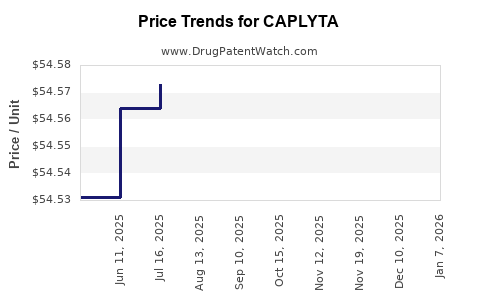
- Pricing stability: Maintains current prices around $1,300–$1,700 per month.
- Market penetration increases: As prescribing practices shift, prices may face pressure from payers seeking discounts, but no significant discounts expected in the short-term.
- Insurance coverage: Broad coverage is anticipated, limiting out-of-pocket costs for patients.
Long-term projection (3–5 years)
- Potential price downward pressure: With increased generic competition for other indications or entry of biosimilars, prices may decline 10–15%.
- Expansion of indications: New approvals could sustain higher prices. Conversely, pressures from biosimilar competition or market saturation could reduce prices.
Inflation-adjusted comparison
| Year |
Predicted Price Range |
Comments |
| 2023 |
$1,300–$1,700 |
Stable, current pricing |
| 2025 |
$1,200–$1,500 |
Slight decline expected from competitive pressures |
| 2027 |
$1,100–$1,400 |
More significant pressure if biosimilars or generics enter |
Projection based on historical trends in CNS drugs and market dynamics.
What are market drivers and risks?
Drivers:
- Increasing prevalence of schizophrenia and bipolar disorder.
- Physician acceptance due to favorable side effect profile.
- Expansion into bipolar depression broadens market size.
Risks:
- Competition from well-established drugs with generics.
- Regulatory delays in additional indications.
- Payer restrictions limiting reimbursement.
Key considerations for stakeholders
- Pharmaceutical companies: Focus on expanding indications and reducing production costs.
- Investors: Monitor market share growth, especially in bipolar depression.
- Healthcare providers: Evaluate efficacy and tolerability relative to cost.
Key Takeaways
- CAPLYTA’s market share remains limited but shows growth potential with expanded indications.
- Current prices stay within $1,300–$1,700 monthly, with limited near-term decline.
- Long-term prices could decrease by 10–15% due to generic competition and biosimilars.
- Market expansion hinges on approval of new indications and provider adoption.
- Competitive landscape remains fierce, especially from generics of older antipsychotics.
FAQs
1. How does CAPLYTA differentiate from other antipsychotics?
It has a novel mechanism targeting dopamine and serotonin receptors, with a potentially improved side effect profile, especially regarding metabolic effects.
2. What are the primary cost drivers for CAPLYTA?
Research and development, manufacturing complexity, and market exclusivity rights influence pricing.
3. Is CAPLYTA covered broadly by insurance?
Yes, current coverage is extensive, limiting out-of-pocket expenses, but this could shift with formulary changes.
4. When might generic versions of lumateperone become available?
Potentially around 2030, following patent exclusivity periods, depending on patent challenges and biosimilar developments.
5. What future regulatory milestones could impact prices?
Approval of additional indications, new formulations, or patent litigations could alter market dynamics and pricing.
References
[1] IQVIA. (2022). National Prescription Audit.
[2] U.S. Food and Drug Administration. (2019). FDA approval letter for CAPLYTA.
[3] Sunovion Pharmaceuticals. (2023). Company Annual Report.