Last updated: February 13, 2026
Market Overview of CAPECITABINE
Capecitabine is an oral chemotherapeutic agent primarily used for metastatic colorectal, breast, gastric, and pancreatic cancers. It functions as a prodrug converted into 5-fluorouracil (5-FU) within tumor tissues, which inhibits DNA synthesis.
The drug is marketed under brand names such as Xeloda by Roche and has received approvals in multiple jurisdictions including the U.S., Europe, and Asia. Its global sales reached approximately $1.4 billion in 2022, driven by its efficacy in metastatic settings and expanding indications.
Market Size and Key Drivers
Current Market Size
| Metric |
2022 Estimate |
| Global sales |
~$1.4 billion |
| Key markets |
U.S., Europe, Asia-Pacific |
| Number of patients treated |
Estimated 200,000-250,000 annually |
Growth Drivers
- Uptake in Asia-Pacific: Increasing cancer prevalence and expanding approvals.
- Expanded indications: Usage in early-stage adjuvant settings for colon cancer.
- Patient preference: Oral administration enhances compliance compared to infusion therapies.
Market Challenges
- Generic competition: Multiple generics now available, reducing prices.
- Side effects: Hand-foot syndrome and diarrhea limit dosing for some patients.
- Emerging therapies: Immunotherapy combinations (e.g., checkpoint inhibitors) are gaining popularity, potentially reducing reliance on capecitabine.
Competitive Landscape
Key Manufacturers
| Company |
Product |
Market Share (2022) |
Notes |
| Roche |
Xeloda |
~70% |
Market leader, robust global distribution network |
| Others |
Generics |
~30% |
Multiple manufacturers, price-sensitive segment |
Patent Expiry and Generic Entry Timeline
- Original Roche patent for Xeloda expired in the U.S. in 2018 and in Europe in 2017.
- Multiple generics entered markets post-expiry, reducing pricing power.
Price Projections and Future Trends
Historical Pricing
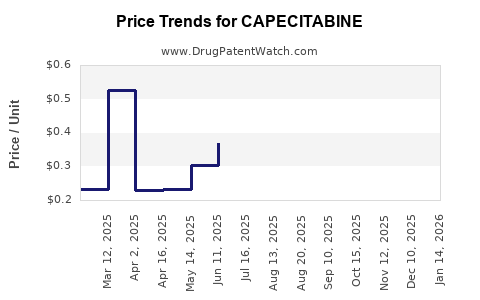
- Brand-name Xeloda: Approximate wholesale price per 500 mg tablet (~$6-$8).
- Generic versions: Prices declined by 35-50% post patent expiration.
Short-term Outlook (Next 1-2 Years)
- Prices likely stabilize with slight reductions as generic market share consolidates.
- Wholesale acquisition costs for generics estimated between $2-$4 per 500 mg tablet.
- Volume increases driven by expanding indications and improved reimbursement policies.
Long-term Forecast (3-5 Years)
- Increased competition could further depress prices.
- Potential for biosimilar-like strategies might influence pricing margins.
- New formulations (e.g., combination regimens, extended-release) could alter pricing landscapes and patient adherence.
Price Projections Summary
| Year |
Brand Name (Xeloda) |
Generic Price Range |
Comments |
| 2023 |
$6-$8 per 500 mg |
$2-$4 per 500 mg |
Market stabilization post-generic entry |
| 2025 |
$5-$7 per 500 mg |
$1.5-$3 per 500 mg |
Potential further price reductions amid increased competition |
Regulatory and Policy Impact
- Reimbursement policies favor generic utilization to lower healthcare costs.
- Pricing regulations in Europe (e.g., NICE guidelines) exert pressure on prices.
- Market access improvements via inclusion in national formularies further influence volume.
Key Takeaways
- Capecitabine remains a significant contributor to oncology treatment markets, with global sales expected to hover around $1.3-$1.5 billion annually over the next five years.
- Pricing will decline due to patent expirations and rising generic competition, with wholesale prices potentially reducing by up to 60% compared to original brand prices.
- The expanding use in early and adjuvant indications may support volume growth, offsetting some price erosion.
- Competition from immunotherapies and targeted agents could gradually diminish capecitabine's market share in certain indications.
- Market access and reimbursement policies will significantly influence future pricing and utilization strategies.
FAQs
1. How does capecitabine's price compare to other chemotherapeutic agents?
Capecitabine's wholesale prices are generally lower than infusion-based chemotherapies like 5-FU or irinotecan but face more price pressure following generic entry, aligning prices closer to other oral agents.
2. What factors could influence future price reductions?
Introduction of additional generics and biosimilars, regulatory reforms targeting drug pricing, and shifts towards combination therapies with immuno-oncology agents.
3. Are there emerging formulations that could impact the market?
Yes. Extended-release formulations and combination regimens with other oral agents may alter market dynamics but are in early development stages.
4. How does geographic variation affect pricing?
In the U.S., prices are higher due to less regulation and higher healthcare costs. European and Asian markets tend to have lower prices owing to regulatory controls and cost containment policies.
5. What is the outlook for capecitabine's market share?
Expect a gradual decline in market share in some indications due to emerging therapies but maintained relevance in combination regimens and supply for metastatic cancers.
Sources:
- IQVIA, 2022 sales data.
- Roche annual reports, 2022.
- European Medicines Agency, 2022.
- U.S. FDA approval database.
- Market research reports on oncology therapeutics, 2023.