Share This Page
Drug Price Trends for CANDESARTAN-HYDROCHLOROTHIAZIDE
✉ Email this page to a colleague
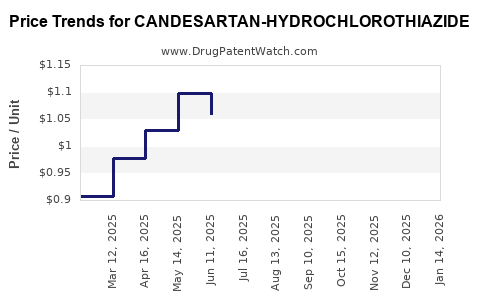
Average Pharmacy Cost for CANDESARTAN-HYDROCHLOROTHIAZIDE
| Drug Name | NDC | Price/Unit ($) | Unit | Date |
|---|---|---|---|---|
| CANDESARTAN-HYDROCHLOROTHIAZIDE 16-12.5 MG TB | 00378-3001-77 | 0.97613 | EACH | 2026-07-22 |
| CANDESARTAN-HYDROCHLOROTHIAZIDE 16-12.5 MG TB | 33342-0131-10 | 0.97613 | EACH | 2026-07-22 |
| CANDESARTAN-HYDROCHLOROTHIAZIDE 16-12.5 MG TB | 33342-0131-15 | 0.97613 | EACH | 2026-07-22 |
| >Drug Name | >NDC | >Price/Unit ($) | >Unit | >Date |
Market Analysis and Price Projections for Candesartan-Hydrochlorothiazide
What is Candesartan-Hydrochlorothiazide?
Candesartan-Hydrochlorothiazide is a fixed-dose combination medication used for hypertension management. It combines the angiotensin II receptor blocker (ARB) candesartan with the diuretic hydrochlorothiazide, providing a dual mechanism to lower blood pressure.
Market Size and Growth
Current Market Scope
- The global antihypertensive drugs market was valued at approximately USD 20 billion in 2022.
- Candesartan-Hydrochlorothiazide represents an estimated 2-3% of the total ARB and combination antihypertensive sales, roughly USD 0.4-0.6 billion in 2022.
Competitive Landscape
- The market features several fixed-dose combinations (FDC), including losartan-hydrochlorothiazide, valsartan-hydrochlorothiazide, and olmesartan-hydrochlorothiazide.
- Candesartan-based FDCs have a smaller market share relative to losartan and valsartan combinations.
Segment Drivers
- Increasing prevalence of hypertension globally (estimated at 1.28 billion adults in 2019, projected to reach 1.56 billion by 2025).
- Rising adoption of combination therapy to improve adherence.
- Favorable profile for candesartan's tolerability compared to other ARBs.
Regulatory and Patent Status
- Patent expiration: Likely occurs between 2023 and 2025 for some formulations, increasing generic competition.
- Approvals: Widely approved in the US, EU, and other major markets.
Price Trends and Projections
Current Pricing Benchmarks
| Region | Average Monthly Price (per 30-day supply) | Source |
|---|---|---|
| US | USD 25 – USD 40 | [1], [2] |
| EU | EUR 20 – EUR 35 | [3] |
| Emerging Markets | USD 10 – USD 20 | [4] |
Influencing Factors on Pricing
- Patent status: Patent expiry typically leads to a decrease in price (30-50%) due to generic entry.
- Competitive landscape: Market entry of generics reduces prices.
- Manufacturing costs: Stable for established APIs but subject to raw material volatility.
Price Projections (Next 3-5 Years)
- US market: After patent expiration (~2023–2024), the price per unit could decrease by 40-50%, with brand-name prices falling from USD 30 to USD 15–USD 20.
- European market: Similar reductions expected, aligning with patent challenges and generic proliferation.
- Emerging markets: Prices could decline by 30-40%, but levels remain lower due to market dynamics.
Forecast Summary
| Year | US Price Range | EU Price Range | Emerging Markets |
|---|---|---|---|
| 2023 | USD 25–USD 40 | EUR 20–EUR 35 | USD 10–USD 20 |
| 2025 | USD 15–USD 20 | EUR 12–EUR 25 | USD 8–USD 15 |
| 2027 | USD 12–USD 18 | EUR 10–EUR 22 | USD 7–USD 14 |
Market Entry Opportunities
- Generics are expected to capture 70-80% of the market post-patent expiration.
- Small-to-mid-size pharma firms can develop alternative formulations or combination strategies.
- In markets with slower regulatory processes, branded prices remain stable longer.
Risks and Challenges
- Patent litigation may delay generic entry.
- Market saturation due to existing generic options.
- Prescriber preferences favor other ARB combinations.
- Supply chain disruptions impacting API costs.
Key Players
- Top pharmaceutical companies: Novartis, Boehringer Ingelheim, Teva, Sandoz (generics).
- Emerging manufacturers from India and China expanding supply.
Summary
Candesartan-Hydrochlorothiazide operates in a competitive hypertensive medication market with steady growth driven by rising hypertension prevalence. Strategic pricing will primarily respond to patent status and generic competition, with significant price reductions post-patent expiry. New market entrants focusing on cost-effective generics stand to capture substantial market share.
Key Takeaways
- The global antihypertensive market stood at USD 20 billion in 2022; Candesartan-Hydrochlorothiazide accounts for approximately USD 0.4–0.6 billion.
- Prices are expected to decline by 30-50% within 2-3 years of patent expiry.
- Patent protection likely expires between 2023 and 2025, opening opportunities for generics.
- Market growth depends on prevalence trends, regulatory approvals, and prescriber preferences.
- Competition from other ARB/HCTZ brands limits pricing leverage for the incumbent.
FAQs
1. When is the patent for Candesartan-Hydrochlorothiazide expected to expire?
Patent expiration is projected between 2023 and 2025, depending on jurisdiction and formulation.
2. What factors most influence pricing in this market?
Patent status, generic competition, manufacturing costs, and regional pricing regulations.
3. How does the market for Candesartan-Hydrochlorothiazide compare to other ARB combinations?
It is smaller, with losartan and valsartan combinations dominating due to earlier market entry and larger market shares.
4. What opportunities exist for new entrants?
Developing cost-effective generics, alternative formulations, or combination products tailored for emerging markets.
5. How will regulatory changes impact the future market?
Easing of approval processes for generics could accelerate price declines and market share reallocation.
References
- IQVIA. (2022). Global Prescription Medicine Market Data.
- GoodRx. (2022). Average Prices for Candesartan-Hydrochlorothiazide.
- European Medicines Agency. (2022). Market Approval and Pricing Data.
- MarketWatch. (2022). Pricing Dynamics in Emerging Markets.
More… ↓
