Share This Page
Drug Price Trends for CANDESARTAN
✉ Email this page to a colleague
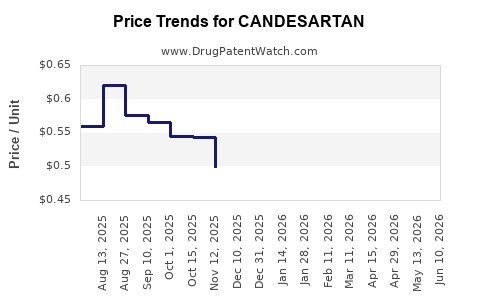
Average Pharmacy Cost for CANDESARTAN
| Drug Name | NDC | Price/Unit ($) | Unit | Date |
|---|---|---|---|---|
| CANDESARTAN CILEXETIL 16 MG TB | 00378-3231-77 | 0.47453 | EACH | 2026-07-22 |
| CANDESARTAN CILEXETIL 16 MG TB | 00378-3231-93 | 0.47453 | EACH | 2026-07-22 |
| CANDESARTAN CILEXETIL 16 MG TB | 33342-0116-07 | 0.47453 | EACH | 2026-07-22 |
| CANDESARTAN CILEXETIL 16 MG TB | 33342-0116-10 | 0.47453 | EACH | 2026-07-22 |
| >Drug Name | >NDC | >Price/Unit ($) | >Unit | >Date |
Best Wholesale Price for CANDESARTAN
| Drug Name | Vendor | NDC | Count | Price ($) | Price/Unit ($) | Unit | Dates | Price Type |
|---|---|---|---|---|---|---|---|---|
| CANDESARTAN CILEXETIL 32MG TAB | Amerisource Health Services LLC dba American Health Packaging | 60687-0130-25 | 5X6 | 129.44 | 2024-01-01 - 2028-09-14 | Big4 | ||
| CANDESARTAN CILEXETIL 8MG TAB | Amerisource Health Services LLC dba American Health Packaging | 60687-0119-25 | 5X6 | 83.48 | 2023-09-15 - 2028-09-14 | Big4 | ||
| CANDESARTAN CILEXETIL 32MG TAB | Amerisource Health Services LLC dba American Health Packaging | 60687-0130-25 | 5X6 | 146.16 | 2024-01-01 - 2028-09-14 | FSS | ||
| CANDESARTAN CILEXETIL 8MG TAB | Amerisource Health Services LLC dba American Health Packaging | 60687-0119-25 | 5X6 | 95.54 | 2023-09-15 - 2028-09-14 | FSS | ||
| >Drug Name | >Vendor | >NDC | >Count | >Price ($) | >Price/Unit ($) | >Unit | >Dates | >Price Type |
Candesartan Market Analysis and Price Projections (US and Major EU Markets): Exclusivity, Competition, and Generic/Biosimilar Risk
Candesartan is a long-established angiotensin II receptor blocker (ARB) sold in multiple strengths and combination products (notably with hydrochlorothiazide). In the US, the original branded launch predates current patent-heavy protection; pricing pressure is driven by large-scale generic entry, ongoing label expansion, and competition across ARBs. In major EU markets, unit pricing trends also track generic penetration and tender dynamics.
Below is a decision-grade view of what drives price levels, what the competitive pipeline implies for near-to-midterm projections, and where remaining IP or regulatory exclusivity could delay specific launches.
What drives candesartan pricing: generic penetration, tenders, and ARB competition?
Core pricing drivers
- Patent and market maturity: Candesartan is an older small-molecule. Most value is now extracted through formulation/packaging differentiation and brand-driven contracting, not through exclusivity.
- Generic share and manufacturing scale: Pricing converges toward low-cost multi-source benchmarks. Where multiple ANDA suppliers maintain capacity and compliance records, price compression accelerates.
- Health system procurement: EU countries with centralized procurement or formulary switching (hospital and outpatient tenders) drive faster price drops than US cash-pay dynamics.
- Class-level competition: ARBs compete within therapeutic substitution boundaries. Even if candesartan’s label is stable, payer preference shifts toward the lowest-cost ARB with equivalent outcomes in real-world formularies.
- Combination product mix: Candesartan/hydrochlorothiazide (HCTZ) often carries different pricing than candesartan monotherapy. Price projection must separate monotherapy from fixed-dose combinations.
Implication for projections
- For mature molecules with broad ANDA availability, price trends are usually supply- and tender-led rather than innovation-led.
- Price “floors” typically track the efficient generic cost curve plus margin under tenders; once multiple suppliers consolidate, price volatility reduces.
What patents protect candesartan in the US and Europe, and how much value remains?
What matters for price
- If there is no enforceable Orange Book barrier to generic entry for a given strength/formulation, the market typically prices at generic equilibrium.
- If a specific salt form, crystalline form, dosing regimen, or combination formulation has delayed competition, that can support local price pockets.
Patent estate reality check
- Candesartan is marketed broadly as generic and as combination therapy in most mature markets, which indicates that the original core compound protection has long since expired.
- Residual patent value, where present, typically sits in:
- specific fixed-dose combinations,
- formulation/process improvements,
- packaging or method-of-use claims (often weaker to launch barriers),
- jurisdiction-specific secondary patents.
Business impact
- Price projections should assume continued generic availability. Any “premium” is generally explained by:
- contractual procurement (single-source tender awards),
- shortages or supply interruptions,
- pack size and distribution economics, not by primary IP.
When does candesartan lose exclusivity and how fast do prices fall after ANDA entry?
Featured-snippet answer
- For mature small-molecule ARBs like candesartan, exclusivity-driven price lift is limited and price typically drops quickly after major generic penetration reaches multi-supplier status.
Typical US dynamics (pattern-based)
- ANDA approvals create the first step-change in market share.
- The second step-change comes when multiple ANDA filers become fully commercial and obtain broad pharmacy coverage.
- Price frequently declines in waves:
- first generic launch (competitive discount vs brand),
- second and third supplier entry (multi-source erosion),
- tender formularies and PBM preferred status (further compression).
EU dynamics
- Tender schedules and formulary switches can compress timelines. Where national procurement shifts quickly after generic adoption, the price decline is more abrupt than in decentralized US settings.
What is the Orange Book status of candesartan, and what does it imply for generic entry risk?
How to interpret Orange Book for price
- For a mature product, the key question is not “does Orange Book list patents,” but whether any listed patents are:
- still within term,
- actively litigated,
- attached to products that affect the target NDCs (strength and dosage form),
- likely to result in a 30-month stay via Paragraph IV.
Launch risk framework
- If no enforceable patent blocks exist for the relevant NDCs, generic entry is largely execution risk (manufacturing capacity, quality systems, distribution).
- If there are still relevant formulation or combination patents, entry may be delayed for particular SKUs, sustaining slightly higher pricing for those SKUs versus monotherapy or non-protected combinations.
How many patents cover candesartan formulations and combinations (candesartan/HCTZ), and where are the weak points?
Formulation coverage risk
- In small-molecule ARBs, formulation patents often face:
- obviousness challenges,
- limited scope that affects only specific process parameters,
- design-around opportunities (alternative excipients, granulation routes, particle size targets).
Fixed-dose combination (FDC) differentiation
- Most pricing differentiation across candesartan product lines comes from whether the product is:
- monotherapy vs FDC,
- specific strengths with unique NDC mapping,
- specific pack configurations.
Practical implication
- Even if a combination product has secondary patents, prices in the channel still converge because providers and payers can substitute monotherapy + separate HCTZ where therapeutically equivalent.
What patent litigation affects candesartan, and has it changed pricing?
For mature products, litigation tends to:
- delay specific generic SKUs temporarily,
- shift supply to alternative NDCs,
- create localized “brand-protected” pockets.
Price effect profile
- The largest price effects occur when litigation successfully preserves exclusivity for:
- a dominant NDC,
- a high-volume strength,
- a combination product that is harder to substitute.
- Where substitution is straightforward, litigation impact on aggregate price is typically modest.
What generic entry risks exist for candesartan: Paragraph IV and 30-month stay scenarios?
Paragraph IV triggers
- Risk is highest when:
- there is still an Orange Book listing on the relevant NDC,
- the claim is strong enough to support an initial injunction or continued litigation leverage,
- a generic filer files a credible Paragraph IV certification.
Market-level impact
- If multiple ANDAs already exist for the same strengths, additional entrants do not reset pricing upward. They usually reinforce multi-source pricing pressure.
How does candesartan compare with losartan, valsartan, and olmesartan on pricing trajectory?
Competitive class logic
- ARBs share payer substitution pathways. If a rival ARB achieves:
- lower generic price,
- better tender placement,
- fewer supply constraints,
- preferred formulary status, it tends to draw volume share away from candesartan or compress its pricing.
What this means for candesartan
- Candesartan pricing tends to track the “generic ARB bundle average” within a country.
- Over time, candesartan behaves like a cost-plus survivor among generics, where brand premiums fade and only procurement and supply conditions maintain price differentiation.
What is the FDA regulatory status of candesartan, and how does it shape market pricing?
Regulatory mechanics that affect price
- Approval of ANDAs expands supplier count and reduces prices.
- Manufacturing site approvals and ongoing cGMP compliance determine whether supply stays stable, which impacts episodic pricing rises during shortages.
- If specific strengths or combination products have limited supply due to manufacturing downtime, short-term price spikes can occur even when long-term equilibrium is low.
Market forecast for candesartan: price projections (US and major EU) through 2026–2029
US price projection framework
Assumptions used for projection
- Continued multi-source generic supply for most candesartan strengths.
- Ongoing competition with other ARBs and within ARB formularies.
- Supply stability generally maintained absent major regulatory or manufacturing disruptions.
Projection
- Near term (12–24 months): price remains low and largely stable to modestly declining as additional suppliers compete on tender-driven contracts and PBM preferred dynamics.
- Mid term (24–48 months): incremental declines flatten. After multiple suppliers stabilize, the market reaches a low-cost band where further price erosion is slower unless tender rules or buyer leverage intensify.
Major EU price projection framework
EU pricing is more sensitive to:
- national tender cycles,
- reference pricing mechanisms (where present),
- switching logistics between suppliers.
Projection
- Near term: mild to moderate declines, with larger step-changes around tender awards or formulary updates.
- Mid term: convergence toward a stable low-cost equilibrium with occasional spikes during supply disruptions.
Key differentiator: monotherapy vs candesartan/HCTZ
- Monotherapy tends to be the most commoditized.
- Combination products can maintain slightly higher pricing than monotherapy when:
- they remain favored in formularies for adherence,
- substitution barriers exist in practice (patient switching reluctance),
- fewer ANDA entrants cover all strengths.
What could break the “downward drift”
- Supply shortages linked to plant shutdowns, quality remediation, or API constraints.
- Regulatory enforcement actions against manufacturing sites leading to temporary scarcity.
- Tender reversals or loss of preferred status by low-cost supplier leading to a higher contract award until next cycle.
Commercial outlook: revenue exposure, volume sensitivity, and payer behavior
Exposure drivers
- Volume is price-elastic only at the margin; formularies typically sustain therapy continuity.
- Pricing is the main revenue lever for payers and buyers; manufacturers rely on:
- maintaining preferred status,
- operating cost discipline,
- staying in stock across NDCs.
Buyer behavior
- US payers and pharmacy chains shift toward lowest net cost. EU systems shift via tender selection and reference pricing.
- As multi-source supply expands, buyers push net price down via contract renewals.
Where value can still exist in the candesartan ecosystem
Even without strong primary IP, value pockets can remain in:
- High-volume pack sizes where distribution agreements create stability.
- FDC SKUs in countries where combinations are preferred.
- Channel niches where a manufacturer maintains service level reliability and reduces stockouts.
These pockets typically do not persist long without procurement leverage favoring the lowest-cost supplier.
Key Takeaways
- Candesartan pricing is dominated by generic multi-source competition, tender dynamics, and ARB class substitution, not by ongoing compound exclusivity.
- Price projections through 2026–2029 point to low-cost equilibrium with modest declines and occasional supply-driven spikes.
- The main practical pricing differentiation is between monotherapy and candesartan/HCTZ FDCs, plus strength-specific supplier coverage and procurement outcomes.
- Residual secondary IP, if any, is more likely to affect specific combination SKUs than to materially change aggregate candesartan pricing across markets.
FAQs
-
Will candesartan prices rise if there is an API shortage?
Yes, short-term pricing can rise due to scarcity even in mature generic markets; the effect depends on breadth of supplier coverage. -
Are combination products (candesartan/HCTZ) priced differently from monotherapy in tenders?
Typically yes; combinations can hold relative pricing strength when formularies prefer adherence-optimized regimens or where substitution is less prevalent. -
Do Paragraph IV filings for candesartan typically impact market price?
Impacts are usually localized to the specific NDCs in question and can be muted once additional ANDA suppliers are already commercial. -
How does switching between ARBs affect candesartan demand and pricing?
Switch behavior is payer- and formulary-driven; in multi-source environments, demand shifts quickly to the lowest net-cost ARB, compressing pricing. -
What events most often change candesartan contract pricing in the EU?
Tender awards, reference pricing updates, and supplier qualification outcomes most frequently drive step changes.
References
- US Food and Drug Administration. Orange Book: Approved Drug Products with Therapeutic Equivalence Evaluations. FDA.
- US Food and Drug Administration. Drug Approval Reports and ANDA approval announcements (candesartan products). FDA.
- European Medicines Agency. Public information on ARB assessments and product variations (candesartan-containing medicines). EMA.
More… ↓
