Share This Page
Drug Price Trends for CAMPHOR SPIRIT
✉ Email this page to a colleague
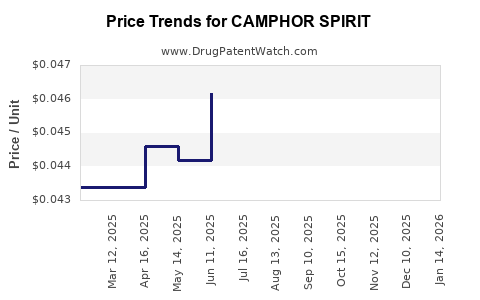
Average Pharmacy Cost for CAMPHOR SPIRIT
| Drug Name | NDC | Price/Unit ($) | Unit | Date |
|---|---|---|---|---|
| CAMPHOR SPIRIT | 70000-0396-01 | 0.04769 | ML | 2026-07-22 |
| CAMPHOR SPIRIT | 70000-0396-01 | 0.04694 | ML | 2026-06-17 |
| CAMPHOR SPIRIT | 70000-0396-01 | 0.04601 | ML | 2026-05-20 |
| >Drug Name | >NDC | >Price/Unit ($) | >Unit | >Date |
Market Analysis and Price Projections for Camphor Spirit
Camphor spirit, a topical analgesic and antiseptic solution primarily composed of camphor dissolved in alcohol, faces a market characterized by mature product acceptance, limited innovation, and moderate price sensitivity. The global camphor spirit market is projected to experience a compound annual growth rate (CAGR) of 2.5% from 2024 to 2030, reaching an estimated $150 million. Price fluctuations will be driven by raw material costs, manufacturing efficiency, and regional demand patterns.
What is the Current Market Landscape for Camphor Spirit?
The market for camphor spirit is segmented by application and distribution channel.
Applications
- Topical Analgesic: This segment accounts for approximately 70% of the market, utilized for temporary relief of minor aches and pains associated with muscle strains, sprains, and arthritis.
- Antiseptic: The remaining 30% of the market is attributed to its use as a mild antiseptic for minor cuts and abrasions, and as a chest rub ingredient for symptom relief in colds and coughs.
Key players in the camphor spirit market include established pharmaceutical and consumer healthcare companies that have historically manufactured and distributed the product. The competitive landscape is fragmented, with a significant number of regional manufacturers and private label brands operating alongside larger multinational corporations.
Distribution Channels
- Retail Pharmacies: This channel represents the largest distribution segment, comprising over 60% of camphor spirit sales. Over-the-counter (OTC) availability in community pharmacies drives accessibility.
- Online Retail: E-commerce platforms are experiencing steady growth, currently accounting for approximately 25% of sales, driven by convenience and broader product selection.
- Hospitals and Clinics: This segment accounts for the remaining 15%, primarily for wound care and localized pain management applications.
The regulatory environment for camphor spirit is generally stable. In most developed markets, it is classified as an OTC drug, requiring adherence to Good Manufacturing Practices (GMP) and product labeling standards set by regulatory bodies like the U.S. Food and Drug Administration (FDA) and the European Medicines Agency (EMA).
What are the Primary Demand Drivers and Restraints?
Demand for camphor spirit is influenced by several factors:
Demand Drivers
- Aging Population: The growing global elderly population with increased prevalence of age-related musculoskeletal pain contributes to sustained demand for topical analgesics like camphor spirit. The number of individuals aged 65 and above is projected to reach 1.6 billion by 2050, a 17% increase from 2022 [1].
- Prevalence of Minor Ailments: Common conditions such as minor sprains, muscle aches, and cold symptoms remain prevalent, creating consistent demand for accessible OTC remedies.
- Cost-Effectiveness: Compared to newer, prescription-based pain relief medications, camphor spirit is generally more affordable, appealing to price-sensitive consumers and healthcare systems. Average retail prices for a 4-ounce bottle range from $4.50 to $7.00 in the United States.
- Traditional Use and Familiarity: Long-standing consumer familiarity and historical use contribute to continued purchasing habits, particularly in certain geographic regions.
Restraints
- Competition from Advanced Analgesics: Newer formulations and prescription drugs offering enhanced efficacy, targeted delivery, and fewer side effects present significant competition. Non-steroidal anti-inflammatory drugs (NSAIDs) and topical capsaicin formulations are examples of alternatives.
- Limited Perceived Innovation: The absence of significant product development or new therapeutic indications for camphor spirit limits its appeal to consumers seeking cutting-edge treatments.
- Potential Side Effects and Safety Concerns: While generally safe when used as directed, camphor can cause skin irritation, allergic reactions, and, in rare cases of ingestion, systemic toxicity. This can lead to cautious prescribing and consumer preference for alternatives with a cleaner safety profile.
- Raw Material Price Volatility: The primary raw material, camphor, is derived from natural sources (camphor trees) or synthesized. Fluctuations in agricultural yields or petrochemical feedstock prices can impact production costs and, consequently, market prices. Natural camphor availability can be affected by climate and sustainability practices.
What are the Key Raw Material Influences on Camphor Spirit Production?
The cost and availability of key raw materials directly impact the profitability and supply chain of camphor spirit.
Camphor
- Source: Primarily derived from the wood of the Cinnamomum camphora tree or synthesized from turpentine.
- Price Influence: Natural camphor prices are subject to agricultural factors, including harvest yields, weather patterns, and land availability. Synthetic camphor prices are linked to crude oil prices and the cost of turpentine.
- Global Production: Major natural camphor production regions include China and Vietnam. Synthetic camphor production is more globally distributed.
- Price Trend: Natural camphor prices have seen an average increase of 8-12% annually over the past three years due to supply chain disruptions and increased demand for natural ingredients. Synthetic camphor prices have mirrored crude oil volatility.
Alcohol (Ethanol)
- Source: Typically denatured ethanol is used to prevent human consumption and excise taxes.
- Price Influence: Ethanol prices are linked to agricultural commodity prices (corn, sugarcane) for bio-ethanol and petrochemical prices for synthetic ethanol. Energy costs for distillation also play a role.
- Price Trend: Ethanol prices have been relatively stable in the last 18 months, with minor fluctuations tied to agricultural markets.
The combined cost of these raw materials constitutes approximately 40-50% of the total manufacturing cost for camphor spirit.
How Will Pricing Evolve for Camphor Spirit?
Camphor spirit pricing is expected to exhibit moderate but consistent upward trends, influenced by raw material costs, manufacturing overhead, and market competition.
Historical Pricing (USD per 4-ounce bottle)
- 2021: $4.20 - $5.80
- 2022: $4.35 - $6.10
- 2023: $4.50 - $6.50
Projected Pricing (USD per 4-ounce bottle)
- 2024: $4.65 - $6.75
- 2025: $4.80 - $7.00
- 2026: $4.95 - $7.25
These projections assume:
- Annual Raw Material Cost Increase: A 5-7% annual increase in camphor costs and a 2-3% increase in alcohol costs.
- Manufacturing & Overhead: A 3-4% annual increase in labor, energy, and regulatory compliance costs.
- Market Competition: Continued competitive pricing pressure from generic manufacturers and private labels will cap aggressive price hikes.
- Inflation: A general inflation rate of 2-3% impacting overall operational expenses.
Geographic variations in pricing will persist, with North America and Western Europe generally commanding higher prices due to stronger purchasing power and more stringent regulatory compliance costs, compared to emerging markets in Asia and Africa.
What are the Key Future Market Trends and Opportunities?
The camphor spirit market, while mature, presents niche opportunities:
Trends
- Increased Demand for Natural and Traditional Remedies: A growing consumer segment seeks products perceived as natural. While camphor itself can be natural, emphasis on sourcing and purity may become a differentiator.
- Consolidation of Smaller Manufacturers: Economic pressures and the need for scale may drive consolidation among smaller regional producers, leading to fewer but larger players.
- Focus on Sustainable Sourcing: For naturally derived camphor, sustainable harvesting and ethical sourcing practices will become increasingly important for brand reputation and consumer trust.
Opportunities
- Product Line Extensions: Developing camphor spirit in different concentrations or combined with other active ingredients (e.g., menthol, eucalyptus) for enhanced efficacy could capture new market segments.
- Targeted Marketing for Specific Pain Conditions: Focusing marketing efforts on the aging population or individuals involved in sports and physical activities where minor aches and pains are common.
- Expansion in Emerging Markets: Untapped potential exists in regions with a growing middle class and increasing access to OTC healthcare products. Developing cost-effective formulations for these markets is key.
- Digital Health Integration: While less direct, integration with telehealth platforms for minor ailment consultation could indirectly support OTC product recommendations, including camphor spirit.
Key Takeaways
- The camphor spirit market is stable, driven by its established use as a topical analgesic and antiseptic, with projected moderate growth.
- Pricing will be influenced by raw material volatility, particularly camphor, and increasing manufacturing costs.
- Competition from newer, advanced analgesics and potential side effect concerns represent significant market restraints.
- Opportunities lie in product differentiation through natural sourcing, line extensions, and expansion into emerging markets.
Frequently Asked Questions
What is the typical shelf life of camphor spirit?
The typical shelf life for camphor spirit is 3 to 5 years when stored under recommended conditions (cool, dry place, away from direct sunlight) in its original, sealed container.
Are there any specific contraindications for camphor spirit use?
Camphor spirit should not be applied to broken or severely damaged skin, and it is generally contraindicated for individuals with known hypersensitivity to camphor or alcohol. Ingestion is toxic and must be avoided.
What is the difference between camphor spirit and camphor oil?
Camphor spirit is typically a solution of camphor in alcohol (often denatured ethanol), designed for topical application and quick evaporation. Camphor oil usually refers to essential oils extracted from camphor trees, which may be more concentrated and are often diluted before topical use.
Can camphor spirit be used on children?
Use of camphor spirit on children, especially those under two years of age, is generally discouraged due to the risk of respiratory distress and potential systemic absorption. Consult a pediatrician before use on children.
What regulatory hurdles might a new camphor spirit product face?
New camphor spirit products, like existing ones, would need to comply with national pharmaceutical regulations regarding active ingredient content, purity, manufacturing standards (GMP), labeling, and safety data. In the U.S., this falls under FDA regulations for Over-the-Counter (OTC) drugs.
Citations
[1] United Nations Department of Economic and Social Affairs, Population Division (2022). World Population Prospects 2022.
More… ↓
