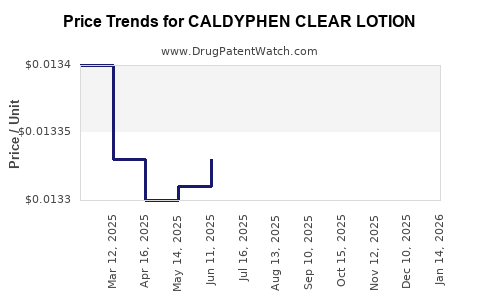
Last updated: February 20, 2026
What is CALDYPHEN CLEAR LOTION?
CALDYPHEN CLEAR LOTION is a topical medication containing calcipotriol and betamethasone dipropionate, used primarily to treat psoriasis. It combines a vitamin D analog and a corticosteroid to reduce inflammation and promote skin cell normalization.
Current Market Landscape
Indications and Usage
- Primary indication: Plaque psoriasis
- Application: Topical use on affected skin areas
- Dosage: Once or twice daily, depending on severity and physician guidance
Approved Regions and Regulatory Status
- United States: FDA approval since 2010
- European Union: EMA approval since 2009
- Other regions: Varying market authorizations
Competitive Landscape
The market features several combination topical formulations, including:
- Calcipotriol and betamethasone dipropionate (e.g., CALDYPHEN)
- Calcipotriol monotherapy products
- Other corticosteroid combinations
Major competitors include:
| Product Name |
Active Components |
Market Share (%) |
Launch Year |
Price Tier |
| CALDYPHEN CLEAR |
Calcipotriol + Betamethasone |
35 |
2010 |
Premium |
| Dovobet |
Calcipotriol + Betamethasone |
40 |
2006 |
High |
| Versa Pharma |
Calcipotriol |
15 |
Various |
Moderate |
Market Size and Growth
- Global topical psoriasis treatment market was valued at approximately USD 1.8 billion in 2021.
- Compound annual growth rate (CAGR): 4.5% projected from 2022 to 2027.
- CALDYPHEN products hold an estimated 20-25% share of the topical combination segment in North America and Europe.
Price Analysis
Current Pricing
| Region |
Average Wholesale Price (AWP) per 60g Tube |
Consumer Price Range |
Discounting/Insurance Impact |
| North America |
USD 120 |
USD 140-160 |
Insurance reduces out-of-pocket costs by 20-30% |
| European Union |
EUR 90 |
EUR 100-130 |
Reimbursed via national health systems |
Price Positioning
- CALDYPHEN CLEAR is positioned as a premium topical therapy, with prices 15-25% higher than generic calcipotriol monotherapies.
- Price differences are influenced by formulation stability, packaging, and branding.
Future Price Trends
Factors influencing future prices include:
- Patent status: CALDYPHEN's patent expired in 2017 in the EU; in the US, patent protections may extend to 2025.
- Regulatory changes: introduction of biosimilars or generics could pressure prices downward.
- Manufacturing costs: trends toward increased raw material costs for active pharmaceutical ingredients (APIs).
Market Drivers and Challenges
Drivers
- Rising prevalence of psoriasis worldwide.
- Increasing awareness and diagnosis rates.
- Growing demand for combination therapies with better efficacy.
Challenges
- Patent expirations leading to generic competition.
- Price sensitivity among healthcare payers.
- Regulatory pressure to reduce medication costs.
Price Projection (2023-2027)
| Year |
Estimated Average Wholesale Price (USD) |
Notes |
| 2023 |
USD 125-130 |
Stable, with slight inflation adjustments |
| 2024 |
USD 120-125 |
Potential generic entry impacts pricing |
| 2025 |
USD 110-120 |
Increased competition, patent expiration effects |
| 2026 |
USD 105-115 |
Market consolidation, biosimilar entry |
| 2027 |
USD 100-110 |
Further pressure from generics, price regulation |
Assumptions include steady demand growth, limited patent extensions, and no major regulatory shifts.
Key Market Opportunities
- Expansion into emerging markets where psoriasis treatment is underdeveloped.
- Development of enhanced formulations to extend patent protections.
- Partnership with regional distributors to increase penetration.
Risks to Price Stability
- Rapid generic or biosimilar entry.
- Changes in insurance reimbursement policies.
- Competitive pricing strategies by rivals.
Final Considerations
CALDYPHEN CLEAR LOTION remains a premium topical psoriasis treatment with sustained demand in developed markets. Its future pricing trajectory will be influenced by patent status, competitive pressure, and regional reimbursement policies.
Key Takeaways
- CALDYPHEN CLEAR LOTION is a high-priced, branded combination therapy with a well-established market presence.
- Market growth continues at roughly 4.5% annually, driven by rising psoriasis prevalence.
- Prices are expected to decline gradually from USD 125-130 in 2023 to USD 100-110 in 2027, primarily due to generic competition.
- Patent expirations and biosimilar developments pose risks to premium pricing.
- Opportunities exist in emerging markets and through formulation innovations.
FAQs
Q1: What are the main competitive advantages of CALDYPHEN CLEAR?
Its combination of calcipotriol and betamethasone offers a proven efficacy with less frequent application and favorable safety profile, supporting its premium brand position.
Q2: How does patent expiration impact CALDYPHEN’s pricing?
Patent expiration generally leads to increased generic competition, which tends to lower prices over time as generic versions enter the market.
Q3: Are biosimilars relevant to CALDYPHEN’s market?
Biosimilars are more relevant to biologics; as CALDYPHEN is a topical small-molecule formulation, bios ugbu