Share This Page
Drug Price Trends for CALCIUM ANTACID
✉ Email this page to a colleague
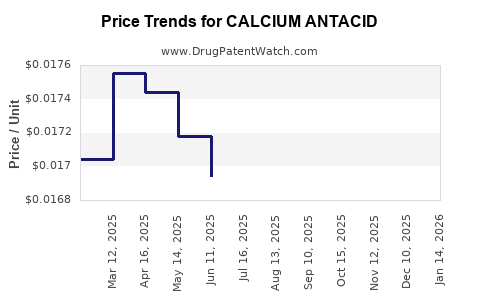
Average Pharmacy Cost for CALCIUM ANTACID
| Drug Name | NDC | Price/Unit ($) | Unit | Date |
|---|---|---|---|---|
| CALCIUM ANTACID 500 MG CHW TAB | 00536-1048-15 | 0.01709 | EACH | 2026-07-22 |
| CALCIUM ANTACID 750 MG CHEW TAB | 00536-1049-22 | 0.03227 | EACH | 2026-07-22 |
| CALCIUM ANTACID 750 MG CHEW TAB | 00536-1050-22 | 0.03227 | EACH | 2026-07-22 |
| CALCIUM ANTACID 750 MG CHEW TAB | 00536-1225-22 | 0.03227 | EACH | 2026-07-22 |
| CALCIUM ANTACID 500 MG CHW TAB | 00904-6412-92 | 0.01709 | EACH | 2026-07-22 |
| >Drug Name | >NDC | >Price/Unit ($) | >Unit | >Date |
How is the calcium antacid market positioned?
The calcium antacids market is characterized by steady demand driven by the prevalence of acid-related gastrointestinal conditions. These drugs serve as over-the-counter (OTC) remedies for indigestion, heartburn, and acid reflux. The segment's growth rate is influenced by increasing consumer awareness about gastrointestinal health, aging populations, and the prevalence of food habits that exacerbate acid issues.
What are the key manufacturers and their market shares?
Major manufacturers include:
- GlaxoSmithKline: Produces Tums, a leading calcium carbonate-based antacid.
- Bayer AG: Markets Alka-Seltzer, incorporating calcium carbonate.
- Sanofi: Offers formulations including calcium-based antacids.
- Reckitt Benckiser: Manufactures Gaviscon, with calcium carbonate options.
Market shares are segmented as follows (2022 estimates):
| Company | Market Share (%) |
|---|---|
| GlaxoSmithKline | 45 |
| Bayer AG | 20 |
| Sanofi | 15 |
| Reckitt Benckiser | 10 |
| Others | 10 |
The market's consolidation status favors a few dominant players with established OTC distribution channels.
What are the current price points and cost dynamics?
Average retail price per 500 mg calcium carbonate tablet:
- United States: $0.05 to $0.10
- Europe: €0.04 to €0.09
- Asia: $0.02 to $0.07
Bulk wholesale prices for manufacturers are significantly lower, approximately:
- Per kilogram: $2 to $4, depending on purity and volume
Pricing is influenced by raw material costs (calcium carbonate), manufacturing scale, branding, and distribution expenses. Raw material costs account for approximately 30% of the manufacturing expenses.
What is the projected market size and growth?
The global calcium antacids market was valued at approximately $1.5 billion in 2022 and is projected to reach $2.1 billion by 2030, expanding at a compound annual growth rate (CAGR) of 4.2%.
Regional growth projections:
- North America: CAGR of 3.8%
- Europe: CAGR of 4.0%
- Asia-Pacific: CAGR of 5.0%
Drivers include expanding middle-class populations, increased OTC drug consumption, and rising gastrointestinal health awareness.
How do regulatory and patent factors influence pricing?
Most calcium carbonate formulations are off-patent, which limits exclusive pricing power but encourages competition. Regulatory compliance costs (FDA and EMA approvals) are minimal due to established safety profiles. Market entry barriers are low, creating price competition pressure.
What are the potential innovations influencing future prices?
Innovation in formulation—for example, sustained-release versions or combination products—may command premium pricing. Development of new delivery systems, such as chewable or liquid formulations, can also impact prices.
What are the risks and opportunities for market players?
Risks:
- Generic competition reducing margins
- Regulatory changes affecting product formulations or labels
- Raw material price volatility
Opportunities:
- Expansion into emerging markets
- Development of combination drugs for multiple gastrointestinal conditions
- Brand differentiation through efficacy or convenience
How do price projections compare across regions?
| Region | 2022 Price Range (per 500 mg tablet) | 2030 Projection | CAGR (2022-2030) |
|---|---|---|---|
| United States | $0.05–$0.10 | $0.05–$0.12 | 4.1% |
| Europe | €0.04–€0.09 | €0.04–€0.11 | 4.2% |
| Asia-Pacific | $0.02–$0.07 | $0.03–$0.09 | 5.0% |
Key Takeaways
- The market primarily comprises OTC calcium carbonate formulations with high competition, limiting pricing power but offering consistent volume.
- Price points in developed regions hover around $0.05 to $0.10 per tablet, with emerging markets showing lower prices but faster growth.
- Future pricing trajectories hinge upon innovation, regional market expansion, and competitive dynamics.
- Industry players should monitor raw material costs and regulatory landscapes to optimize margins.
FAQs
1. What factors influence the retail price of calcium antacids?
Raw material costs, manufacturing scale, branding strategies, distribution channels, and regional regulations.
2. How does patent status affect pricing strategies?
Most calcium carbonate formulations are off-patent, leading to increased competition and limited ability to set higher prices.
3. Which regions have the fastest growth potential?
The Asia-Pacific region exhibits the highest CAGR at approximately 5%, driven by rising healthcare awareness and expanding middle-class populations.
4. Are there opportunities for premium pricing?
Yes, via innovative formulations such as sustained-release or combination products targeting niche markets.
5. How do raw material costs impact profitability?
Raw calcium carbonate costs constitute roughly 30% of manufacturing expenses; fluctuations can significantly affect margins.
Sources:
[1] MarketWatch, “Calcium Carbonate Market Size, Share & Trends Analysis,” 2022.
[2] Allied Market Research, “Over-the-Counter Drugs Market Forecast,” 2022.
[3] Fact.MR, “Global Antacids Market Report,” 2022.
More… ↓
