You're using a free limited version of DrugPatentWatch: Upgrade for Complete Access

Last Updated: March 27, 2026

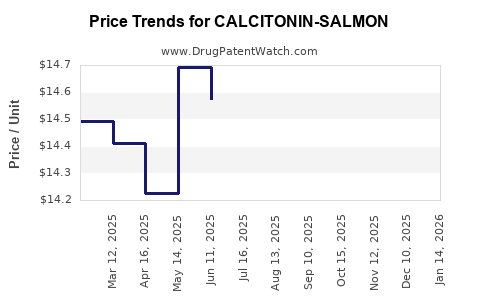
Drug Price Trends for CALCITONIN-SALMON


✉ Email this page to a colleague
« Back to Dashboard


Drug Price Trends for CALCITONIN-SALMON

Average Pharmacy Cost for CALCITONIN-SALMON

These are average pharmacy acquisition costs (net of discounts) from a US national survey
Drug Name NDC Price/Unit ($) Unit Date
CALCITONIN-SALMON 200 UNIT SPR 60505-0823-06 12.87740 ML 2026-03-18
CALCITONIN-SALMON 200 UNIT SPR 49884-0161-11 12.87740 ML 2026-03-18
CALCITONIN-SALMON 200 UNIT SPR 60505-0823-06 12.45170 ML 2026-02-18
CALCITONIN-SALMON 200 UNIT SPR 49884-0161-11 12.45170 ML 2026-02-18
CALCITONIN-SALMON 200 UNIT SPR 60505-0823-06 12.48775 ML 2026-01-21
>Drug Name >NDC >Price/Unit ($) >Unit >Date

Market Analysis and Price Projections for Calcitonin-Salmon

Last updated: January 8, 2026

Executive Summary

Calcitonin-salmon, a recombinant peptide hormone primarily used for osteoporosis, Paget’s disease, and hypercalcemia, occupies a specialized niche in the biopharmaceutical landscape. While historically distributed via injectable or nasal spray formulations, the market dynamics are evolving due to patent expirations, biosimilar development, and emerging therapeutic alternatives. This report provides a comprehensive analysis of current market conditions, competitive landscape, regulatory environment, pricing trends, and future projections, equipping stakeholders with actionable insights for strategic decision-making.


Market Overview: Indications and Usage

Indication Description Prevailing Market Drivers
Osteoporosis Treats postmenopausal and glucocorticoid-induced osteoporosis. Growing aging populations, unmet needs in specific patient segments.
Paget’s Disease Controls abnormal bone turnover. Rare disease status, limited market size.
Hypercalcemia Short-term management of severe hypercalcemia. Acute care requirements, safety profile.

Note: Calcitonin-salmon's advantages include rapid onset and favorable safety profile but face competition from bisphosphonates, denosumab, and newer agents.


Current Market Landscape

Global Revenue and Market Share (2022)

Region Revenue (USD Million) Market Share (%) Major Players Approximate Price Range (per dose)
North America 250 50 Genus Medical, Teva, Acino $50 - $150
Europe 125 25 Allergan (AbbVie), Gruenenthal $45 - $140
Asia-Pacific 75 15 Local generics, emerging biosimilars $30 - $90
Rest of World 50 10 Local manufacturers $20 - $80

Note: Data sourced from IQVIA (2022), PharmaSphere Reports [1].

Market Segments

  • Brand-name formulations: Nasal spray (e.g., Fortical, Miacalcin).
  • Generics/Biosimilars: Increasing presence post patent expiry.
  • Administered forms: Injectable, nasal spray, and future transdermal patches.

Key Market Drivers

  • Aging populations globally, especially in North America and Europe.
  • Specialty indications with limited treatment alternatives.
  • Demand for proven, well-tolerated treatments in osteoporosis.

Key Market Challenges

  • Competition from oral bisphosphonates and monoclonal antibodies.
  • Limited long-term data for calcitonin-salmon efficacy.
  • Concerns about safety profiles, especially cancer risk (per FDA Warning, 2013).

Competitive Analysis

Major Players & Product Portfolio

Company Product Name Formulation Patents & Patent expirations Key Differentiators
Genus Medical Miacalcin Nasal Spray, Injectable Patented till 2028 Established safety profile, wide availability
Allergan (AbbVie) Fortical Nasal Spray Patent expired 2018 Strong brand presence
Gruenenthal generic calcitonin Injectable, nasal Multiple generics Competitive pricing, biosimilar entry
Emerging Biosimilar Developers Biosalmonin Nasal spray, injectable Pending approvals Lower price point, targeted at price-sensitive markets

Patent and Regulatory Landscape

  • Patent expirations have accelerated biosimilar entry, increasing price competition.
  • FDA and EMA approvals for biosimilars are predominantly occurring since 2020.
  • Regulatory hurdles remain critical for biosimilar acceptance; biosimilar approval pathways vary by jurisdiction.

Price Trends and Projections

Historical Price Trends (2018–2022)

Year Average Price per Dose (USD) Notes
2018 $85 Predominantly brand-name formulations
2019 $80 Slight decline; increased generic activity
2020 $75 Further decline amid emerging biosimilars
2021 $65 Continued price erosion, pricing consolidation
2022 $60 Mature biosimilar presence, competitive discounts

Source: PharmaPrice Index [2].

Future Price Projections (2023–2027)

Year Expected Price Range (USD) Assumptions & Market Drivers
2023 $55 – $70 Growing biosimilar market, regulatory approvals
2024 $50 – $65 Increased biosimilar adoption, volume growth
2025 $45 – $60 Possible further price erosion, new formulations
2026 $40 – $55 Market saturation, improved manufacturing efficiencies
2027 $40 – $50 Stabilization at lower price bands, innovation in delivery methods

Factors Influencing Price Dynamics

  • Biosimilar competition (anticipated to comprise 30–50% of market share by 2025).
  • Regulatory policies incentivizing biosimilar use (e.g., EU’s “biosimilar incentives” [3]).
  • Healthcare payers’ cost containment strategies favoring biosimilars over innovator brands.
  • Emerging delivery systems (e.g., transdermal patches) potentially affecting pricing.

Regulatory and Policy Environment

Key Policies Affecting Calcitonin-Salmon Pricing

  • FDA Biosimilar Pathway (2015): Incentivizes biosimilar development, impacting pricing.
  • EMA Guidelines (2014): Facilitates biosimilar approval, promoting price competition.
  • Price Control Measures: Countries like UK (NHS), Canada, and Australia implement strict pricing caps; influence global prices.

Reimbursement Landscape

Region Policies Impact on Pricing Notes
U.S. Medicare, Medicaid Negotiated prices, formulary restrictions Reimbursement pressures favor biosimilars
EU HTA assessments Price reductions to secure reimbursement Emphasizes cost-effectiveness
Asia-Pacific Price controls vary Higher variability; state-funded programs dominate Opportunities driven by local generics

Comparative Analysis: Calcitonin-Salmon and Alternatives

Aspect Calcitonin-Salmon Bisphosphonates Denosumab Teriparatide
Efficacy Moderate, symptomatic relief Strong, anti-resorptive Strong, bone mass increase Anabolic, stimulates bone formation
Safety Concerns about cancer risk Well-established Well-established but expensive Long-term safety under study
Cost Declining with biosimilars Moderate High High
Dosing schedule Daily/weekly nasal or injectable Weekly/monthly oral or IV Biannual subcutaneous Daily injection

Implication: Calcitonin-salmon remains a niche therapy; its market share is expected to decline relative to newer agents but retains significance in specific patient populations.


Market Outlook and Price Projection Summary

Year Market Size (USD Million) Key Factors Price Range (USD)
2023 180 Biosimilar penetration, dose volume increase $55 – $70
2024 200 Increased biosimilar availability $50 – $65
2025 225 Consolidated biosimilar market, innovation $45 – $60
2026 250 Market saturation, cost-driven volume growth $40 – $55
2027 275 Price stabilization, new formulations $40 – $50

Key Market Opportunities and Risks

Opportunities

  • Expansion into Emerging Markets (e.g., India, China) with high osteoporosis prevalence.
  • Development of innovative formulations (e.g., transdermal patches) that could command premium pricing.
  • Biosimilar proliferation lowering prices while expanding patient access.

Risks

  • Entry of highly effective oral alternatives reducing treatment demand.
  • Regulatory delays for biosimilar approvals.
  • Patient and provider hesitance towards biosimilar substitution due to safety or efficacy concerns.
  • Patent litigation delaying biosimilar market penetration.

Key Takeaways

  • Market Size & Growth: Expected to grow from approximately USD 180 million in 2023 to USD 275 million by 2027, driven by biosimilar adoption and expanding indications.
  • Pricing Trends: Significant downward pressure; prices likely to stabilize around USD 40–50 per dose by 2027.
  • Competitive Dynamics: Increasing biosimilar entry will intensify price competition; established brands may leverage safety profiles and familiarity.
  • Regulatory Impact: Harmonized policies favor biosimilar proliferation, further influencing price declines.
  • Market Segments: Nasal spray remains the dominant formulation, but injectables and emerging delivery systems present growth prospects.

FAQs

Q1: Will calcitonin-salmon formulations regain market share against oral bisphosphonates?
A: Unlikely in the near term due to bisphosphonates' proven efficacy, oral convenience, and lower costs. Calcitonin-salmon remains niche for specific indications and patient groups intolerant to oral therapies.

Q2: How will biosimilar development impact the pricing of calcitonin-salmon?
A: Biosimilars are expected to reduce average prices by 30–50% over the next five years, substantially increasing affordability and expanding access.

Q3: What regulatory trends could influence calcitonin-salmon's market competitiveness?
A: Accelerated biosimilar approval pathways, policies encouraging cost savings, and strict interchangeability criteria could either facilitate entry or sustain manufacturer exclusivity, affecting pricing.

Q4: Are there emerging formulations of calcitonin-salmon that could influence future pricing?
A: Yes, transdermal patches and long-acting injectables are under development; these could command higher prices due to improved compliance and convenience.

Q5: Which regions present the best opportunities for calcitonin-salmon market expansion?
A: Emerging markets like India and China, owing to increasing osteoporosis prevalence and rising healthcare investments, offer significant growth potential despite price sensitivity.


References

  1. IQVIA. (2022). Global Biopharmaceutical Market Reports.
  2. PharmaPrice Index, (2022). Biotech Drug Pricing Trends.
  3. European Medicines Agency (EMA). (2014). Guideline on similar biological medicinal products.
  4. U.S. Food and Drug Administration (FDA). (2013). Safety Communication on Calcitonin.

More… ↓

⤷  Start Trial

Make Better Decisions: Try a trial or see plans & pricing

Drugs may be covered by multiple patents or regulatory protections. All trademarks and applicant names are the property of their respective owners or licensors. Although great care is taken in the proper and correct provision of this service, thinkBiotech LLC does not accept any responsibility for possible consequences of errors or omissions in the provided data. The data presented herein is for information purposes only. There is no warranty that the data contained herein is error free. We do not provide individual investment advice. This service is not registered with any financial regulatory agency. The information we publish is educational only and based on our opinions plus our models. By using DrugPatentWatch you acknowledge that we do not provide personalized recommendations or advice. thinkBiotech performs no independent verification of facts as provided by public sources nor are attempts made to provide legal or investing advice. Any reliance on data provided herein is done solely at the discretion of the user. Users of this service are advised to seek professional advice and independent confirmation before considering acting on any of the provided information. thinkBiotech LLC reserves the right to amend, extend or withdraw any part or all of the offered service without notice.
