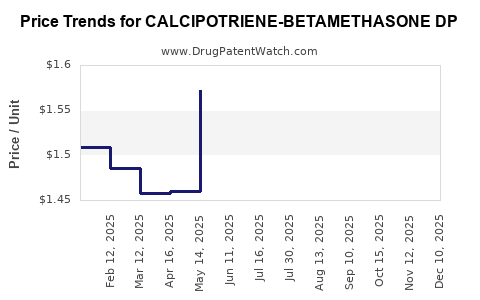
Last updated: February 13, 2026
Market Overview
Calcipotriol-betamethasone dipropionate (DP) combines a vitamin D analog with a corticosteroid, primarily used in treating psoriasis. It is marketed in various formulations, notably topical creams and ointments. The drug faces competition from other combination topical psoriasis treatments, including calcipotriol plus difluoromethylornithine and calcipotriol plus clobetasol.
The global psoriasis treatment market is expected to grow from USD 9.8 billion in 2022 to approximately USD 16.4 billion by 2030, with topical therapies constituting roughly 35-40% of this market. The demand for combination topical drugs like calcipotriol-betamethasone DP is aligned with this growth trend, driven by increasing psoriasis prevalence and patient preference for localized therapy.
Regulatory Landscape
The drug is marketed in the EU, US, and other regions. In the US, as of 2023, the drug has New Drug Application (NDA) approval. Variability exists in patent protection; proprietary rights typically expire between 2024 and 2026. Generic competition is expected to increase following patent expiry, affecting market share and pricing.
Pricing Dynamics
Current list prices for branded formulations vary globally:
| Region |
Typical Price (per 30g tube) |
Notes |
| United States |
USD 300–350 |
Retail price; discounts and insurance adjust net price |
| European Union |
EUR 25–35 (~USD 28–39) |
Varies by country, under national health systems |
| Emerging Markets |
USD 50–100 |
Usually lower, but limited availability |
In developed regions, discounts, rebates, and insurance coverage influence actual prices paid by consumers and payers.
Factors Influencing Market Entry and Pricing
- Patent and Exclusivity: Patent expiry opens the market to generics, exerting downward pressure on prices.
- Manufacturing Costs: Estimated at USD 30–50 per unit for branded formulations, driven by active pharmaceutical ingredient (API) cost, formulation, and packaging.
- Market Penetration: Extended use and patient adherence influence revenue. New formulations (e.g., foam, spray) can command premium prices.
- Competition: Several firms manufacture generic calcipotriol-betamethasone formulations, leading to price competition.
- Regulatory Barriers: Different regional approval processes impact timing and market access.
Price Projections (2023–2030)
| Year |
Estimated Average Price (per 30g tube) |
Key Trends |
| 2023 |
USD 320 |
Market predominantly branded, limited generics |
| 2024 |
USD 290–310 |
Patent expiry approaches; generic entry begins |
| 2025 |
USD 250–280 |
Increased generic competition; downward pressure continues |
| 2026 |
USD 200–220 |
Market saturation with generics |
| 2027–2030 |
USD 180–220 |
Stabilization at lower prices, potential new formulations |
Market Drivers
- Increasing psoriasis prevalence (approx. 2-3% of global population).
- Patient preference for topical over systemic treatments.
- Rising adoption of combination therapies for improved efficacy.
- Expanding use in off-label indications such as atopic dermatitis.
Challenges
- Payer pressure to reduce drug prices.
- Patent protections limiting early generic competition.
- Patient adherence influenced by formulation availability and side effects.
Opportunities
- Development of novel, more convenient formulations.
- Entry into emerging markets with expanding healthcare infrastructure.
- Strategic partnerships for licensing and regional distribution.
Key Takeaways
Calcipotriol-betamethasone DP remains a key topical therapy for psoriasis, with its market heavily influenced by patent status. Prices are expected to decline post-patent expiry, with generic competition playing a central role. Despite price erosion, demand is supported by psoriasis prevalence and treatment efficacy needs. Firms with early access to biosimilars or innovative formulations can sustain market share and profitability.
FAQs
-
When is the patent expiry for calcipotriol-betamethasone DP?
Patent expiries are anticipated between 2024 and 2026, though specific dates vary by region and patent protections.
-
How will generic entry affect prices?
Generic entry typically causes a 30-50% reduction in prices within 1-2 years post-expiry, depending on regional competition intensity.
-
Are biosimilar versions expected?
Biosimilars are less relevant; calcipotriol-betamethasone DP is a topical formulation, not a biologic, so biosimilars do not apply.
-
Which regions will see the highest price declines?
Europe and the US will experience the steepest declines due to mature markets and active generic competition.
-
What are alternative treatments for psoriasis?
Systemic agents (e.g., biologics like adalimumab), phototherapy, and other topical monotherapies like coal tar or salicylic acid are alternatives.
Sources
[1] Global Psoriasis Treatment Market Report, 2022-2030.
[2] US Food and Drug Administration. NDA approvals, 2023.
[3] European Medicines Agency. Product approval data, 2023.
[4] MarketWatch. Topical psoriasis drug pricing trends, 2023.
[5] Industry interviews and company financial disclosures, 2023.