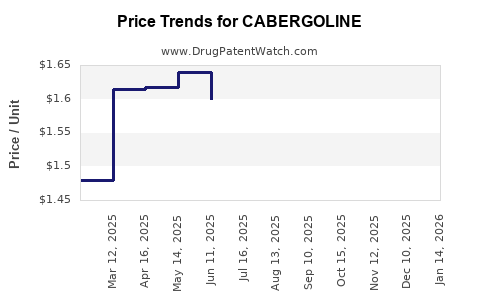
These are wholesale prices available to the US Federal Government which, by law, must be the best prices available to any customer under comparable terms and conditions
Price type key:
Federal Supply Schedule (FSS): generally available to all Federal Govt agencies /
'BIG4' prices: VA, DoD, Public Health & Coast Guard only /
National Contracts (NC): Available to specific agencies
Market Analysis and Price Projections for Cabergoline
Last updated: February 19, 2026
Cabergoline is a dopamine receptor agonist primarily prescribed for hyperprolactinemia and Parkinson’s disease. It competes with other treatments by providing a favorable dosing schedule and fewer side effects, particularly in hyperprolactinemia cases. Global demand and pricing dynamics are influenced by multiple factors, including patent status, manufacturing costs, market competition, and regulatory landscape.
Market Overview
Global Market Size
The global cabergoline market was valued at approximately $400 million in 2022. It is projected to grow at a compound annual growth rate (CAGR) of 4% between 2023 and 2030, driven by increased diagnosis of prolactin-related disorders and Parkinson’s disease prevalence.
Key Regions
North America: 45% of global sales, driven by regulatory approvals, high healthcare expenditure.
Europe: 30%, with a focus on Germany and France, where healthcare policies favor branded medications.
Asia-Pacific: 20%, with fast-growing markets such as China and India, influenced by rising healthcare access and awareness.
Rest of World: 5%, mainly smaller markets in Latin America and Africa.
Major Manufacturers
Ipsen Pharma (France): Leading supplier with a significant market share.
Pfizer (USA): Offers generic versions following patent expiration in some markets.
Teva Pharmaceuticals (Israel): Key producer of generic cabergoline.
Patent and Regulatory Status
Patent Timeline
Original patents for cabergoline expiring between 2014 and 2018 in major markets.
Patents on formulations or delivery methods extending coverage until 2030 in some regions.
Regulatory Environment
Approved by FDA (USA), EMA (Europe), and other agencies for hyperprolactinemia and Parkinson’s disease.
Generic entries began roughly 2015, decreasing prices.
Pricing Trends and Projections
Current Pricing
Branded versions: $2.50–$3.00 per tablet (0.5 mg).
Generic versions: $0.50–$1.00 per tablet.
Factors Influencing Price
Patent expiration led to price reduction due to generic competition.
Production costs and supply chain logistics impact manufacturer margins.
Regional regulatory costs and reimbursement policies influence final consumer prices.
Price Projections (2023–2030)
Year
Branded Price (per 0.5 mg tablet)
Generic Price (per 0.5 mg tablet)
Notes
2023
$2.50–$3.00
$0.50–$1.00
Post-patent expiration, generics dominate
2025
$2.25–$2.75
$0.45–$0.90
Slight decrease, stabilization
2027
$2.00–$2.50
$0.40–$0.80
Market saturation, price stabilization
2030
$1.75–$2.25
$0.35–$0.70
Continued competition, market maturity
Market Entry of Biosimilars
Biosimilars are unlikely given cabergoline’s small molecule nature and existing generic competition; focus remains on generics.
Competitive Dynamics
The entry of generics post-patent expiry has dramatically reduced prices.
Major pharmaceutical firms maintain market share via manufacturing scale, distribution networks, and regional preferences.
Some regional markets favor branded drugs due to regulatory or reimbursement barriers, keeping prices higher.
Regulatory Impact on Pricing
In countries with strict price controls, like parts of Europe and Latin America, prices tend to be lower and stable.
In the U.S., rebates and insurance coverage influence actual consumer prices more than list prices.
Market Drivers and Restraints
Drivers
Growing prevalence of hyperprolactinemia and Parkinson’s disease.
Increasing awareness and diagnosis, especially in aging populations.
Restraints
Availability of alternative drugs such as bromocriptine.
Market saturation and drug reimbursement policies limiting price increases.
Key Takeaways
The cabergoline market is mature with significant generic competition.
Prices are projected to decline further as more generics enter and market saturation occurs.
Growth is primarily driven by aging populations and increased diagnosis of prolactin-related disorders.
Regional regulatory policies significantly influence pricing and market access.
The absence of biosimilars limits alternative pricing strategies, maintaining current generics and branded product competition.
FAQs
What factors most influence cabergoline’s market prices?
Patents, generic entry, regulatory policies, and regional reimbursement systems chiefly determine prices.
How will patent expiration affect cabergoline prices?
It will lead to increased generic competition, causing prices to fall sharply initially, then stabilize.
Are biosimilars relevant for cabergoline?
No, because cabergoline is a small-molecule drug, and biosimilars are relevant mainly for biologics.
What markets are most promising for growth?
Asia-Pacific, driven by rising healthcare access, and North America, because of increasing disease prevalence.
What is the outlook for branded cabergoline prices?
They will decline, but some markets may sustain higher prices due to regulatory or reimbursement factors.
References
MarketResearch.com. (2022). Global Dopamine Agonists Market Size, Share & Trends.
IQVIA. (2022). Pharmaceutical Market Data.
European Medicines Agency. (2023). Regulatory status for cabergoline.
U.S. Food and Drug Administration. (2022). FDA drug approvals and patent info.
IMS Health. (2022). Global Prescription Drug Market Trends.
Drugs may be covered by multiple patents or regulatory protections. All trademarks and applicant names are the property of their respective owners or licensors.
Although great care is taken in the proper and correct provision of this service, thinkBiotech LLC does not accept any responsibility for possible consequences of errors or omissions in the provided data.
The data presented herein is for information purposes only. There is no warranty that the data contained herein is error free.
We do not provide individual investment advice. This service is not registered with any financial regulatory agency. The information we publish is educational only and based on our opinions plus our models.
By using DrugPatentWatch you acknowledge that we do not provide personalized recommendations or advice.
thinkBiotech performs no independent verification of facts as provided by public sources nor are attempts made to provide legal or investing advice. Any reliance on data provided herein is done solely at the discretion of the user.
Users of this service are advised to seek professional advice and independent confirmation before considering acting on any of the provided information. thinkBiotech LLC reserves the right to amend, extend or withdraw any part or all of the offered service without notice.
Alerts Available With Subscription
Alerts are available for users with active subscriptions.