Share This Page
Drug Price Trends for BUDESONIDE ER
✉ Email this page to a colleague
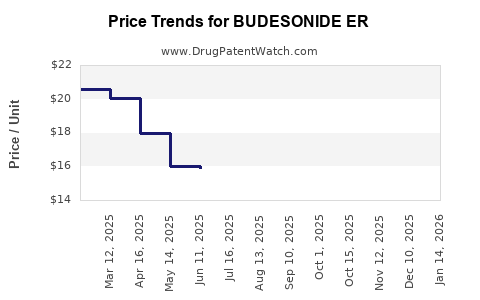
Average Pharmacy Cost for BUDESONIDE ER
| Drug Name | NDC | Price/Unit ($) | Unit | Date |
|---|---|---|---|---|
| BUDESONIDE ER 9 MG TABLET | 00378-4500-93 | 15.36960 | EACH | 2026-07-22 |
| BUDESONIDE ER 9 MG TABLET | 00591-2510-30 | 15.36960 | EACH | 2026-07-22 |
| BUDESONIDE ER 9 MG TABLET | 00378-4500-93 | 14.21048 | EACH | 2026-06-17 |
| >Drug Name | >NDC | >Price/Unit ($) | >Unit | >Date |
Market Analysis and Price Projections for BUDESONIDE ER
Market Overview
Budesonide Extended Release (ER) is a corticosteroid used primarily for inflammatory bowel diseases, including Crohn’s disease and ulcerative colitis. The drug is delivered via oral formulation, offering a targeted release mechanism designed to reduce systemic absorption and side effects compared to traditional corticosteroids.
Global demand for bowel-specific corticosteroids is rising, driven by increasing prevalence of inflammatory bowel diseases (IBD). The World Gastroenterology Organisation estimates that IBD affects over 6 million people worldwide, with a rising trend in North America, Europe, and parts of Asia. This demographic shift, coupled with an aging population, is expected to expand the market.
Market Size and Growth Potential
The global IBD therapeutics market was valued at approximately $8.3 billion in 2022 and is projected to grow at a Compound Annual Growth Rate (CAGR) of 6.8% through 2030 [1].
Within this, the corticosteroid segment, including budesonide formulations, accounts for roughly 15-20%, reflecting the therapy’s importance in early disease management and induction of remission.
Key factors influencing growth include:
- Increasing diagnosis rates of IBD
- Enhanced awareness leading to earlier intervention
- Shift toward targeted delivery systems reducing side effects
- Patent protections and ongoing clinical trials expanding indications
Competitive Landscape
Major competitors include:
- Entocort EC (budesonide): The branded, controlled-release formulation with global presence.
- Generic versions of budesonide ER: Entering markets as patents expire.
- Emerging drugs with alternative mechanisms, such as biologics (e.g., infliximab, adalimumab), which are used in more severe cases.
The patent expiry of Entocort EC has enabled a surge in generic competition, exerting downward pressure on prices.
Pricing Analysis
Current Price Points
- Branded Budesonide ER (Entocort EC): Average wholesale price (AWP) in the U.S. ranges from $850 to $1,000 per 30-day supply.
- Generics: Prices have declined to approximately $400–$700 per 30-day supply, depending on discounts, pharmacy margins, and insurance coverage.
Factors Affecting Price Trajectory
- Patent expiry: Scheduled for 2024/2025 in the U.S., opening markets for generics.
- Market penetration: Increasing adoption of generic formulations will suppress prices over time.
- Regulatory approvals: New formulations or delivery mechanisms may command premium pricing initially.
- Insurance coverage: Reimbursement policies significantly influence patient out-of-pocket costs and provider prescribing behavior.
Price Projection
| Year | Estimated Price Range (30-day supply) | Notes |
|---|---|---|
| 2023 | $850–$1,000 (branded), $400–$700 (generic) | Market remains dominated by branded, with emerging generics |
| 2024 | $750–$900 (branded), $350–$650 (generics) | Patent expiry leads to increased generic market share |
| 2025 | $700–$850 (branded), $300–$600 (generics) | Greater penetration by generics reduces prices |
| 2026 and beyond | $600–$750 (branded), $250–$500 (generics) | Competition stabilizes prices lower than initial years |
Prices are expected to decline with increased generic competition, but premium priced formulations or new delivery platforms may temporarily sustain higher price points.
Regulatory and Market Risks
- Patent and exclusivity timelines: Delays in patent challenges could extend higher prices.
- Market acceptance: Physician and payer preferences for biologics vs. corticosteroids influence volume and pricing.
- Pricing regulations: U.S. and international pricing controls could pressure margins.
Implications for Stakeholders
- Pharmaceutical companies: Investment in R&D for next-generation ER formulations or combination therapies could justify premium pricing.
- Investors: Timing product launches around patent cliffs can optimize returns.
- Payers: Cost-containment pressures favor generics, influencing reimbursement strategies.
Key Takeaways
- The global IBD market is expanding at approximately 6.8% CAGR, driven by rising diagnoses and demand for targeted delivery.
- Branded budesonide ER prices in the U.S. range from $850 to $1,000; generics reduce costs to about $400–$700.
- Patent expiry around 2024–2025 will accelerate generic market penetration, exerting downward price pressure.
- Price projections anticipate a decline over the next three years, stabilizing at lower levels as competition intensifies.
- Market and regulatory risks could alter these trajectories, but generally, increased generics and new formulations will dampen prices.
FAQs
Q1: When will generic versions of budesonide ER become widely available?
A1: Patent protections are expected to expire around 2024–2025, enabling generics to enter the U.S. market.
Q2: How does the price of braned budesonide compare internationally?
A2: Prices vary globally, often lower in countries with nationalized health systems, but similar trends of declining prices post-patent expiry are observed.
Q3: What factors could delay price declines?
A3: Regulatory hurdles, patent disputes, or slow market adoption of generics could slow down price reductions.
Q4: Are there any premium formulations expected to command higher prices?
A4: Yes, formulations with improved delivery mechanisms, combination drugs, or novel delivery platforms may sustain higher prices temporarily.
Q5: How do insurance policies influence budesonide ER prices?
A5: Insurance coverage and formulary positioning influence patient copayments and prescribing practices, impacting overall market prices.
References
[1] MarketsandMarkets, "Inflammatory Bowel Disease Drugs Market," 2022.
More… ↓
