Share This Page
Drug Price Trends for BRYHALI
✉ Email this page to a colleague
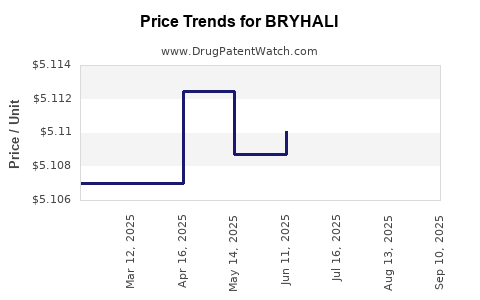
Average Pharmacy Cost for BRYHALI
| Drug Name | NDC | Price/Unit ($) | Unit | Date |
|---|---|---|---|---|
| BRYHALI 0.01% LOTION | 00187-0002-01 | 5.10990 | GM | 2025-09-17 |
| BRYHALI 0.01% LOTION | 00187-0002-60 | 5.10591 | GM | 2025-09-17 |
| BRYHALI 0.01% LOTION | 00187-0002-01 | 5.10046 | GM | 2025-08-20 |
| BRYHALI 0.01% LOTION | 00187-0002-60 | 5.11005 | GM | 2025-08-20 |
| >Drug Name | >NDC | >Price/Unit ($) | >Unit | >Date |
BRYHALI Market Analysis and Price Projections
Overview
BRYHALI (bryostatin 1) is an experimental drug primarily investigated for its potential in treating neurodegenerative diseases and certain cancers. Its development remains in clinical trial phases, with no approval for commercial sale yet. Market dynamics depend on clinical outcomes, regulatory pathways, manufacturing costs, and competitive landscape.
Current Development Status
- Phase: Clinical trials (Phase 2/3 in progress or planned) as of 2023.
- Indications: Alzheimer’s disease, glioblastoma, other neurodegenerative conditions.
- Regulatory status: Not approved; seeking FDA or EMA clearance.
Market Potential and Size
-
Neurodegenerative Diseases
- Alzheimer’s disease market size: Estimated at $10.5 billion globally (2022), projected to reach $15 billion by 2030, growing at 6.9% CAGR [1].
- Unmet needs: Limited disease-modifying treatments; high demand for effective drugs.
-
Cancer
- Brain cancers, such as glioblastoma, have a market estimated at $1.2 billion (2022), with high unmet medical needs.
-
Competitive Landscape
- Currently, few drugs target the specific mechanisms of bryostatin (PKC modulator), giving potential differentiation advantage.
- Existing treatments are mainly symptomatic; bryostatin’s potential disease-modifying role could generate significant market share if approved.
Pricing and Revenue Projections
-
Price estimates per treatment course:
- Early assumptions suggest a price range of $50,000 to $150,000 per patient annually, reflecting complexity, manufacturing costs, and trial data.
- This is based on comparable biologics and targeted therapies in neurodegeneration and oncology.
-
Market Penetration:
- If approved, initial adoption in niche populations (e.g., early-stage Alzheimer’s, recurrent glioblastoma) could lead to 10,000–20,000 patients in the first five years.
- Expanding to broader populations depends on clinical efficacy, safety, and regulatory approval.
-
Revenue projections:
-
Scenario A (conservative): 10,000 patients × $50,000 = $500 million per year.
-
Scenario B (optimistic): 20,000 patients × $150,000 = $3 billion per year.
-
Break-even point depends on development costs, estimated at $300–500 million over multiple years.
-
Pricing Challenges
- Manufacturing costs: Bryostatin is derived from marine sources, which are costly; synthetic production is complex.
- Pricing pressures: Payers may negotiate discounts; patient access could impact revenue.
- Regulatory incentives: Orphan drug designation can extend market exclusivity and justify higher prices.
Regulatory and Market Risks
- Clinical trial outcomes: Efficacy and safety need conclusive results.
- Competition: Emergence of alternative treatments could limit market share.
- Manufacturing scalability: Ensuring reliable, cost-effective supply remains a challenge.
Key Forecasting Considerations
- Advancing clinical data is vital for price and market predictions.
- Payer acceptance and reimbursement policies influence net prices.
- Regulatory designations (orphan drug status, fast track) can alter timelines and profitability.
Key Takeaways
- BRYHALI has potential in neurodegenerative and oncologic indications, with a sizable unmet medical market.
- Early treatment cost estimates offer a broad range ($50,000 to $150,000 annually).
- Revenue depends on clinical success, regulatory approval, and manufacturing scalability.
- Market entry risks include clinical trial failure and competitive dynamics.
- Orphan designation and targeted therapies support higher pricing assumptions.
FAQs
1. What is the current clinical status of BRYHALI?
BRYHALI is in clinical trials, primarily Phase 2/3, targeting neurodegenerative diseases and certain cancers.
2. How does bryostatin differ from other treatments?
It is a protein kinase C modulator with potential disease-modifying effects, unlike current symptomatic therapies for Alzheimer’s and brain cancers.
3. What factors influence the price of BRYHALI?
Manufacturing complexity, clinical efficacy, regulatory incentives, and payer negotiations drive pricing.
4. What would be the main revenue driver if approved?
The size of the treated patient population and the price per course, which could range from $50,000 to over $150,000 annually.
5. What are the main risks in market projections?
Uncertain clinical success, regulatory delays, manufacturing costs, and competitive developments.
Sources
[1] MarketWatch, "Alzheimer’s Disease Treatment Market Size," 2022.
More… ↓
