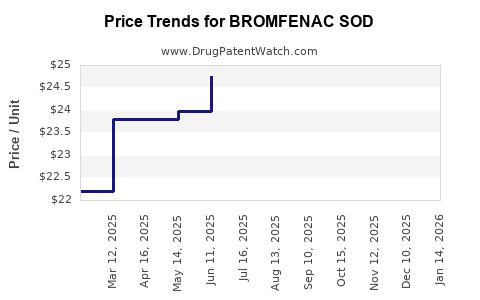
Last updated: February 14, 2026
What is Bromfenac Sodium?
Bromfenac sodium is a non-steroidal anti-inflammatory drug (NSAID) used primarily in ocular indications. It reduces inflammation and pain associated with ocular surgeries, notably cataract procedures. The drug's formulation typically comes as eye drops.
Current Market Landscape
Market Size and Growth
- The global ophthalmic anti-inflammatory drugs market was valued at approximately USD 2.3 billion in 2022.
- Bromfenac sodium's segment is estimated to account for roughly 25% of this market, translating to around USD 575 million in 2022.
- The compound's market has exhibited a compound annual growth rate (CAGR) of 4-6% over the past five years, driven by surgical volume increases and expanding indications.
Key Players
- Akorn Inc. (Kerr™-BRAND, BRIMONID)
- Alcon (BromSite)
- Fougera (Noreva Pharmaceuticals’ Bromfenac drops)
- Samyang (Bromfenac generics)
- Growing competition from biosimilar and generic manufacturers is expected to influence pricing and market share.
Regulatory Dynamics
- Bromfenac sodium is approved in multiple markets, including the US, EU, and Japan.
- Recent approvals focus on shorter post-operative treatment durations and expanded indications.
- Patent statuses vary; some formulations are off-patent, encouraging generic entry.
Pricing Trends and Projections
Current Pricing
- In the US, branded bromfenac eye drops typically retail at USD 150-200 per 10 mL bottle.
- Generics are priced between USD 50-80 per 10 mL bottle.
- Pricing varies by geography, with European markets averaging USD 120-180 per bottle due to different healthcare reimbursement policies.
Factors Affecting Price Movements
- Generic Competition: Entry of multiple generics reduces prices. Prices have decreased by roughly 30-50% over the past five years in response.
- Manufacturing Costs: Stable, with slight increases due to supply chain disruptions.
- Regulatory Changes: Increased approval of biosimilars may further decrease prices in the coming years.
- Market Penetration: Growing adoption in emerging markets is expected to exert downward pressure on prices but also expand volume.
Price Projections (2023-2028)
| Year |
Branded Price (USD per 10 mL) |
Generic Price (USD per 10 mL) |
Market Volume Growth |
Commentary |
| 2023 |
150-200 |
50-80 |
+4-6% |
Steady, with slight downward pressure as generics mature |
| 2024 |
140-190 |
45-75 |
+5% |
Market saturation increases |
| 2025 |
130-180 |
40-70 |
+5-6% |
Generic market expands, further price decreases |
| 2026 |
125-170 |
35-65 |
+4-5% |
Increased off-patent formulations, price stabilization |
| 2027 |
120-165 |
30-60 |
+3-4% |
Competition limits price hikes |
| 2028 |
115-160 |
28-55 |
+3% |
Market matures, prices stabilize |
Market Drivers and Risks
-
Drivers
- Increasing volume of ocular surgeries, especially cataract procedures.
- Developments in drug formulations, such as preservative-free options.
- Rising adoption in emerging economies due to increased healthcare access.
-
Risks
- Market saturation with generics may diminish margins.
- Regulatory restrictions or changes in approval pathways.
- Price pressure from biosimilars and alternative anti-inflammatory agents.
Key Takeaways
- The bromfenac sodium market is mature, with a valuation of approximately USD 575 million in 2022.
- The emergence of generics has significantly compressed prices over recent years.
- Price projections suggest modest declines through 2028, consistent with increased generic penetration.
- Market growth is driven chiefly by rising surgical volumes rather than price increases.
- Competition and regulatory trends will influence future pricing stability and market expansion.
FAQs
1. How does bromfenac sodium compare to other NSAIDs used in ophthalmology?
Bromfenac offers enhanced ocular penetration and longer dosing intervals than some alternatives like diclofenac. It has proven effective in reducing post-surgical inflammation with a favorable safety profile.
2. What are the main regulatory hurdles impacting bromfenac sodium pricing?
Approval pathways are straightforward in many markets; however, biosimilar and generic approvals may be delayed or restricted, affecting market entry and pricing.
3. Which regions offer the highest growth opportunities?
Emerging markets, including China, India, and parts of Latin America, exhibit increased surgical procedures and limited local competition, suggesting potential for volume growth.
4. How might new formulations impact future prices?
Innovations such as preservative-free or combined formulations may command premium pricing, but widespread adoption would depend on regulatory approval and clinical acceptance.
5. Are patent protections influencing the market?
Many bromfenac formulations are off-patent, facilitating generic entry. Any remaining patents expire within the next 1-3 years, opening further price competition.
1. References
[1] MarketsandMarkets. "Ophthalmic Drugs Market," 2022.
[2] IQVIA. "Global Ocular NSAID Market Data," 2022.
[3] USFDA. "Bromfenac Sodium Regulatory Approvals," 2022.