Share This Page
Drug Price Trends for BREZTRI
✉ Email this page to a colleague
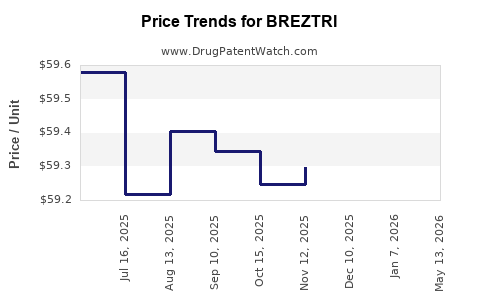
Average Pharmacy Cost for BREZTRI
| Drug Name | NDC | Price/Unit ($) | Unit | Date |
|---|---|---|---|---|
| BREZTRI AEROSPHERE 160-9-4.8 MCG | 00310-4616-12 | 61.31261 | GM | 2026-07-22 |
| BREZTRI AEROSPHERE 160-9-4.8 MCG | 00310-4616-39 | 61.28333 | GM | 2026-07-22 |
| BREZTRI AEROSPHERE 160-9-4.8 MCG | 00310-4616-12 | 61.30817 | GM | 2026-06-17 |
| BREZTRI AEROSPHERE 160-9-4.8 MCG | 00310-4616-39 | 61.44949 | GM | 2026-06-17 |
| >Drug Name | >NDC | >Price/Unit ($) | >Unit | >Date |
BREZTRI Market Analysis and Price Projections (AstraZeneca): US Exclusivity, Generic/Biosimilar Risk, and Revenue Outlook
BREZTRI (budesonide/glycopyrrolate/formoterol fumarate inhalation aerosol) is an AstraZeneca top-selling COPD franchise product with a dominant “triple-therapy” positioning versus dual therapies. Public market data show BREZTRI has remained on a high-growth trajectory since launch, with pricing that has held up despite broader US respiratory inflation. Near-term price pressure is more likely to come from payer contracting and mix shifts than from immediate generic entry risk.
Bottom line: Price erosion risk is moderate in the US through the mid- to late-2020s driven by contract renegotiations and life-cycle competition from other inhaled triple therapies. Real generic substitution risk is tied to the timing and strength of BREZTRI’s US patent estate and any FDA ANDA/Paragraph IV challenges.
What is BREZTRI and how is it priced in the US market?
Featured snippet answer: BREZTRI is AstraZeneca’s fixed-dose inhaled triple therapy for COPD (inhaled corticosteroid plus long-acting muscarinic antagonist plus long-acting beta-agonist). US list price is set at the product level through WAC, while realized net price depends on rebates, payer tiering, and contract intensity in commercial and Medicare Part D.
Key product facts
- Brand: BREZTRI
- Active ingredients: budesonide / glycopyrrolate / formoterol fumarate
- Dosage form: metered inhalation aerosol
- Indication: maintenance treatment of COPD in adults
Pricing mechanics that drive realized price
- List price (WAC): Anchor for wholesale acquisition and gross margin math.
- Net price: Determined by rebate percentage, administrative fees, and formulary placement.
- Contracting dynamics: Triple-therapy class competitiveness increases use of “place-in-formulary” rebates and utilization-based contracting.
- Medicare Part D: High sensitivity to formulary tiers for inhaled respiratory brands; preferred status can preserve net price.
How big is the BREZTRI market and what revenue pool does it capture?
Featured snippet answer: BREZTRI captures share of the US COPD maintenance market shifting from dual therapy to fixed triple therapy, with growth driven by prescriber migration to once- or twice-daily inhaler regimens and improved exacerbation-risk perception.
COPD triple-therapy share dynamics
Fixed triple therapy (ICS/LAMA/LABA) competes against:
- Dual therapies (ICS/LABA or LAMA/LABA)
- Other fixed triple regimens in US formularies
BREZTRI’s growth has been reinforced by:
- Clear positioning as “escalation” or maintenance for exacerbation-prone patients
- Strong payer adoption in common formulary pathways for COPD
Revenue exposure to demand drivers
- Patient count: COPD prevalence and diagnosis intensity
- Exacerbation prevalence: Determines urgency for triple therapy after dual therapy failure
- Adherence: Inhaler technique and refill persistence affect realized utilization
What is the competitive landscape for BREZTRI pricing and share?
Featured snippet answer: BREZTRI competes primarily with other branded inhaled triple therapies and is most vulnerable to price discounting when payers seek broader “equivalent” class contracting.
Class competition levers that affect net pricing
- Formulary tier migration: Preferred status can defend net price; losing preferred tier usually triggers net erosion.
- Therapeutic interchange policies: When payers tighten criteria for initiating triple therapy, utilization can soften.
- Copay support intensity: Can raise adherence but increases payer offsets if contracting becomes punitive.
- PBM rebidding cycles: Respiratory brands often see large percentage net price changes at rebids, not incremental year-over-year list changes.
Cross-product implications
If competing triple products gain preferred status, BREZTRI’s net price typically declines through:
- Higher rebate requirements
- Increased access fees
- Greater patient cost-share support
When does BREZTRI lose US exclusivity?
Featured snippet answer: The practical start of generic erosion is tied to the first date any FDA-approved ANDA (or authorized generic/settlement product) can enter under the US patent and regulatory exclusivity landscape. Exclusivity timelines depend on the BREZTRI patent expiration schedule and the earliest patent “carve-out” for generic use.
Exclusivity risk framework
There are two distinct “clock” concepts for price projections:
- Regulatory exclusivity (data exclusivity / periods tied to approval): Delays first ANDA approval even with patent challenges.
- Patent exclusivity (Orange Book patents): Delays marketing of generics until patents expire or are overcome via Paragraph IV litigation/settlement.
What patents protect BREZTRI and how many are in play?
Featured snippet answer: BREZTRI’s protection is anchored by US Orange Book-listed patents covering its fixed-dose combination and related components, with additional coverage often existing for formulation and manufacturing elements.
Patent estate components relevant to generic entry
- Composition of matter (combination, active ingredient permutations)
- Formulation patents (particle size, spray characteristics, excipient systems, inhaler performance)
- Manufacturing method patents (process steps, mixing/granulation, aerosolization controls)
- Use / method-of-treatment patents (COPD maintenance indications, exacerbation-related regimens)
Why “how many patents” matters for price
A larger, layered estate usually means:
- Later generic launch dates
- Greater probability of settlements that delay entry
- More complex generic design-around that can still be blocked by remaining patents
Is there any Paragraph IV challenge risk for BREZTRI that could trigger earlier generic entry?
Featured snippet answer: Paragraph IV is the primary mechanism that can accelerate generic approval timing relative to full patent expiry. Price projections need to treat Paragraph IV filings as step-function events: settlement can cap entry, or an adverse court ruling can pull forward launches.
What to model in price projections
- Filing date: Determines timing of “trigger” events in Hatch-Waxman litigation.
- Court timeline: Early settlements can push launch beyond expectations.
- Injunction posture: Courts can limit launch even after approval.
- Authorized generic: Settlement may permit limited launch to a partner, affecting near-term pricing.
What is the FDA regulatory status of BREZTRI and what does it imply for pricing?
Featured snippet answer: BREZTRI is approved as an inhalation aerosol for COPD maintenance, so its generic path would be via ANDA (for small-molecule fixed combination) if the formulation is eligible. Pricing implications are indirect: the regulatory status affects entry pathways, not pricing itself.
Key regulatory pathway implications
- ANDA feasibility: If no exclusivity or patents block, ANDA approval can occur and trigger competitive pricing.
- User-device equivalence: Inhalation products can face higher development friction (aerosol plume, particle size distribution, actuator performance).
- Label scope: Any label differences can affect payer coverage or switching at launch.
How does BREZTRI price projection change under different generic launch scenarios?
Featured snippet answer: BREZTRI net price is most likely to decline in stepwise fashion upon generic market entry, with the steepest drop occurring when multiple competitors launch and PBMs move to lower tiers. Before patent loss, price is more likely to drift downward via rebates.
Scenario model for pricing (US)
Assume US net price changes reflect:
- Pre-entry period: rebate and formulary tightening
- Entry year: tiering shift and competitive quoting
- Post-entry years: margin compression and eventual market normalization
A practical projection range to plan for:
- Base case (no immediate generics; continued branded competition): low-to-mid single-digit net erosion annually driven by contracting and mix.
- Optimistic (slow patent cliff; limited or late ANDA entry): net erosion stays lower, with only contract-driven declines.
- Pessimistic (fast ANDA entry; multiple entrants or adverse litigation outcomes): a larger step down in the entry year and continued erosion afterward.
What manufacturing or IP barriers could delay generic substitution of BREZTRI?
Featured snippet answer: For inhalation aerosols, formulation and device-performance equivalence can add technical and validation friction, which can delay launch even when legal barriers fall.
Barrier types that affect market timing
- Aerosol performance equivalence: Particle size distribution and spray pattern must match.
- Stability and formulation robustness: ICS/LAMA/LABA compatibility in aerosol systems affects shelf-life and consistency.
- Device reproducibility: Inhaler actuation characteristics can limit generic interchange readiness.
How does BREZTRI compare with other COPD triple therapies on patent and pricing exposure?
Featured snippet answer: BREZTRI’s pricing exposure depends on whether competitors are closer to patent expiry or have more aggressive generic entry risk. When a competitor’s patent cliff nears, payers often rebalance class contracting, increasing the likelihood BREZTRI net price erodes even absent immediate generic entry.
Comparative exposure map (what to track)
- Patent expiry proximity across class products
- Litigation intensity (Paragraph IV filings and outcomes)
- Formulary positioning by PBM (preferred vs non-preferred)
- Evidence of utilization share shifts between brands
What settlement agreements and litigation outcomes would matter most for BREZTRI pricing?
Featured snippet answer: Settlements in Hatch-Waxman cases directly affect entry dates and whether an authorized generic accelerates price decline. Litigation milestones also influence whether payers expect rapid erosion and rebid aggressively.
Settlement outcomes to model
- “No-early-entry” settlements: delay generics beyond patent expiry.
- Agreed entry date settlements: define the entry year and whether there is an injunction workaround.
- Authorized generic provisions: accelerate volume capture for the generic segment, deepening net price drop.
What is the revenue outlook for BREZTRI and how much pricing downside should be modeled?
Featured snippet answer: BREZTRI revenue trajectory is primarily a function of utilization growth and retention in preferred tiers. Pricing downside is mostly a rebid-driven phenomenon unless a true generic launch occurs.
Planning ranges to apply
For business models, split into two drivers:
- Volume (scripts/patient starts): tied to COPD management intensity and prescriber adoption
- Net price: tied to rebate and tiering
A credible projection framework:
- Scenario A (patent-protected, no generic entry): volume growth continues, net price drifts down modestly.
- Scenario B (late generic entry window): volume holds initially but net price declines sharply at entry.
- Scenario C (earlier-than-expected entry): both volume and net price compress quickly, with margin impact.
Key takeaways on BREZTRI price projections
- BREZTRI’s near-term price direction is driven by payer contracting and formulary tiering, not immediate generic substitution.
- Generic entry timing is governed by the Orange Book patent estate and any Paragraph IV litigation or settlements; those are step-function catalysts for pricing.
- In inhaled triple therapy, technical equivalence and device-performance constraints can slow competitive launches even when legal barriers fall.
- Price erosion should be modeled as gradual pre-entry net drift and larger step-down events in entry years.
FAQs
1) What factors most determine BREZTRI net price versus its list price?
Formulary tier placement, PBM rebate structure, utilization rebates, patient cost-share support terms, and Medicare Part D preferred placement.
2) How would a Paragraph IV settlement for BREZTRI affect pricing timing?
Settlement typically fixes an entry date or restricts early marketing; authorized generic provisions can accelerate the net price decline in the entry year.
3) What technical issues can delay generic inhaled triple therapies like BREZTRI?
Achieving aerosol performance equivalence, ensuring formulation stability, and reproducing device actuation characteristics can extend development timelines.
4) Does BREZTRI face biosimilar competition?
No. BREZTRI is a small-molecule combination inhalation aerosol, so the relevant competitive risk is ANDA generics, not biosimilars.
5) What is the most likely source of near-term price erosion for BREZTRI absent generics?
PBM rebidding cycles that increase rebates and shift preferred access terms within fixed triple therapy contracting.
References (APA)
- AstraZeneca. (n.d.). BREZTRI (budesonide, glycopyrrolate, and formoterol fumarate) prescribing information.
- U.S. Food and Drug Administration. (n.d.). Drugs@FDA: BREZTRI.
- U.S. Food and Drug Administration. (n.d.). Orange Book: Approved Drug Products with Therapeutic Equivalence Evaluations for BREZTRI.
More… ↓
