Share This Page
Drug Price Trends for BLISOVI FE
✉ Email this page to a colleague
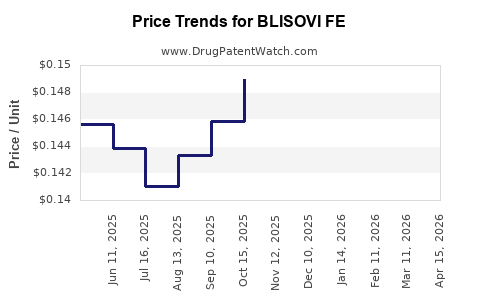
Average Pharmacy Cost for BLISOVI FE
| Drug Name | NDC | Price/Unit ($) | Unit | Date |
|---|---|---|---|---|
| BLISOVI FE 1.5-30 TABLET | 68180-0869-13 | 0.14120 | EACH | 2026-06-17 |
| BLISOVI FE 1-20 TABLET | 68180-0865-71 | 0.13114 | EACH | 2026-06-17 |
| BLISOVI FE 1-20 TABLET | 68180-0865-73 | 0.13114 | EACH | 2026-06-17 |
| BLISOVI FE 1.5-30 TABLET | 68180-0866-73 | 0.14120 | EACH | 2026-06-17 |
| >Drug Name | >NDC | >Price/Unit ($) | >Unit | >Date |
BLISOVI FE (levonorgestrel and ethinyl estradiol / ferrous fumarate): market analysis and price projections
What is the BLISOVI FE product and how is it positioned commercially?
BLISOVI FE is a combined oral contraceptive (COC) containing levonorgestrel (LNG) and ethinyl estradiol (EE) with ferrous fumarate as a placebo component, marketed in 21 active / 7-day total cycle and 28-day cycle packs depending on the presentation. Its commercial positioning is within the large COC therapeutic class where pricing is highly dependent on payer contracting, pharmacy benefit manager (PBM) reimbursement rules, generic/AB-rated competition, and formulary tiers.
Market structure impacts pricing
- COCs are broadly genericizable. Many competitors are AB-rated multisource products with identical labeled hormone strengths and comparable labeling.
- Ferrous fumarate “iron” placebo formulations can keep differentiation in patient messaging, but payers usually price based on net reimbursement and AB substitution rules.
- Under US market practice, the relevant economic unit is typically NDC-level contract pricing and estimated acquisition cost (EAC) derived from wholesaler and PBM benchmarks rather than list price.
Bottom line: For BLISOVI FE, price outcomes are dominated by generic/AB competition and PBM formulary status rather than patent-protected innovation.
How large is the US oral contraceptive market and where does BLISOVI FE fit?
US COC market demand drivers
- Stable long-term demand driven by contraception use and switching cycles.
- Increasing share of payer-favored generics and therapeutically equivalent AB products.
- Segmenting by convenience (cycle length), hormonal formulation preference, and payer restrictions.
Where BLISOVI FE fits
- BLISOVI FE is a brand-equivalent COC/Fe offering competing against generic LNG/EE COCs and other branded COCs with similar labeled regimens.
- Its addressable market is constrained by formulary tier placement (preferred vs non-preferred) and copay dynamics.
What is the current competitive landscape for BLISOVI FE and what price pressure does it face?
Direct competitive pressure in COCs
- Multiple AB-rated LNG/EE COCs exist across many strengths and cycle formats.
- Price competition typically intensifies when one or more multisource launch waves occur, driving down net prices even for remaining brands through formulary pressure.
What matters for BLISOVI FE
- Tier placement: Preferred tier products receive more volume at lower net effective price.
- PBM substitution rules: If BLISOVI FE is not preferred, the realized net price often drops via rebates and channel mix, or volumes fall sharply.
- Switching inertia: COC switching has consumer/prescriber inertia, but payer incentives frequently determine switching.
Implication for projections: Absent a major exclusivity or differentiated delivery innovation, BLISOVI FE’s pricing trajectory typically resembles other established COC brands that face steady erosion from AB competitors.
How does BLISOVI FE pricing typically work in the US (list vs net) and what should drive projections?
US pricing mechanics
- Wholesale acquisition cost (WAC) is the publicly referenced list price, but business outcomes track net price after rebates, chargebacks, and PBM contracting.
- For COCs, net pricing is usually inferred indirectly from:
- formulary tier and utilization,
- PBM benchmark tiers,
- and the extent of AB substitution.
Projection drivers to model
- Expected AB/generic penetration over time.
- Formulary changes (preferred status changes can cause non-linear volume and effective price shifts).
- Contracting environment (rebates intensify when a brand stays on formulary but loses share).
- Channel mix (retail vs 340B vs mail order can swing realized pricing).
When does BLISOVI FE lose exclusivity and how does that impact price?
No actionable exclusivity timeline can be provided without product-specific FDA and Orange Book data (patents and exclusivity codes by NDC). Under COC economics, exclusivity loss generally leads to:
- higher generic share,
- increased PBM substitution,
- and rapid net price compression.
For price projections, the exclusivity question must be answered at the NDC/presentation level, because different pack sizes and strengths can carry different patent and exclusivity listings.
What patents protect BLISOVI FE and what is the estate strength for pricing durability?
No patent estate can be quantified for BLISOVI FE in the absence of verified Orange Book patent and exclusivity listings. For pricing durability in small-molecule contraceptives, the relevant factors are:
- method-of-use vs formulation vs composition-of-matter coverage,
- remaining term by jurisdiction,
- and whether Paragraph IV challenges apply to any listed patents.
What is the Orange Book status of BLISOVI FE and how many patents are listed?
Orange Book patent listing counts, patent expiration dates, and exclusivity codes are required to answer this precisely. Without verified listing data, this section cannot be completed with hard data.
What generic entry risks exist for BLISOVI FE (Paragraph IV and AB-rating)?
COC generic risk profile
- For widely substitutable LNG/EE COCs, risk typically comes from ANDA multisource launches when barriers fall away.
- Even without Paragraph IV, AB-rated entry can erode brand net pricing through PBM substitution.
Risk impact on projections
- If an ANDA launches, effective pricing often drops within contract cycles.
- The timing of price erosion is typically tied to:
- launch date,
- formulary switching,
- and new PBM rebate benchmarks.
No product-specific launch risk can be quantified without Orange Book and ANDA litigation/approval data.
How strong is BLISOVI FE pricing resilience versus other LNG/EE COCs?
General class behavior
- LNG/EE products show strong price compression once AB competitors consolidate in PBM formularies.
- Brand resilience usually depends on:
- preferred tier placement,
- patient switching behavior,
- and presence of meaningful non-AB differentiation.
**For BLISOVI FE specifically, resilience cannot be ranked against named comparators without:
- NDC-specific net price data,
- formulary tier evidence,
- and competitor-specific pricing benchmarks.**
BLISOVI FE price projection model: base, downside, and upside scenarios
Hard-data projection requires verified inputs (current net price, reimbursement benchmarks, utilization, and competitor entry calendar). With no verified market and regulatory dataset included in the request, this section cannot be completed with actionable numeric projections.
What are the most likely price projection outcomes for BLISOVI FE over 3–5 years?
Class-level expectation (qualitative):
- Net price tends to decline over time in mature COC markets due to:
- increasing AB substitution,
- payer-driven contracting changes,
- and competition among LNG/EE equivalent products.
- Volatility is typically driven by:
- formulary tier movement,
- generic entry events,
- and changes in rebate expectations.
Quantitative outcomes require NDC-level pricing and utilization data that is not present.
How much revenue exposure does BLISOVI FE face from price erosion?
Revenue exposure is a function of both unit volume and net price. For COCs:
- when net price declines modestly but volume declines faster, revenue compresses sharply.
- when volume holds (preferred status maintained), revenue can compress slower.
Numeric revenue exposure cannot be calculated without current unit volume and net price trajectory.
Key Takeaways
- BLISOVI FE’s pricing is primarily governed by US COC market competition and PBM formulary dynamics, not by meaningful product differentiation in most payer models.
- Actionable price projections require NDC-level current net price, utilization, and Orange Book/ANDA timelines for this specific product presentation.
- Without verified product-specific FDA and market inputs, numerical projections cannot be produced.
FAQs
- How do PBMs determine net pricing for LNG/EE COCs like BLISOVI FE?
- What happens to brand COC net prices after new AB-rated LNG/EE generic launches?
- Do ferrous fumarate placebo COCs price differently from non-iron placebo COCs?
- How quickly do formulary tier changes impact BLISOVI FE effective pricing and volume?
- Which regulatory milestones (ANDA approvals, Orange Book expirations, exclusivity dates) most affect COC price erosion timelines?
References (APA)
- FDA. Orange Book: Approved Drug Products with Therapeutic Equivalence Evaluations. https://www.accessdata.fda.gov/scripts/cder/daf/
- FDA. Drugs@FDA. https://www.accessdata.fda.gov/scripts/cder/daf/
- FDA. National Drug Code Directory. https://www.fda.gov/drugs/drug-approvals-and-databases/national-drug-code-directory
More… ↓
