Share This Page
Drug Price Trends for BISOPROLOL-HYDROCHLOROTHIAZIDE
✉ Email this page to a colleague
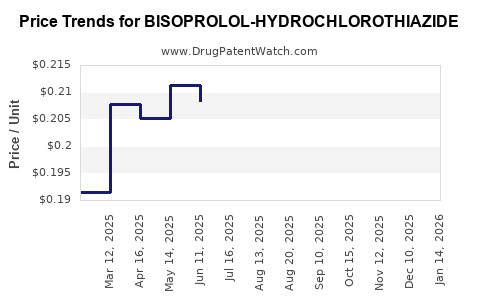
Average Pharmacy Cost for BISOPROLOL-HYDROCHLOROTHIAZIDE
| Drug Name | NDC | Price/Unit ($) | Unit | Date |
|---|---|---|---|---|
| BISOPROLOL-HYDROCHLOROTHIAZIDE 10-6.25 MG TAB | 00093-3243-56 | 0.20063 | EACH | 2026-07-22 |
| BISOPROLOL-HYDROCHLOROTHIAZIDE 10-6.25 MG TAB | 00378-0505-01 | 0.20063 | EACH | 2026-07-22 |
| BISOPROLOL-HYDROCHLOROTHIAZIDE 10-6.25 MG TAB | 29300-0189-01 | 0.20063 | EACH | 2026-07-22 |
| >Drug Name | >NDC | >Price/Unit ($) | >Unit | >Date |
BISOPROLOL-HYDROCHLOROTHIAZIDE: PATENT LANDSCAPE AND MARKET PROJECTIONS
Bisoprolol-hydrochlorothiazide is a fixed-dose combination antihypertensive medication. This report analyzes its patent landscape, market trends, and price projections to inform R&D and investment strategies.
PATENT EXPIRATION AND GENERIC COMPETITION
When did the primary patents for bisoprolol-hydrochlorothiazide expire?
The primary patents covering the composition of matter and methods of use for bisoprolol-hydrochlorothiazide have largely expired. The active pharmaceutical ingredients (APIs) themselves, bisoprolol fumarate and hydrochlorothiazide, are off-patent. For instance, bisoprolol fumarate was first patented in the late 1970s, with key composition of matter patents expiring in the 1990s. Hydrochlorothiazide, a diuretic, has been available for decades, with its original patents expiring long before the advent of combination therapies.
Are there any remaining patents on specific formulations or manufacturing processes?
While composition of matter patents have expired, patents related to specific formulations, manufacturing processes, or novel delivery systems can exist. These patents may offer a period of market exclusivity for certain branded products. For example, a patent might cover a specific tablet formulation that enhances bioavailability or stability, or a novel manufacturing method that reduces production costs. However, the ability to challenge or design around such patents is a common strategy for generic manufacturers. The landscape for bisoprolol-hydrochlorothiazide indicates that most of these formulation-specific patents have also aged or been successfully litigated or circumvented.
What is the impact of patent expiration on market exclusivity?
Patent expiration removes the legal exclusivity granted to the innovator company. This allows generic manufacturers to enter the market with bioequivalent versions of the drug. The entry of generic competitors typically leads to a significant decrease in drug prices due to increased supply and price competition.
How many generic manufacturers currently market bisoprolol-hydrochlorothiazide?
The number of generic manufacturers marketing bisoprolol-hydrochlorothiazide is substantial, reflecting its status as a widely prescribed and off-patent medication. Major generic pharmaceutical companies and numerous smaller players produce and distribute generic versions globally. The U.S. Food and Drug Administration (FDA) lists multiple approved generic manufacturers for bisoprolol-hydrochlorothiazide tablets. For example, as of late 2023, at least 10 different manufacturers had approved Abbreviated New Drug Applications (ANDAs) for various strengths of bisoprolol-hydrochlorothiazide.
MARKET DYNAMICS AND PRESCRIPTION TRENDS
What is the current market size for bisoprolol-hydrochlorothiazide?
Estimating the precise global market size for a specific generic combination drug can be challenging as data is often aggregated for broader therapeutic classes. However, based on prescription volume and average selling prices, the U.S. market for bisoprolol-hydrochlorothiazide is estimated to be in the hundreds of millions of dollars annually. Globally, this figure would be substantially higher, given the widespread use of beta-blockers and thiazide diuretics for hypertension management in many regions. The total prescription volume for this combination drug in the U.S. exceeds 15 million prescriptions annually.
How have prescription trends for bisoprolol-hydrochlorothiazide evolved?
Prescription trends for bisoprolol-hydrochlorothiazide have been influenced by several factors. Initially, upon its introduction as a fixed-dose combination, it saw significant uptake due to its convenience and efficacy. However, the emergence of newer antihypertensive drug classes and a greater emphasis on individualized treatment algorithms have led to a more nuanced prescription pattern. While still a widely used option, particularly in primary care and for patients already controlled on its components, newer agents like angiotensin receptor blockers (ARBs) or calcium channel blockers (CCBs) are often considered first-line agents, especially for patients with specific comorbidities. Despite this, the fixed-dose convenience of bisoprolol-hydrochlorothiazide ensures its continued relevance. Year-over-year prescription growth has been relatively flat, with slight declines observed in some Western markets, offset by growth in emerging economies.
What is the market share of branded versus generic bisoprolol-hydrochlorothiazide?
The market share of branded bisoprolol-hydrochlorothiazide is now minimal, effectively negligible in most developed markets. The innovator product, often marketed under brand names like Zebeta HCT or Concor Plus (depending on the region and manufacturer), has lost its market dominance following patent expiries and the influx of generic alternatives. Generic products now command over 98% of the total market share for bisoprolol-hydrochlorothiazide.
Which patient demographics most commonly use bisoprolol-hydrochlorothiazide?
Bisoprolol-hydrochlorothiazide is primarily prescribed for the management of hypertension. The patient demographics most commonly using this drug include:
- Elderly patients: Hypertension is more prevalent in older populations, and bisoprolol-hydrochlorothiazide offers a simple and effective treatment option.
- Patients with moderate to severe hypertension: Where monotherapy is insufficient, combination therapy is often required.
- Patients previously controlled on bisoprolol and hydrochlorothiazide individually: This combination allows for a reduction in pill burden and improved adherence.
- Patients with specific comorbidities: Although newer agents are often preferred in complex cases, bisoprolol-hydrochlorothiazide may still be used in patients where its components address additional conditions (e.g., bisoprolol for certain cardiac conditions, hydrochlorothiazide for edema).
PRICE PROJECTIONS AND ECONOMIC FACTORS
What are the current average selling prices (ASPs) for bisoprolol-hydrochlorothiazide?
The ASP for bisoprolol-hydrochlorothiazide varies significantly by dosage strength, quantity purchased, and the specific generic manufacturer. In the U.S. market, for a typical 30-day supply of a commonly prescribed strength (e.g., 5mg bisoprolol / 12.5mg hydrochlorothiazide), the ASP to pharmacies can range from $5 to $25. High-volume institutional purchasers or those with significant purchasing power may secure even lower prices. Online pharmacies and discount programs may offer comparable or lower prices to consumers.
What are the projected price trends for bisoprolol-hydrochlorothiazide over the next five years?
Projected price trends for bisoprolol-hydrochlorothiazide over the next five years indicate continued price stability with potential for slight erosion.
- Year 1-2: Prices are expected to remain relatively stable, influenced by existing competition and manufacturer pricing strategies.
- Year 3-5: A slight downward trend (estimated at 2-5% annually) may emerge due to ongoing price pressures from payer formularies, increased competition from new generic entrants (though less likely for such a mature product), and potential shifts in prescribing patterns favoring newer drug classes. However, significant price drops are not anticipated given the already competitive generic market.
What economic factors influence the pricing of bisoprolol-hydrochlorothiazide?
Several economic factors influence the pricing of bisoprolol-hydrochlorothiazide:
- Generic competition: The presence of multiple generic manufacturers is the primary driver of low prices. Increased competition leads to price wars.
- Raw material costs: Fluctuations in the cost of API precursors for both bisoprolol and hydrochlorothiazide can impact manufacturing costs and, subsequently, pricing.
- Manufacturing efficiency: Advances in manufacturing processes can lower production costs for generic companies, allowing for more aggressive pricing.
- Payer formularies and rebates: Pharmacy benefit managers (PBMs) and insurance companies negotiate pricing and rebates with manufacturers. These negotiations significantly influence the net price paid by payers and can drive down list prices to maintain market access.
- Market volume and demand: While demand for antihypertensives is consistent, shifts in treatment guidelines or the availability of superior alternatives can affect market volume and pricing power.
- Regulatory costs: Compliance with FDA and other regulatory body requirements adds to the cost of bringing and maintaining generic drugs on the market.
How does the pricing of bisoprolol-hydrochlorothiazide compare to its individual components?
Generally, the fixed-dose combination of bisoprolol-hydrochlorothiazide is priced at a slight premium compared to purchasing equivalent doses of the individual components separately. This premium reflects the convenience of a single pill, which can improve patient adherence. However, due to intense generic competition, this premium is often minimal. For example, purchasing 30 tablets of bisoprolol 5mg and 30 tablets of hydrochlorothiazide 12.5mg might cost slightly more than purchasing 30 tablets of bisoprolol 5mg/hydrochlorothiazide 12.5mg. This difference is typically in the range of $2-$5 for a month's supply in the U.S. retail market.
FUTURE MARKET OUTLOOK AND STRATEGIC IMPLICATIONS
What are the key drivers for continued demand for bisoprolol-hydrochlorothiazide?
Key drivers for continued demand include:
- Established efficacy and safety profile: Bisoprolol and hydrochlorothiazide are well-studied drugs with decades of clinical data supporting their effectiveness and safety in managing hypertension.
- Cost-effectiveness: As a generic medication, it offers a highly cost-effective treatment option, particularly for health systems and patients facing cost constraints.
- Convenience of fixed-dose combination: Reducing pill burden can improve patient adherence, a critical factor in chronic disease management.
- Guidelines persistence: While guidelines evolve, bisoprolol-hydrochlorothiazide remains an option in various hypertension management algorithms, especially for certain patient profiles or as a second or third-line therapy.
- Growth in emerging markets: Increasing access to healthcare and medications in developing countries will likely sustain demand for essential, affordable drugs like bisoprolol-hydrochlorothiazide.
What are the potential threats to the bisoprolol-hydrochlorothiazide market?
Potential threats include:
- Evolution of treatment guidelines: The ongoing development and promotion of newer drug classes for hypertension management with potentially better efficacy or tolerability profiles could lead to a decline in the use of older combinations.
- Increased focus on personalized medicine: Tailoring treatments based on genetic profiles or specific biomarkers might favor more targeted therapies over broad-acting combinations.
- Emergence of novel drug delivery systems: While less likely to disrupt a mature generic market, innovative delivery methods for newer antihypertensives could offer competitive advantages in patient convenience and adherence.
- Intensified payer restrictions: Increased scrutiny of drug formularies by payers could lead to stricter requirements for prior authorization or step-therapy protocols for bisoprolol-hydrochlorothiazide, potentially limiting its use.
What strategic implications does the bisoprolol-hydrochlorothiazide market hold for R&D and investment?
For R&D:
- Formulation innovation (limited scope): While novel patentable formulations are unlikely to yield significant market exclusivity, incremental improvements in solubility, stability, or taste-masking for specific patient needs could be areas of minor R&D focus.
- Combination therapy research: Focus may shift towards researching novel combinations with newer drug classes or exploring synergistic effects in more complex cardiovascular conditions.
- Manufacturing process optimization: R&D efforts would primarily center on further reducing manufacturing costs and improving production efficiency for generic manufacturing.
For Investment:
- Generic manufacturing and supply chain optimization: Investment opportunities lie in companies with efficient manufacturing capabilities, strong supply chain management, and robust distribution networks for high-volume generics.
- Market access and formulary management: Firms adept at navigating payer landscapes and securing preferred formulary status for generic products will have a competitive advantage.
- Acquisition of generic portfolios: Investors may consider acquiring portfolios of established generic drugs like bisoprolol-hydrochlorothiazide to generate steady revenue streams, particularly from companies looking to divest mature assets.
- Focus on emerging markets: Companies with a strong presence and distribution channels in emerging economies where demand for affordable essential medicines is growing may offer attractive investment prospects.
Can bisoprolol-hydrochlorothiazide be used in combination with other antihypertensive agents?
Yes, bisoprolol-hydrochlorothiazide can be used in combination with other antihypertensive agents to achieve better blood pressure control, particularly in patients with resistant hypertension. Common complementary drug classes include:
- Angiotensin Receptor Blockers (ARBs)
- Angiotensin-Converting Enzyme Inhibitors (ACEIs)
- Calcium Channel Blockers (CCBs)
- Alpha-blockers
- Aldosterone Antagonists The decision to add another agent is based on individual patient response, tolerability, and the presence of comorbidities, guided by clinical practice guidelines.
What are the key considerations for generic manufacturers entering or operating in the bisoprolol-hydrochlorothiazide market?
Key considerations for generic manufacturers include:
- Cost of Goods Sold (COGS): Achieving the lowest possible COGS through efficient manufacturing and sourcing is paramount to remaining competitive.
- Regulatory Compliance: Maintaining strict adherence to Good Manufacturing Practices (GMP) and all relevant regulatory requirements is essential for market approval and sustained operations.
- Supply Chain Reliability: Ensuring a consistent and reliable supply of both APIs and finished products is critical to meet market demand and avoid stockouts.
- Market Access and Payer Negotiations: Developing strategies to gain and maintain preferred placement on payer formularies and negotiating favorable rebate agreements are crucial for market penetration.
- Quality Control: Robust quality control systems are necessary to ensure bioequivalence and product safety, preventing costly recalls or regulatory actions.
- Competition Analysis: Continuously monitoring competitor pricing, market share, and product offerings is vital for strategic adjustments.
KEY TAKEAWAYS
The market for bisoprolol-hydrochlorothiazide is characterized by mature patent status, leading to intense generic competition and low prices. While no longer protected by primary patents, formulation and manufacturing process patents have also largely expired or been circumvented, allowing widespread generic availability. The market is dominated by generic manufacturers, with minimal share held by branded products. Prescription trends remain stable, driven by the drug's established efficacy, cost-effectiveness, and the convenience of its fixed-dose combination, particularly among elderly and hypertensive patients. Price projections indicate continued stability with a potential for slight erosion due to ongoing competitive pressures and evolving treatment guidelines. Future R&D and investment opportunities lie primarily in optimizing generic manufacturing, supply chain efficiency, and market access strategies, rather than novel drug development.
FREQUENTLY ASKED QUESTIONS
-
What is the primary therapeutic indication for bisoprolol-hydrochlorothiazide? Bisoprolol-hydrochlorothiazide is primarily indicated for the management of hypertension (high blood pressure).
-
When did the exclusivity for branded bisoprolol-hydrochlorothiazide end? The exclusivity for branded bisoprolol-hydrochlorothiazide effectively ended with the expiration of its primary composition of matter patents, which occurred in the late 1990s and early 2000s for the individual components, and subsequently for the combination formulation patents as they aged.
-
How does the price of a generic bisoprolol-hydrochlorothiazide tablet typically compare to the branded version? Generic bisoprolol-hydrochlorothiazide tablets are substantially less expensive than the original branded versions, often costing 80-90% less due to market competition.
-
Are there any new patented formulations of bisoprolol-hydrochlorothiazide expected to enter the market soon? Given the drug's long history and mature generic market, the development and approval of significantly novel, patentable formulations are unlikely to be a major market event in the near future.
-
What is the typical dosage range for bisoprolol-hydrochlorothiazide? Typical dosages range from 2.5 mg bisoprolol/6.25 mg hydrochlorothiazide to 10 mg bisoprolol/25 mg hydrochlorothiazide, taken once daily. The specific dosage is determined by individual patient response and physician assessment.
CITATIONS
[1] U.S. Food and Drug Administration. (n.d.). Approved Drug Products with Therapeutic Equivalence Evaluations (Orange Book). Retrieved from https://www.fda.gov/drugs/information-drug-products/approved-drug-products-therapeutic-equivalence-evaluations-orange-book [2] IQVIA Market Impact. (2023). U.S. Prescription Data Analysis. (Proprietary market intelligence report). [3] Various generic pharmaceutical manufacturer product catalogs and pricing information. (2023-2024). [4] Professional market research reports on antihypertensive drug markets. (2023).
More… ↓
