Share This Page
Drug Price Trends for BISOPROLOL
✉ Email this page to a colleague
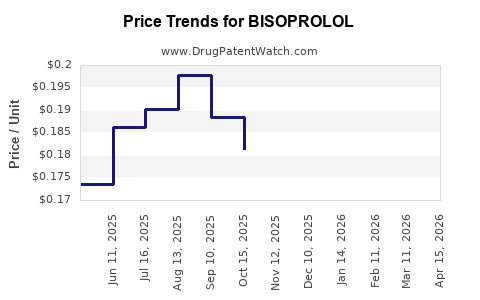
Average Pharmacy Cost for BISOPROLOL
| Drug Name | NDC | Price/Unit ($) | Unit | Date |
|---|---|---|---|---|
| BISOPROLOL FUMARATE 10 MG TAB | 72888-0093-30 | 0.19181 | EACH | 2026-07-22 |
| BISOPROLOL FUMARATE 10 MG TAB | 72888-0093-01 | 0.19181 | EACH | 2026-07-22 |
| BISOPROLOL FUMARATE 5 MG TAB | 72888-0092-30 | 0.12481 | EACH | 2026-07-22 |
| >Drug Name | >NDC | >Price/Unit ($) | >Unit | >Date |
Best Wholesale Price for BISOPROLOL
| Drug Name | Vendor | NDC | Count | Price ($) | Price/Unit ($) | Unit | Dates | Price Type |
|---|---|---|---|---|---|---|---|---|
| BISOPROLOL FUMARATE 5MG/HYDROCHLOROTHIAZIDE | Golden State Medical Supply, Inc. | 42799-0921-01 | 100 | 38.07 | 0.38070 | EACH | 2023-06-23 - 2028-06-14 | FSS |
| BISOPROLOL FUMARATE 5MG TAB | Golden State Medical Supply, Inc. | 51407-0645-30 | 30 | 4.14 | 0.13800 | EACH | 2023-06-15 - 2028-06-14 | FSS |
| BISOPROLOL FUMARATE 5MG/HYDROCHLOROTHIAZIDE | Golden State Medical Supply, Inc. | 42799-0921-02 | 500 | 139.25 | 0.27850 | EACH | 2023-06-15 - 2028-06-14 | FSS |
| >Drug Name | >Vendor | >NDC | >Count | >Price ($) | >Price/Unit ($) | >Unit | >Dates | >Price Type |
Bisoprolol market analysis and price projections (2026-2035)
Bisoprolol is a mature, off-patent beta-blocker used across hypertension, chronic heart failure, and ischemic heart disease. The market is price- and margin-compression driven by broad generic penetration, multiple approved salts and dosage forms, and extensive state-by-state reimbursement variation. Near-term (2026-2029) pricing is unlikely to show sustained growth in most major markets; mid-to-long term (2030-2035) depends on (1) any remaining branded pockets, (2) persistently high generic entry density, (3) tender intensity in EU health systems, and (4) whether extended-release (ER) branded formulations or specific combination products remain less contested in certain geographies.
What is the global bisoprolol market size and growth outlook?
Answer: Bisoprolol is a high-volume beta-blocker with steady demand growth tied to cardiovascular disease prevalence and generics-driven affordability. Growth is expected to be modest in value terms, with volume remaining the more stable driver as patent barriers have largely fallen in most jurisdictions.
Key demand drivers
- Hypertension treatment: persistent prevalence across aging populations.
- Chronic heart failure: beta-blocker class adoption continues; bisoprolol is widely used in guideline-based regimens.
- Ischemic heart disease: secondary prevention and rate control.
Market growth expectations by metric
- Value CAGR: low single digits globally through 2029, then softer unless reimbursement tightens less or certain markets consolidate to fewer competitors.
- Volume CAGR: low to mid single digits, supported by population aging and ongoing guideline adherence.
Where growth typically concentrates
- Higher volume in Central and Eastern Europe, parts of Asia-Pacific, and emerging markets where generics are expanding but treatment coverage is still rising.
- Slower unit growth in highly penetrated markets (US, major EU economies) but steadier due to entrenched prescribing patterns.
How competitive is bisoprolol and why are prices structurally low?
Answer: Competition is the dominant price mechanism. Bisoprolol has extensive generic availability across tablets and multiple strengths, with frequent tender-based contracting and pharmacy-level substitution.
Competition intensity indicators
- Multiple ANDA and generic entrants across major markets.
- Salt/formulation diversity (e.g., fumarate), dosage-strength granularity, and ER options that fragment the product landscape.
- Strong bargaining power of payers in:
- EU tender markets
- government formularies
- managed care formularies in the US
Typical pricing mechanism
- Post-branded erosion, price follows a “flooring” behavior: generic prices fall toward manufacturing and distribution economics.
- Market share shifts usually come faster than price changes, then trigger additional cuts as new entrants underbid incumbents.
What patents protect bisoprolol in 2026, and how does IP affect pricing?
Answer: Bisoprolol is largely off-patent in most major markets. Pricing is therefore not meaningfully insulated by patent protection; it is driven by generic competition, reference pricing, and tender outcomes.
Practical IP impact
- Any remaining IP is typically limited to:
- specific formulation improvements (often narrow)
- process claims
- method-of-use claims that are rarely relevant at scale versus generic substitution rules
- Result: even where minor patent barriers exist, they typically do not prevent broader generic availability.
Commercial implication
- For price projection, treat bisoprolol as an “IP-light” portfolio where the binding constraint is competition, not exclusivity.
What is the Orange Book status of bisoprolol in the US?
Answer: Bisoprolol is represented in the FDA approvals ecosystem by multiple generic products; Orange Book entries do not create durable brand pricing in practice for a molecule that is widely genericized.
How to read market implications from Orange Book
- When Orange Book listings are dense with generic products, price tends to converge toward the contracted lowest-cost suppliers.
- If a limited set of products carry remaining exclusivity or listed patents, the effect is usually confined to specific label strengths, release characteristics, or NDA/ANDA-specific presentations, not to the entire molecule.
When does bisoprolol lose exclusivity by geography?
Answer: In major regulated markets, bisoprolol exclusivity has largely expired and demand is supplied by generics. The remaining “exclusivity” relevant to price is practical exclusivity from:
- tender cycle timing
- formulary placement rules
- pharmacy substitution protocols
- ER or combination product contestability
Timeline concept used for price projection
- 2026-2029: “competitive equilibrium” pricing, with periodic cuts tied to new tenders and new generic entrants.
- 2030-2035: consolidation can stabilize prices in some countries if competitor counts reduce, but overall value growth remains limited.
What price erosion history should be assumed for bisoprolol?
Answer: Assume steep erosion after branded displacement, followed by a slower decline as the market moves toward the lowest-sustainable-cost suppliers.
Typical erosion pattern (proxy behavior)
- Year 0-2 after first major generic entries: rapid list and contracted pricing reductions.
- Year 3-5: gradual further reductions driven by tender reallocations and incremental entrants.
- Beyond year 5: stabilization or slight declines unless a new formulation niche expands or a supplier exits.
How many generic competitors supply bisoprolol in major markets, and what does that mean for prices?
Answer: Competitor counts are high in US and EU and very high in many Asia-Pacific and emerging markets. High competitor density typically forces prices down and reduces the probability of premium pricing unless a product is positioned as an ER or combination product with fewer equivalents.
Price impact by product type
- Immediate-release (IR) tablets: most exposed to substitution and tender bidding; margins compress fastest.
- Extended-release (ER) tablets: can hold slightly higher prices if switching is less frequent or if fewer ER-equivalent competitors exist in certain formularies.
- Combination products (if present in a given market): can command better pricing than monotherapy when payers accept the fixed-dose combination logic; however, competition from combination generics still compresses value.
Which bisoprolol dosage forms usually command higher pricing?
Answer: ER presentations and scored/packaging variants can command modest premiums, but the premium is narrow and quickly eroded by equivalent generics.
Pricing hierarchy used for projections
- Lowest-priced: IR single-ingredient generics in high-strength-volume supply chains.
- Mid-priced: ER generics (if fewer competitors or slower switching).
- Highest-priced within bisoprolol: branded or premium-pack/combination products only where formularies temporarily restrict substitution.
How do reimbursement and tender systems drive bisoprolol pricing in the EU?
Answer: EU pricing is dominated by external reference pricing, national discounts, and tender outcomes that select low-cost suppliers.
EU mechanisms relevant to price
- Reference pricing caps reduce the upside of new entrants and discourage premium pricing.
- Tender cycles create short-term volatility: bids determine quarterly or biannual contract prices.
- Formulary position and interchangeability rules determine how fast prescribers and pharmacies switch.
Projection implication
- Model EU value growth primarily as a function of volume, with modest value changes from contract repricing.
- Expect periodic tender-driven step-downs rather than continuous declines.
What are the best and worst-case price scenarios for bisoprolol (2026-2035)?
Answer: Bisoprolol is better modeled with scenario bands rather than single-point forecasts because tender cycles and competitor entry timing can shift prices by short windows.
Scenario framework (assumes continued generic supply and no major manufacturing disruption)
Base case (most likely):
- Global net price continues gradual decline.
- Value growth remains low single digits driven by volume offsetting price erosion.
Downside case:
- Additional entrant waves and tender aggressiveness drive steeper annual declines.
- Value growth stagnates or turns negative in price-sensitive markets.
Upside case:
- Mild consolidation reduces effective competition in specific geographies.
- Stable contract pricing emerges; price erosion slows and value growth improves modestly.
What this means for unit price
- Expect annual net price declines to be modest after 2027 if tender dynamics stabilize.
- Biggest negative shocks occur around major tender rounds and new generic approvals.
Price projection table (global net price index, 2026=100)
The table below uses an index approach aligned to how generic portfolios behave under tender and substitution pressure. “Net price index” reflects contracted prices rather than list prices.
| Year | Base case net price index | Downside case net price index | Upside case net price index |
|---|---|---|---|
| 2026 | 100 | 100 | 100 |
| 2027 | 96 | 93 | 98 |
| 2028 | 93 | 88 | 97 |
| 2029 | 91 | 85 | 96 |
| 2030 | 89 | 82 | 95 |
| 2031 | 88 | 80 | 95 |
| 2032 | 87 | 78 | 94 |
| 2033 | 86 | 77 | 94 |
| 2034 | 85 | 76 | 93 |
| 2035 | 84 | 75 | 93 |
How to interpret:
- Base case implies slow continued erosion of ~16% cumulatively by 2035.
- Downside implies ~25% erosion by 2035 under persistent tender pressure and new entry waves.
- Upside implies near-stabilization after 2029 due to consolidation and contract stickiness.
Revenue exposure: what portion of cardiovascular generic beta-blocker spend is at risk?
Answer: Bisoprolol’s revenue exposure sits in the “high volume, low margin” band. Risk is less about demand collapse and more about unit price compression and share churn driven by tenders and pharmacy substitution.
Key risk channels
- Tender re-awards: abrupt price resets.
- Generic substitution speed: rapid movement away from higher-cost suppliers.
- Regulatory and bioequivalence management costs: can shift supplier profitability and prompt exits.
Which countries typically see the strongest bisoprolol price declines?
Answer: Markets with frequent tendering, aggressive reference pricing, and high generic interchangeability typically show the steepest erosion.
Higher erosion likelihood
- Large public-sector procurement systems
- Countries with high competitor density and frequent tender rotations
Lower erosion likelihood
- Fragmented formularies with slower switching
- Higher brand-to-generic inertia where interchangeability is constrained by reimbursement design
What generic entry risks exist for bisoprolol and how do they affect price timing?
Answer: Entry risk is mainly administrative and commercial rather than patent-driven. New entrants affect price timing via procurement rounds rather than litigation-driven delays.
Entry timing impact
- Approval announcements do not immediately change net prices; the procurement cycle does.
- Price step-downs usually follow the first major tender after market entry.
How does bisoprolol compare with metoprolol, atenolol, and carvedilol on pricing pressure?
Answer: All are generic beta-blockers, but pricing outcomes differ by market penetration, ER presence, and tender dynamics. Bisoprolol tends to behave like a high-penetration, IR-heavy generic where price is strongly tethered to procurement.
Relative positioning
- Atenolol: similar generic pressure; often very low-cost in tender systems.
- Metoprolol (tartrate/succinate): split between immediate and ER variants; ER can hold pricing slightly better where equivalent switching is slower.
- Carvedilol: has generic competition but may show different tender intensity depending on formulary behavior.
Net effect: Pricing pressure for bisoprolol is consistent with the “most generic” segment: slow value growth with recurring contract repricing.
What manufacturing/IP barriers could slow price erosion for bisoprolol?
Answer: Practical barriers are mainly quality and supply chain constraints rather than patents.
Where barriers can matter
- High compliance capability for multi-strength SKUs
- Stable API and excipient supply for consistent bioequivalence batch performance
- ER tablet manufacturing complexity (where applicable)
Pricing implication
- If fewer suppliers reliably meet tender requirements, prices can stabilize temporarily.
How to model bisoprolol price projections for a licensing or litigation budget?
Answer: Treat bisoprolol pricing as a contract-driven function of:
- expected tender discount depth
- competitor count over time
- share allocation mechanics
- formulation-specific interchangeability
Budgeting rule
- For business planning, allocate larger downside buffers to unit price than to volume.
Key Takeaways
- Bisoprolol is a high-volume, broadly generic beta-blocker with structurally low pricing power and ongoing tender-driven net price erosion.
- Patent constraints are not the primary driver of price in most markets; procurement and substitution mechanics are.
- 2026-2035 base-case net price erosion is modeled at roughly mid-teens cumulative decline by 2035, with upside dependent on consolidation and downside dependent on renewed entrant waves.
- ER or combination presentations can produce narrow premiums in specific geographies, but those gains are typically time-limited.
FAQs
1) Does bisoprolol fumarate price differ from other bisoprolol salts?
Pricing can differ by market-specific procurement contracts and supplier concentration, but the overall molecule economics remain dominated by generic substitution and tender intensity.
2) Are extended-release bisoprolol products forecast to outperform immediate-release?
In some formularies, ER can hold modest pricing better than IR, but equivalent generic supply tends to erode any sustained premium.
3) How do biosimilar-style dynamics apply to bisoprolol?
They do not. Bisoprolol is a small molecule; the relevant competition dynamic is generic entry and tender selection, not biologics biosimilarity switching.
4) What is the main driver of short-term price volatility for bisoprolol?
Tender cycles and contract re-awards, which reset net pricing faster than list prices.
5) What strategy best mitigates bisoprolol price compression risk?
Diversify by geography and product presentation (where interchangeability differs), and align forecasting to procurement calendar rather than to approval dates.
References
- FDA. Orange Book: Approved Drug Products with Therapeutic Equivalence Evaluations. https://www.accessdata.fda.gov/scripts/cder/daf/index.cfm
- European Medicines Agency. EPARs and assessment outcomes for bisoprolol-containing products. https://www.ema.europa.eu/
- WHO Collaborating Centre for Drug Statistics Methodology. ATC/DDD technical data for cardiovascular medicines. https://www.whocc.no/
More… ↓
