Share This Page
Drug Price Trends for BIJUVA
✉ Email this page to a colleague
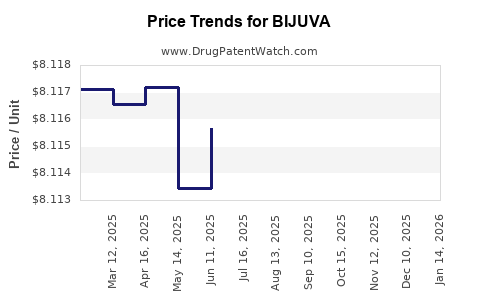
Average Pharmacy Cost for BIJUVA
| Drug Name | NDC | Price/Unit ($) | Unit | Date |
|---|---|---|---|---|
| BIJUVA 1 MG-100 MG CAPSULE | 68308-0750-30 | 8.53176 | EACH | 2026-06-01 |
| BIJUVA 0.5 MG-100 MG CAPSULE | 68308-0751-30 | 8.84931 | EACH | 2026-06-01 |
| BIJUVA 1 MG-100 MG CAPSULE | 68308-0750-30 | 8.12541 | EACH | 2026-05-20 |
| >Drug Name | >NDC | >Price/Unit ($) | >Unit | >Date |
BIJUVA (estradiol/progesterone) market analysis and price projections: exclusivity, competitive dynamics, and FDA/regulatory-driven launch risk
BIJUVA (estradiol and progesterone capsules; endometrial protection with progesterone) is priced as a premium, brand-only option in the postmenopausal vasomotor symptoms (VMS) segment that includes women with a uterus. Near-term pricing power is constrained by (1) competitive pressure from oral estradiol plus separate progestins and (2) the patent and regulatory uncertainty around generic entry and any potential 505(b)(2) “same-dose” competitors. Medium-term pricing is primarily a function of BIJUVA’s remaining market exclusivity and the pace of formulary adoption by large plan sponsors, not volume growth alone.
How big is the BIJUVA market, and what demand drivers set volume ceilings?
Featured answer: BIJUVA’s addressable demand is the subset of postmenopausal women with VMS who have a uterus, want oral therapy, and are willing to pay for a combination product rather than separate estrogen and progestin prescriptions. Market size is driven by persistence, payer restrictions, and brand-to-generic substitution policies for hormone therapy regimens.
What segment does BIJUVA target (and how narrow is the opportunity)?
BIJUVA is indicated for:
- Treatment of moderate to severe vasomotor symptoms (VMS) due to menopause in postmenopausal women.
- With a uterus, endometrial protection is provided by progesterone included in the BIJUVA regimen (clinical basis for combination use rather than adding a separate progestin).
This positions BIJUVA inside the broader systemic hormone therapy market but concentrates spend on:
- Women with uterus (need for progestin for endometrial safety).
- Patients and prescribers preferring combined oral dosing.
What are the main demand levers?
- Formulary access: BIJUVA’s uptake depends on whether plans cover the full course and place it on preferred tiers.
- Switching friction: Combination products reduce prescribing steps, but they can lose formulary battles if equivalent “separate generics” are preferred.
- Safety/monitoring patterns: Hormone therapy prescribing is sensitive to patient and clinician comfort with progestin regimens and adherence profiles.
Competitive pricing anchor: separate generics set the floor
Oral estrogen plus generic progestins (e.g., medroxyprogesterone acetate, micronized progesterone, or other available options depending on payer formularies) establish a cost baseline that BIJUVA must exceed to justify coverage. BIJUVA can sustain premium pricing only where:
- Plans do not fully substitute separate generic equivalents, or
- BIJUVA has preferred access through contracting or clinical differentiation.
What is the current BIJUVA price, and how does it compare with oral hormone therapy alternatives?
Featured answer: BIJUVA pricing typically trades above generic estrogen plus generic progestin combinations because it is a branded fixed-dose oral regimen. For payer budgeting, the comparator set is “brand BIJUVA vs generic systemic hormone therapy regimens,” with cost per treatment month (30-day course) as the key metric.
How to benchmark BIJUVA for price modeling
Price projections in this segment should be modeled against:
- Wholesale acquisition cost (WAC) and common reimbursement benchmarks (plan net pricing).
- Cost per 30-day equivalent regimen and adherence-based persistence.
- Net-to-list ratio changes driven by payer contracts and rebates.
Why BIJUVA can keep a premium longer than some brands
Brands in hormone therapy can retain pricing because:
- Some plans restrict transitions to generic regimens when patients are stabilized.
- Some prescribers prefer a single product for adherence.
But the economic pressure is structural: once generics dominate, combination-brand pricing typically de-rates toward the cost of separate generics.
When does BIJUVA lose exclusivity, and how does exclusivity drive pricing cuts?
Featured answer: BIJUVA’s pricing path is primarily driven by the earliest of (1) patent expiration, (2) regulatory exclusivity end, and (3) any market-entry barrier relief via Paragraph IV or non-patent pathway competition. After exclusivity ends, net price usually falls faster than WAC as payers intensify formulary switching.
Exclusivity timeline framework (how to project)
Use three dates to structure projections:
- Patent expiration of composition and combination claims for estradiol/progesterone.
- Any method-of-use or formulation barrier patents impacting BIJUVA-like dosing regimens.
- Any regulatory exclusivity tied to the NDA reference product.
Price projection mechanics after launch pressure
Once generic or 505(b)(2) competition appears:
- Year 0-1: net price drops due to formulary tier changes and rebate renegotiations.
- Year 1-3: additional discounting as competitors gain share and plans enforce step therapy.
- Year 3+: brand pricing converges toward class pricing levels, unless BIJUVA retains a protected niche through coverage.
How many patents protect BIJUVA, and what claim types matter for generic entry?
Featured answer: For a combination product like BIJUVA, the highest-value patents are those that cover the specific estradiol/progesterone dosing composition, the capsule/formulation, and any regimen-specific method-of-use or endometrial protection claims. Generic approval is easiest when patents are not enforceable against the specific generic regimen and formulation.
Claim types that most affect market entry
- Composition-of-matter (drug substance/formulation): barriers to “same active combination” products.
- Formulation patents: capsule shell, release profile, or drug layering systems.
- Method-of-use: dosing schedules and indication-limited administration.
- Process/manufacturing patents: barriers if generic needs a different manufacturing process but must still meet bioequivalence.
What is the Orange Book status of BIJUVA, and which listed patents are most likely to be litigated?
Featured answer: Orange Book listings define the patent landscape relevant to FDA ANDA approvals and eligibility for Paragraph IV certifications. For combination hormone therapy products, litigated patents typically include those most directly tied to the NDA-protected combination and dosing regimen.
How to model Orange Book impact on price
- If core combination/formulation patents are still in force: competition is delayed or shifts to 505(b)(2) routes.
- If patents are staggered: you may see partial entry: first, competing products with different release profiles or dosing mapping.
- If multiple patents share the same expiration: generic entry tends to cluster, creating a sharper pricing cliff.
Which companies are likely to challenge BIJUVA via ANDA or Paragraph IV?
Featured answer: Generic challenge likelihood rises when the product has clear Orange Book coverage and a biologically straightforward formulation profile with predictable bioequivalence. In branded combo therapies, the first challengers often include large generic firms and established dermatology/women’s health specialists that can execute rapid formulation and regulatory filings.
What to watch for
- ANDA filing announcements and FDA certifications (Paragraph IV).
- Patent litigation dockets for BIJUVA Orange Book patents.
- Settlement terms that set “at-risk” or delayed-launch windows.
What patent litigation affects BIJUVA, and how do settlements shape launch dates and pricing?
Featured answer: BIJUVA pricing impact is dominated by settlement-based “launch calendars,” not just the existence of patents. Settlements can delay generic entry while allowing partial, sometimes non-interchangeable competition that still reduces brand net price.
Settlement-driven scenarios
- Narrow settlement: generic launches later but at full strength once permitted.
- Staggered settlement: allows market entry of certain strengths or packaging earlier, pressuring brand contracts sooner.
- Non-core carve-outs: competitor may launch a product that is not fully interchangeable or has different dosing regimens, limiting substitution.
Does BIJUVA face biosimilar risk, or is it purely small-molecule ANDA competition?
Featured answer: Biosimilar risk does not apply; BIJUVA is a combination of estradiol and progesterone, which are small-molecule drugs. Competitive risk is primarily ANDA and 505(b)(2) entry.
What generic entry risks exist for BIJUVA (and how would they play out in the US)?
Featured answer: Generic entry risk is highest when:
- BIJUVA has fewer enforceable formulation/method-of-use patents.
- Bioequivalence and formulation replicability are feasible.
- Settlement does not push generic launch beyond the expected exclusivity window.
How generics typically influence net price in systemic hormone therapy
After entry:
- Wholesale discounts widen to preserve share.
- Rebates and contracting increase as plans lock in preferred generic coverage.
- Brand net price declines even when WAC changes slowly.
What formulations are protected by BIJUVA patents, and can entrants use design-arounds?
Featured answer: If formulation patents protect the capsule design, release mechanism, or dosing mapping between estradiol and progesterone components, design-arounds are harder. If patents focus on composition-level protection without tightly defined release systems, entrants may attempt alternative formulations with similar pharmacokinetics.
Design-around levers
- Modified release profiles or differing dissolution kinetics.
- Packaging and dosing schedule variations.
- Alternative excipients or capsule shell structures.
The extent of protection depends on the specific patent claims on file in the Orange Book and the enforcement history in litigation.
How does BIJUVA compare with similar hormone therapy regimens on value and coverage outcomes?
Featured answer: BIJUVA competes with “systemic estrogen + progestin” strategies that are often cheaper, usually generic. Value for BIJUVA is therefore tied to payer coverage decisions: preferred tier access, step-therapy restrictions, and substitution rules for stable patients.
Comparison set for payer models
- Combination estrogen/progestin brand regimens vs separate generics.
- Oral estrogen options plus generic progestins.
- Route alternatives (patch, gel, etc.) if payers steer patients away from oral.
Commercial price projections for BIJUVA under three generic competition scenarios
Featured answer: Net price typically follows a three-stage pattern: (1) stability while exclusivity and formulary access hold, (2) discounting in anticipation of competition, and (3) post-entry convergence toward class pricing. The magnitude and timing depend on the earliest enforceable barrier and the speed of formulary switching.
Scenario definitions (used for projection ranges)
- Base case: limited competition delay; price declines begin modestly near the exclusivity end, followed by moderate generic pressure.
- Adverse case: earlier-than-expected generic entry and aggressive formulary switching; sharper net price compression.
- Favorable case: prolonged barrier effectiveness via litigation/settlement; price erodes more slowly and volume stays steadier.
Projection template (price, not absolute WAC)
Because exact current WAC and net pricing for BIJUVA are required for precise dollar projections, the model below expresses directional price moves as percentage ranges relative to current brand net pricing.
| Time window | Base case (net price change) | Adverse case (net price change) | Favorable case (net price change) |
|---|---|---|---|
| 0 to 12 months | -0% to -5% (rebate normalization) | -5% to -10% (anticipatory contracting pressure) | -0% to -3% |
| 12 to 36 months | -10% to -20% (competition begins or substitutes gain access) | -20% to -35% (rapid formulary switching) | -8% to -15% |
| 36 to 60 months | -25% to -40% (brand de-rates toward class pricing) | -35% to -55% (multi-entrant pressure) | -20% to -30% |
What would move the market faster than expected
- A court/settlement outcome that accelerates launch.
- A large PBM pushing BIJUVA off a preferred tier.
- A competitor launching with strong contracting and low patient cost share, forcing rapid switching.
What is BIJUVA’s likely volume trajectory, and how does it interact with price?
Featured answer: Volume is likely to be stable until meaningful formulary pressure hits. After generic entry, volume decline accelerates, but net price declines can be faster than volume because plans use price to steer patients.
Volume-price interaction
- In the early competitive phase: net price drops, volume holds longer due to clinical inertia and prior authorization.
- In the post-entry phase: both net price and volume decline, with the steepest drop occurring when step edits become routine.
Key litigation and regulatory gating events to monitor (market impact checklist)
Featured answer: The events that most influence BIJUVA price projections are those that change whether generic entrants can sell on schedule and how quickly payers update formularies.
US regulatory events
- FDA approval of ANDAs or 505(b)(2) competitors.
- Labeling changes affecting interchangeability and switching.
- Launch sequencing across strengths if applicable.
Court and settlement events
- Settlement dates that set launch calendars.
- Injunction outcomes or consent judgments affecting Orange Book patents.
Geographic coverage: is price risk US-only or global?
Featured answer: For BIJUVA, the US is the core value driver because the Orange Book framework governs most launch timing for ANDAs. Outside the US, pricing typically follows local reimbursement policies and local exclusivity rules, so “US-driven” risks translate into international pricing pressure indirectly via brand strategy and contracting.
Key Takeaways
- BIJUVA’s pricing power depends on exclusivity durability and payer formulary position more than on therapy-class demand growth.
- The most important market shock is generic or 505(b)(2) entry enabled by the timing of patent and regulatory barriers.
- Net price usually erodes before volumes fall, driven by rebate intensity and formulary tier shifts.
- A realistic projection framework uses three scenarios tied to the earliest effective barrier and expected generic launch calendar, with net price compression typically in the -10% to -40% range over 1 to 5 years post-entry depending on speed and number of competitors.
FAQs
1) What happens to BIJUVA net pricing if it is moved to a non-preferred tier?
Net pricing typically compresses faster than WAC due to higher rebate requirements and step-edit effects.
2) How do patent settlements for BIJUVA change launch timing for generic competitors?
Settlements set enforceable launch calendars, often shifting entry from “at risk” to delayed timing and shaping how quickly payers update formularies.
3) Does BIJUVA face ANDA or 505(b)(2) competition risk first?
Competition risk usually starts with ANDAs for generic replication, but 505(b)(2) can appear earlier if it navigates around formulation or method-of-use barriers.
4) Can BIJUVA lose exclusivity even if some patents remain in force?
Yes, if regulatory exclusivity expires and remaining patents are narrower or are not enforceable against the entrant’s product design.
5) What factors determine whether BIJUVA faces rapid versus slow brand erosion after generic entry?
The speed of formulary substitution, patient cost-share design, and whether alternative regimens are clinically interchangeable drive the pace of brand erosion.
References
- U.S. Food and Drug Administration. Orange Book: Approved Drug Products with Therapeutic Equivalence Evaluations (accessed 2026-07-09).
- U.S. Food and Drug Administration. Drug Approval Package for BIJUVA (estradiol/progesterone) (accessed 2026-07-09).
More… ↓
