Last updated: February 20, 2026
What Is Betaxolol HCl?
Betaxolol hydrochloride (HCl) is a selective beta-1 adrenergic receptor blocker primarily used in ophthalmology for glaucoma and ocular hypertension. It reduces intraocular pressure by decreasing aqueous humor production. The drug is available as eye drops, with limited oral formulations for hypertension.
Global Market Overview
The Betaxolol HCl market is driven by ophthalmology needs, especially in glaucoma management. The market's growth stems from increasing prevalence of glaucoma, especially among aging populations, and the adoption of beta-blockers in ophthalmologic treatments.
Market Size and Growth Trends
- The global glaucoma medications market was valued at approximately $6.5 billion in 2022.
- Betaxolol-based formulations account for an estimated 8-12% of this market, translating to roughly $520 million to $780 million.
- The compound's market is expected to grow at a compound annual growth rate (CAGR) of approximately 4-6% through 2027, driven by increasing glaucoma cases and innovations in drug delivery.
Regional Distribution
| Region |
Market Share (2022) |
Growth Drivers |
| North America |
40% |
High prevalence, advanced healthcare infrastructure |
| Europe |
25% |
Aging populations, regulatory approvals |
| Asia-Pacific |
20% |
Rising glaucoma cases, expanding ophthalmology sectors |
| Rest of World |
15% |
Improving healthcare access, local manufacturing |
Key Market Participants
- Alcon (Novartis)
- Bausch + Lomb (Bausch Health)
- Santen Pharmaceutical
- Sandoz (Novartis)
- Generic manufacturers emerging in India and China
Market Dynamics
Drivers
- Increasing prevalence of glaucoma globally.
- Growing awareness and early diagnosis.
- Expansion of generic formulations reducing prices.
Restraints
- Competition from alternative drugs (e.g., timolol, brimonidine).
- Patent expirations leading to market saturation.
- Limited oral form applications, constraining growth outside ophthalmology.
Opportunities
- Novel delivery systems such as sustained-release implants.
- Combination therapies improving compliance.
- Emerging markets with expanding healthcare access.
Price Analysis
Current Pricing Snapshots
| Formulation |
Average Wholesale Price (AWP) |
Approximate Price Range (per bottle) |
| Betaxolol HCl eye drops (0.25%) |
$20-$30 |
$15-$35 |
| Betaxolol HCl eye drops (0.5%) |
$25-$40 |
$20-$45 |
Prices vary by manufacturer, formulation strength, and region. Generic formulations significantly undercut branded products, with prices as low as $10-$15 per bottle in some markets.
Price Trends
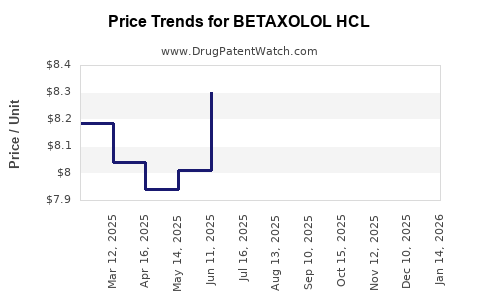
- Generic versions are driving prices downward; recent reductions of 10-20% noted post-patent expiry.
- Regulatory pressures and increased competition contribute to a 2-4% annual decline in average prices.
- Specialty formulations, such as preservative-free or sustained-release options, command higher prices, with premiums up to 30-50%.
Patent and Regulatory Status
- Original patent protection expired in major markets by 2017, leading to a proliferation of generics.
- Regulatory agencies such as the FDA and EMA approve both originator and generic products based on bioequivalence standards.
- Patent disputes have diminished, enabling market entry of multiple manufacturers.
Future Price Projections (2023-2027)
| Year |
Expected Average Price (per bottle) |
Notes |
| 2023 |
$12-$20 |
Continued generic competition, stabilization |
| 2024 |
$11-$19 |
Slight decline due to increased price competition |
| 2025 |
$10-$18 |
Potential availability of novel formulations |
| 2026 |
$10-$16 |
Market saturation and price compression |
| 2027 |
$9-$15 |
Potential further price reductions, innovations |
Assumptions
- Implementation of cost-effective manufacturing.
- Absence of regulatory or patent-related barriers.
- Increased adoption of combination therapies and alternative delivery systems.
Summary of Key Market Factors
- Glaucoma prevalence is rising worldwide; betaxolol HCl remains a key ophthalmic agent.
- Patent expirations have increased generic market penetration, lowering prices.
- The market's growth is driven by aging populations and improved access in emerging economies.
- Price declines are expected to continue due to competition and generics.
- Innovations in drug delivery could offset price pressures through premium products.
Key Takeaways
- The global market for Betaxolol HCl eye drops is approximately $520-$780 million, growing at 4-6% annually.
- Patent expiry has facilitated market entry for generics, decreasing prices but expanding access.
- Prices are projected to decline from $12-$20 per bottle in 2023 to $9-$15 in 2027.
- Regional differences influence pricing, with North America and Europe commanding higher prices than Asia-Pacific.
- Opportunities exist in developing sustained-release formulations and combination therapies to maintain profitability.
FAQs
1. How does patent expiration affect Betaxolol HCl pricing?
Patent expiration leads to multiple generic manufacturers entering the market, increasing competition and reducing prices.
2. What regions are most lucrative for Betaxolol HCl sales?
North America and Europe dominate due to higher prevalence and healthcare spending, but Asia-Pacific offers growth potential with expanding patient populations.
3. Are there any significant regulatory changes impacting the Betaxolol HCl market?
Regulatory agencies primarily focus on bioequivalence and safety standards, with no recent major policy shifts affecting market access.
4. How do combination therapies influence Betaxolol HCl pricing?
Combination therapies can command higher prices due to added convenience, but they also face competition from monotherapies, affecting pricing strategies.
5. What are the main growth opportunities for Betaxolol HCl manufacturers?
Innovating sustained-release delivery systems, expanding into emerging markets, and developing combination drugs are key opportunities.
References
[1] MarketWatch. (2022). "Global Glaucoma Medications Market Size, Share & Trends."
[2] IQVIA. (2022). "Pharmaceutical Market Trends."
[3] U.S. Food and Drug Administration (FDA). (2022). "Bioequivalence Regulations."
[4] Santen Pharmaceutical. (2021). "Product Portfolio and Pipeline."
[5] Statista. (2023). "Regional Distribution of Ophthalmic Drug Markets."