Last updated: February 16, 2026
Overview of Betaxolol
Betaxolol is a selective beta-1 adrenergic receptor blocker primarily prescribed for hypertension and glaucoma. It is available in both ophthalmic and oral forms. The drug is marketed under several brand names, including Betoptic for eye drops and various generic versions.
Market Landscape
The global beta-blocker market, valued at approximately $5.4 billion in 2022, is projected to grow at a compound annual growth rate (CAGR) of 2.5% through 2030. Betaxolol’s market share depends heavily on its ophthalmic applications, typically favored among patients with contraindications for non-selective beta-blockers.
Current Market Trends
-
Growing prevalence of hypertension and glaucoma: The number of hypertension cases exceeds 1.2 billion worldwide, with glaucoma affecting over 76 million people globally.
-
Shift toward selective beta-blockers: Increased preference for cardioselective agents like betaxolol due to reduced side effects.
-
Brand vs. generic: Market penetration of generic versions is high, influencing pricing and profit margins.
Key Market Players
Major pharmaceutical companies producing betaxolol include:
- Alcon (Alcon Laboratories, Inc.)
- Santen Pharmaceutical Co.
- Generic manufacturers in India, China, and other emerging markets.
Pricing Analysis
Current Price Range
| Product Type |
Approximate Price (USD) per unit |
Notes |
| Ophthalmic Betaxolol (10 mL bottle) |
$15–$30 |
Varies by brand and purchase volume |
| Generic Ophthalmic |
$8–$15 |
Widely available |
| Oral Betaxolol (20 mg tablets) |
$0.20–$0.50 per tablet |
Differing by manufacturer |
Price Dynamics
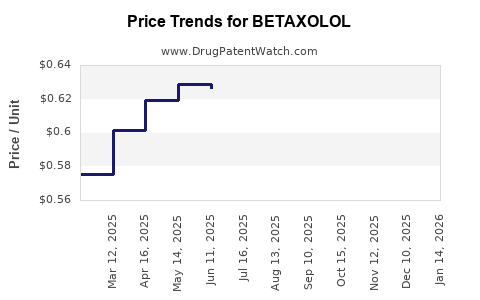
- Generic ophthalmic betaxolol sells at roughly 50-70% lower than branded versions.
- The introduction of biosimilars and generics in emerging markets has driven prices downward.
- Patent expirations for branded formulations are imminent or achieved in key markets, increasing price competition.
Projections for 2023–2030
| Year |
Expected Price Range for Generics (USD) |
Comments |
| 2023 |
$7–$12 |
Market saturation, stable generic supply |
| 2025 |
$6–$10 |
Increased market penetration, biosimilar entry |
| 2030 |
$5–$8 |
Fully commoditized prices, volume-driven margins |
Factors Influencing Future Prices
- Patent expiries: Expected for branded betaxolol products in Europe and North America by 2024–2025.
- Regulatory approvals: Faster approval of generics in emerging markets decreases prices.
- Manufacturing costs: Reduction due to advances in production and supply chain efficiencies.
Regulatory and Patent Considerations
- Patent Expirations: Last patent in the US expired in 2018, leading to increased generic competition (per U.S. Patent and Trademark Office).
- Regulatory pathways: Abbreviated New Drug Applications (ANDAs) facilitate generic entry, supporting price reductions.
- Market exclusivity: Brand dominance diminishes as biosimilars enter markets, pressuring prices downward.
Market Drivers and Barriers
Driving growth:
- Rising prevalence of chronic hypertension and glaucoma.
- Preference for cardioselective beta-blockers.
Hampering growth:
- Competition from other beta-blockers like atenolol and metoprolol.
- Pricing pressures from increasing generic manufacturing.
- Limited indications beyond hypertension and glaucoma.
Key Takeaways
- The beta-blocker segment, including betaxolol, is experiencing gradual growth driven by increasing disease prevalence.
- Price competition heavily favors generics, with long-term prices projected to decline.
- Patent expirations and regulatory pathways will sustain downward pressure on prices.
- The ophthalmic form remains the primary driver of betaxolol sales, with price ranges steadily decreasing through 2030.
- Emerging markets present significant opportunities for volume growth despite lower margins.
FAQs
1. Will betaxolol’s price increase with patent protections?
No. Patent expirations in key markets have led to multiple generics entering the market, driving prices downward.
2. How does betaxolol compare price-wise to other beta-blockers?
Betaxolol generally prices lower than non-selective beta-blockers like propranolol but varies based on brand, formulation, and region.
3. What is the outlook for betaxolol in emerging markets?
The market will likely expand due to increasing prevalence of hypertension and glaucoma, with prices remaining low due to local manufacturing and competitive entries.
4. Are biosimilars impacting betaxolol prices?
While biosimilars are more common in biologics and complex molecules, generics and similar formulations are reducing prices for small-molecule drugs like betaxolol.
5. What regulatory factors could influence future prices?
Faster approval processes for generics and biosimilars, along with patent expirations, will support further price reductions.
References
- MarketWatch. (2022). Beta-Blocker Market Size and Forecast.
- FDA. (2022). Patent and Exclusivity Data for Betaxolol.
- Statista. (2023). Global Hypertension and Glaucoma Cases.
- IMS Health. (2022). Pharmaceutical Market Data.
- U.S. Patent and Trademark Office. (2023). Patent Expiration Records for Beta-blockers.