Last updated: February 13, 2026
Market Overview of Betamethasone Valerate
Betamethasone valerate is a potent topical corticosteroid used to treat inflammatory skin conditions such as eczema, psoriasis, and dermatitis. Its market presence is driven by its efficacy, safety profile, and regulatory approvals across multiple jurisdictions.
Current Market Size
The global corticosteroid market, which includes betamethasone valerate, was valued at approximately $700 million in 2022. Topical corticosteroids account for roughly 40% of this segment, indicating a market size of about $280 million for topical corticosteroids. Betamethasone valerate constitutes an estimated 15-20% of this segment, translating to a market value of approximately $42-$56 million annually.
Geographic Distribution
- United States: Dominates with sales surpassing $25 million due to high prescription rates.
- Europe: Accounts for approximately 30% of global sales.
- Asia-Pacific: Growing at an annual rate of 8-10%, driven by increased dermatological conditions diagnosis and expanding healthcare infrastructure.
- Rest of the World: Smaller but expanding markets, particularly in Latin America and Middle East.
Competitive Landscape
Key competitors include:
- Lotion and cream formulations of betamethasone valerate produced by Pfizer, Sandoz, and Teva.
- Generic versions dominate the market due to patent expirations, especially post-2010.
- Limited innovation with new formulations due to the drug’s generically approved status.
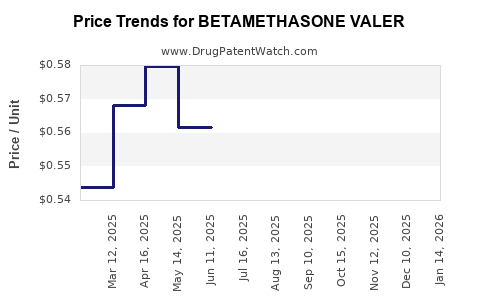
Price Dynamics and Projected Trends
Current Pricing
Prices vary by formulation, brand, and region:
- United States: $5-$15 per tube (15-30g) for generic creams.
- Europe: €4-€12 for similar quantities.
- Emerging markets: $2-$8 per tube.
Pricing is influenced by regulatory approval, competition, and healthcare reimbursement policies. Generic competition has significantly reduced prices since patent expiration.
Price Drivers
- Patent expiration: Most formulations lost patent protection by 2010, leading to increased generics.
- Regulatory pressures: Stricter safety and efficacy standards in the US and Europe keep prices competitive.
- Market penetration: Increased use in developing countries lowers prices due to high competition and cost sensitivity.
Price Projections (Next 5 Years)
| Year |
Estimated Price Range (per 15g tube) |
Key Factors |
| 2023 |
$4.50 - $12 |
Continued generic competition, inflation |
| 2024 |
$4 - $11 |
Pricing pressure from biosimilars, generics |
| 2025 |
$3.50 - $10 |
Market saturation, emerging markets growth |
| 2026 |
$3 - $9 |
Further price erosion, regulatory tightening |
| 2027 |
$2.50 - $8 |
Increasing competition, cost reductions |
Regulatory and Market Access Considerations
Regulatory agencies review topical corticosteroids periodically for safety and efficacy. Recent updates include:
- EU: Reclassification of some formulations to prescription-only status.
- US: Over-the-counter status of some formulations challenged, maintaining prescription sales.
- Emerging Markets: Variable approval standards, impacting prices and market size.
Market access hinges upon local healthcare policies, reimbursement systems, and prescribing habits, which can significantly influence pricing strategies globally.
Future Market Drivers and Barriers
Drivers
- Rising prevalence of dermatological conditions.
- Expanding healthcare infrastructure in Asia-Pacific.
- Increasing awareness and diagnosis rates.
Barriers
- Growing generic competition drives prices down.
- Stringent regulatory requirements limit new formulation development.
- Alternative treatments with fewer side effects emerging.
Summary of Key Data Points
- Market size (2022): $42-$56 million globally.
- Growth rate: Estimated 5-8% annually, driven by emerging markets.
- Price trend (2023-2027): Decline from ~$4.50-$12 per tube to ~$2.50-$8.
- Top markets: US, Europe, Asia-Pacific.
- Patent status: Expired, leading to significant generic presence.
Key Takeaways
- The market for betamethasone valerate remains primarily driven by generic formulations, limiting pricing power but sustaining a consistent demand base.
- Price erosion is expected to continue due to increased competition and regulatory pressures.
- Growth prospects depend heavily on expanding dermatological needs in emerging markets.
- Market size is constrained compared to other corticosteroids, but the drug's established efficacy secures its continued relevance.
- Entry of biosimilars or novel topical formulations could impact future market dynamics.
FAQs
Q1: What factors influence the price of betamethasone valerate products globally?
A1: Patent status, competition among generics, regional regulatory requirements, and reimbursement policies influence pricing.
Q2: How does patent expiration affect the market and pricing?
A2: Patent expiration leads to increased generics, reducing prices and expanding access, but erodes profits for original manufacturers.
Q3: Which regions exhibit the fastest growth in betamethasone valerate market share?
A3: Asia-Pacific regions experience the fastest growth, at approximately 8-10% annually, driven by rising dermatological conditions and healthcare infrastructure development.
Q4: Are there upcoming formulations or innovations expected in this drug segment?
A4: Most innovation is limited; existing formulations dominate. Future growth may involve combination products or novel delivery systems.
Q5: What regulatory challenges could impact future market expansion?
A5: Stricter safety and efficacy standards, reclassification of formulations, and approval delays may restrict market access or increase costs.
Citations
- MarketWatch. "Global Corticosteroids Market Size, Share & Trends Analysis Report." 2022.
- MedMarket Monitor. "Topical Corticosteroids Market Overview." 2022.
- European Medicines Agency. "Regulatory updates on topical corticosteroids." 2022.
- IQVIA. "Pharmaceutical Pricing Trends." 2023.
- GlobalData. "Emerging Markets Dermatology Growth Outlook." 2022.