Share This Page
Drug Price Trends for BETAMETHASONE DP AUG
✉ Email this page to a colleague
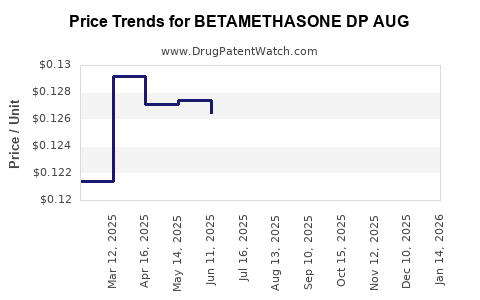
Average Pharmacy Cost for BETAMETHASONE DP AUG
| Drug Name | NDC | Price/Unit ($) | Unit | Date |
|---|---|---|---|---|
| BETAMETHASONE DP AUG 0.05% CRM | 45802-0376-32 | 0.11756 | GM | 2026-07-22 |
| BETAMETHASONE DP AUG 0.05% CRM | 45802-0376-35 | 0.21104 | GM | 2026-07-22 |
| BETAMETHASONE DP AUG 0.05% CRM | 51672-1310-01 | 0.21104 | GM | 2026-07-22 |
| BETAMETHASONE DP AUG 0.05% CRM | 51672-1310-03 | 0.11756 | GM | 2026-07-22 |
| >Drug Name | >NDC | >Price/Unit ($) | >Unit | >Date |
Market Overview for BETAMETHASONE DP AUG
Betamethasone dipropionate (BETAMETHASONE DP AUG) is a potent corticosteroid used primarily in dermatological treatments for conditions such as psoriasis, eczema, and dermatitis. It is available in various topical formulations, including creams, ointments, and lotions. Market demand stems from the increasing prevalence of dermatological conditions, rising awareness of dermatology conditions, and the expanding dermatology healthcare sector globally.
Regulatory Status and Approvals
BETAMETHASONE DP AUG is approved by regulators such as the U.S. Food and Drug Administration (FDA), European Medicines Agency (EMA), and other national agencies for topical anti-inflammatory and immunosuppressant indications. It is marketed under multiple branded and generic names. No significant regulatory barriers inhibit its manufacturing or sales in key markets, broadening its market reach.
Production and Patent Landscape
Currently, no active patents on BETAMETHASONE DP AUG are in force in major markets, leading to increased generic manufacturing and competitive pricing. Its production relies on established corticosteroid synthesis pathways, with major pharmaceutical companies holding manufacturing capabilities.
Market Size and Trends
Global Dermatology Market Valuation
The global dermatology market was valued at approximately $25.2 billion in 2021. It is projected to grow at a compound annual growth rate (CAGR) of 7.3% through 2028. BETAMETHASONE DP AUG, as a key dermatological agent, accounts for a significant share within the corticosteroid segment.
Corticosteroid Market Share
Corticosteroids represent roughly 40% of the dermatology drug market, with topical corticosteroids such as BETAMETHASONE DP AUG making up a considerable portion.
Regional Breakdown
- North America: Largest regional market, driven by high prevalence of dermatological conditions and healthcare spending (~$10 billion in 2021).
- Europe: Second largest, with considerable dermatological healthcare infrastructure.
- Asia-Pacific: Fastest-growing market, with increasing treatment adoption and expanding healthcare access.
Market Drivers
- Rising dermatological condition prevalence due to aging populations and environmental factors.
- Increasing prescription rates driven by better diagnosis capabilities.
- Growth in OTC availability in some regions, although BETAMETHASONE DP AUG remains primarily prescription-only due to potency and safety concerns.
Market Restraints
- Concerns regarding long-term corticosteroid use, including skin atrophy and systemic absorption.
- Competition from newer anti-inflammatory formulations with fewer side effects.
- Stringent regulatory controls on potency and labeling.
Price Projections
Current Price Range
In developed markets, wholesale prices for BETAMETHASONE DP AUG topical formulations range from $0.20 to $0.50 per gram. Retail pharmacy prices typically range from $1.50 to $3.00 per gram, depending on formulation and brand status. Generics dominate the market, exerting downward price pressure.
Future Price Trends
Given patent expirations and increasing generic entries, prices are expected to decline marginally over the next five years. Projected wholesale prices are expected to erode by approximately 10-15%, averaging around $0.17 to $0.43 per gram by 2028.
Market Penetration Impact
- High-income regions: Prices stabilize with minimal decline due to higher regulatory stability and brand presence.
- Emerging markets: Prices are expected to decrease more sharply, with retail prices potentially falling below $1.00 per gram as competition intensifies.
Factors Influencing Prices
- Patent expirations and generic entry.
- Regulatory changes affecting formulation approval.
- Healthcare policies favoring cost-effective treatments.
- Manufacturing scale efficiencies.
Competitive Landscape
Market participants include global pharmaceutical giants such as GlaxoSmithKline, Pfizer, and Teva, along with regional generic manufacturers. The fragmentation due to multiple formulations and regional branding creates diverse competition levels.
Strategic Considerations for Stakeholders
- Manufacturers: Focus on cost-efficient production, regional market expansion, and formulation innovation.
- Investors: Monitor patent expirations, regulatory developments, and regional market growth to assess investment risks.
- Regulators: Emphasize safety regulations, particularly concerning long-term corticosteroid use.
Key Takeaways
- The BETAMETHASONE DP AUG market, driven by dermatology demand, is projected to experience moderate growth through 2028.
- Prices are expected to decline gradually owing to generic competition, with significant regional variability.
- Regulatory and safety concerns influence market dynamics, particularly in emerging markets.
- The absence of active patents supports aggressive pricing strategies by generic manufacturers.
- Market growth is closely tied to emerging dermatological needs, especially in Asia-Pacific.
FAQs
-
What is the primary application of BETAMETHASONE DP AUG?
Used in topical treatments for inflammatory and autoimmune dermatological conditions such as eczema and psoriasis. -
How does patent expiry influence market prices?
Patent expiry enables generic entry, increasing competition and generally lowering prices over time. -
What regions present the most growth opportunities?
The Asia-Pacific region offers the fastest growth due to increasing healthcare access and dermatology awareness. -
Are there safety concerns impacting the market?
Yes, long-term corticosteroid use risks like skin atrophy and systemic effects restrict widespread OTC availability. -
What factors could alter future price projections?
Regulatory changes, patent activities, and the development of alternative therapies could influence prices.
Sources
[1] MarketsandMarkets. "Dermatology Drugs Market," 2021.
[2] IQVIA. "Global Dermatology Market Data," 2022.
[3] FDA approvals database.
[4] European Medicines Agency (EMA).
[5] Industry reports on corticosteroid manufacturing and generics market.
More… ↓
