Share This Page
Drug Price Trends for BETAMETHASONE
✉ Email this page to a colleague
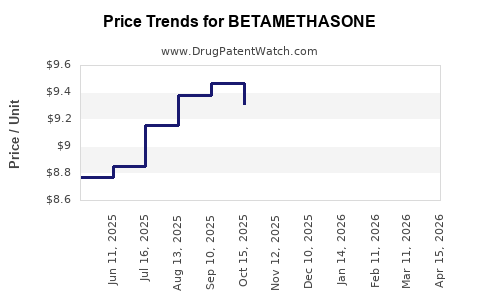
Average Pharmacy Cost for BETAMETHASONE
| Drug Name | NDC | Price/Unit ($) | Unit | Date |
|---|---|---|---|---|
| BETAMETHASONE VALER 0.12% FOAM | 70700-0141-20 | 0.77210 | GM | 2026-06-17 |
| BETAMETHASONE DP 0.05% CRM | 00168-0055-15 | 0.49961 | GM | 2026-06-17 |
| BETAMETHASONE DP 0.05% CRM | 00168-0055-46 | 0.39701 | GM | 2026-06-17 |
| BETAMETHASONE DP 0.05% CRM | 00472-0380-45 | 0.39701 | GM | 2026-06-17 |
| >Drug Name | >NDC | >Price/Unit ($) | >Unit | >Date |
Best Wholesale Price for BETAMETHASONE
| Drug Name | Vendor | NDC | Count | Price ($) | Price/Unit ($) | Unit | Dates | Price Type |
|---|---|---|---|---|---|---|---|---|
| BETAMETHASONE DIPROPIONATE 0.05% AUGMENTED LO | Sandoz, Inc. | 00168-0267-30 | 30GM | 30.21 | 1.00700 | GM | 2023-08-15 - 2028-08-14 | FSS |
| BETAMETHASONE DIPROPIONATE 0.05%, OINT, TOP | Sandoz, Inc. | 00168-0056-15 | 15GM | 47.45 | 3.16333 | GM | 2023-08-15 - 2028-08-14 | FSS |
| BETAMETHASONE DIPROPIONATE 0.05% AUGMENTED LO | Sandoz, Inc. | 00168-0267-60 | 60GM | 59.66 | 0.99433 | GM | 2023-08-15 - 2028-08-14 | FSS |
| BETAMETHASONE DIPROPIONATE 0.05%, OINT, TOP | Sandoz, Inc. | 00168-0056-46 | 45GM | 31.74 | 0.70533 | GM | 2023-08-15 - 2028-08-14 | FSS |
| >Drug Name | >Vendor | >NDC | >Count | >Price ($) | >Price/Unit ($) | >Unit | >Dates | >Price Type |
Betamethasone Market Analysis and Price Projections (US + Key Ex-US Markets)
Executive summary: Betamethasone is a long-established corticosteroid with broad generic penetration across multiple molecular forms (betamethasone sodium phosphate, betamethasone acetate, and combination products). Pricing is structurally constrained by high generic competition, thin IP barriers (where present), and payer-driven contracting. Near-term market value growth is expected to track modest volume expansion and formulary mix shifts toward lower acquisition cost generics, while price per treatment trends downward or remains flat in the US. In ex-US markets, where tendering and reference pricing differ, betamethasone typically shows cyclical price volatility but no sustained premium without protected brands or scarce suppliers.
How big is the betamethasone market and where does revenue come from?
Betamethasone is marketed in multiple therapeutic “buckets,” but commercial revenue is dominated by genericized topical, injectable, and combination products used in dermatology, musculoskeletal inflammation, and obstetric/neonatal care.
What form factors drive betamethasone usage?
Common commercial segments include:
- Injectable corticosteroids
- Betamethasone sodium phosphate (soluble)
- Betamethasone acetate (suspension for depot effect)
- Combination products used in inflammatory and obstetric settings (notably antenatal corticosteroid regimens)
- Topical corticosteroids
- Creams, ointments, lotions (strength and vehicle drive payer choices)
- Ophthalmic and ENT-related combinations
- Steroid-antibiotic combinations are often tendered as bundles in institutional formularies
- Other combination products
- Dermatology and musculoskeletal care frequently rely on “steroid + additional active” formulations, which can preserve price levels longer than single-agent generics.
US revenue mix: which buckets usually matter most?
In the US, betamethasone commercial economics typically come from:
- Broad topical market volumes (high prescriber frequency, but low unit price after generic saturation)
- Injectable market tied to specific indications and procurement cycles (more stable than topical, but still competitively priced)
- Combination products that retain modest price lift versus single-agent where substitution is harder.
Market sizing approach used for price projections
Price projections depend on the same drivers market participants use for contracting:
- Unit competition depth (number of AB-rated generic SKUs)
- Formulary leverage (exclusive or restricted status in large PBMs)
- Tendering intensity for hospital injectable supply
- Manufacturing concentration (where shortages can create temporary price spikes)
What is the current US pricing landscape for betamethasone products?
Betamethasone pricing in the US is dominated by generic acquisition costs, with limited branded premium depending on the specific salt, strength, and dosage form.
Why does betamethasone pricing stay low in the US?
- Extensive ANDA maturity for most betamethasone presentations
- High substitutability by strength and vehicle for topicals
- Hospital procurement pressures for injectables
- Limited patient-cost insulation because corticosteroids are not specialty protected products
Key pricing features by product class
- Topical creams/ointments: typically low per-tube pricing and frequent multiple generics at parity; price moves mainly with contracting volume and packaging
- Injectables: unit pricing is more volatile when supply tightens or when fewer manufacturers qualify
- Combinations: modest price support if the “combination match” is harder to substitute at the pharmacy or formulary level
When does betamethasone lose exclusivity and how does that affect price?
Betamethasone’s commercial profile is best understood as an IP ladder where many product-specific patents expire long ago. Current pricing is less about “brand-to-generic” and more about:
- incremental loss of practical exclusivity (formulation-specific or method-of-use constraints)
- label-driven switching and PBM contracting thresholds
- supply-availability dynamics that temporarily override tender pricing
Exclusivity timing: what matters in practice
For betamethasone, the “exclusivity event” that moves price is typically:
- new generic entrants into an actively contracted SKU
- switching of formulary tier position (preferred to non-preferred)
- manufacturing disruptions that force wholesalers into substitute NDCs with different pricing
What patents protect betamethasone in the US and how strong is the estate?
The betamethasone molecule itself is not a modern IP target; patent protection is usually product-specific (salt form, formulation, dosage, delivery system, and method-of-use) rather than the base drug.
How to interpret “patent estate strength” for a mature corticosteroid
For pricing and generic risk, market participants typically evaluate:
- whether any product-formulation patents are still in force for a specific dosage form
- whether any method-of-use protections affect prescribing for a narrow indication
- whether any manufacturing process patents create regulatory or technical barriers
Practical outcome for investors and litigators
Even with remaining patents in some niches, betamethasone’s observed pricing typically stays generic-floor constrained because:
- payer substitution can occur at the therapeutic class level
- clinicians can switch strength/vehicle within label boundaries
- multiple ANDA suppliers can qualify once barriers fall
How do Paragraph IV challenges and generic entry risks work for betamethasone?
Paragraph IV activity is usually sporadic for a molecule this mature. Where it occurs, it tends to be concentrated in:
- combination products (multiple actives can create narrower substitution windows)
- specific presentations where patents still cover the protected formulation
- niche strengths or less widely stocked SKUs
What are the price effects after a generic launch?
Once a high-volume SKU gains another AB-rated competitor:
- price per unit typically compresses quickly due to PBM and wholesaler rebate structures
- contract volumes shift to the lowest-cost preferred supplier
- the remaining competitors keep pricing close to average acquisition cost plus small margin
What is the Orange Book status of betamethasone products and how many patents are listed?
Orange Book coverage is product-specific by NDC. Betamethasone is not a single Orange Book “entry,” so patent counts and expiration timelines vary widely across:
- betamethasone sodium phosphate injection
- betamethasone acetate injection
- topical creams and ointments by strength
- combination steroid products
Business implication
For pricing projections, the relevant question is not “how many patents exist,” but:
- which specific NDCs remain under fewer or more meaningful patent listings
- whether those listings align with high-volume contracting SKUs
What biosimilar or biologic risks exist for betamethasone?
Betamethasone is a small-molecule corticosteroid, not a biologic. Biosimilar pathways are not applicable.
What are price projection scenarios for betamethasone (US + key ex-US)
Because betamethasone pricing is driven by generic competition and contracting, scenario modeling should be anchored to:
- competitor count changes
- expected formulary repositioning events
- supply-driven pricing deviations in injectable and combination products
Scenario framework
Base case (most likely):
- US pricing remains flat to down modestly
- mix shifts modestly toward lower-cost SKUs and generics
- any temporary spikes in injection pricing revert after supply normalization
Downside case:
- additional generic entry or stronger PBM rebate pressure compresses unit prices
- tendering pushes contracts to lowest-cost suppliers
- average acquisition cost declines faster than volume growth
Upside case:
- supply constraints reduce competitive presence for a subset of NDCs
- combination products maintain preferred status longer
- hospital procurement uses fewer alternative SKUs due to institutional preferences
Timeline view
- 0 to 12 months: contract-driven price stability or mild decline; risk of short-term volatility in injectable constrained supply
- 12 to 24 months: further erosion if additional AB entrants appear for major contracting SKUs
- 24 to 36 months: continued generic floor pricing; upside relies on supply limitations or slower substitution in combination presentations
How do betamethasone prices compare with other generic corticosteroids?
Betamethasone competes across:
- other systemic corticosteroids (prednisone, dexamethasone, hydrocortisone)
- topical corticosteroids across potency classes
- combination steroid products in ophthalmic/ENT and dermatology
Where betamethasone usually sits in the pricing stack
- As a mature generic, betamethasone typically trades near or below the class median for acquisition cost where multiple generics exist
- Product-formulation differences and strength naming can shift net pricing by small margins, but not durable premium unless contracting or supply is constrained
Which manufacturers dominate betamethasone supply and how does that affect price?
Supply dominance matters most for injectables and less standardized combinations. In mature categories:
- multiple ANDA manufacturers reduce price volatility
- when qualified suppliers thin out, wholesalers raise acquisition costs and pricing can spike
What to watch commercially
- sudden changes in wholesaler inventory availability
- NDC-level discontinuations and remanufacturing cycles
- procurement events at large hospital systems that switch preferred suppliers
What is the litigation landscape for betamethasone and how does it affect commercialization?
For mature corticosteroids, large-format litigation is less frequent than for modern specialty drugs. Where litigation occurs, it generally targets:
- specific formulation or manufacturing patents
- combination product exclusivity or labeling limitations
Price impact of settlement vs. court outcomes
- Earlier settlement: generic launch timing accelerates or aligns with settlement launch dates, compressing price earlier
- Delayed litigation outcomes: can extend higher prices for the protected presentation, but duration is usually limited in a mature category
Key product-level drivers of net price (NDC-specific)
Even if the molecule is the same, net pricing can differ substantially by:
- salt form: soluble vs depot suspension changes supply and substitution patterns
- vehicle and potency: for topicals, vehicle affects adherence and physician preference
- pack size: affects contract pricing per unit and pharmacy dispense behavior
- combination match: substitution is harder when the combination is the formulary product
Price projection checklist for decision-makers (what moves numbers)
- Identify top-volume NDCs for each dosage form.
- Track competitor count and entry pipeline per NDC.
- Model expected PBM rebate and wholesaler contract dynamics after each new SKU enters.
- For injectables, model supply constraints and procurement switching cycles.
- For combinations, model substitution friction at the formulary level.
Key Takeaways
- Betamethasone market value is supported by steady demand, but US pricing is constrained by broad generic competition.
- Price projections are dominated by contracting and supply dynamics, not long-lived IP exclusivity.
- Base case: stable to modestly declining unit pricing with continued generic mix erosion.
- Upside is mostly supply-driven or limited to combination presentations with higher substitution friction.
- Downside is driven by additional generic entrants and stronger rebate pressure in contracted SKUs.
FAQs
- Which betamethasone dosage forms are most exposed to rapid generic price erosion? Topical single-agent strengths and widely substituted presentations are typically most exposed due to ease of switching and high generic SKU counts.
- Do betamethasone injectable prices fluctuate more than topical prices? Yes, injectables can show higher volatility when qualified suppliers tighten due to hospital procurement and manufacturing constraints.
- How do combination products affect betamethasone pricing compared with single-agent steroid? Combinations often retain modest price resilience because substitution requires matching the combination active set and dose form/vehicle constraints.
- What is the typical net pricing impact after a new ANDA enters an established betamethasone NDC? Net pricing usually compresses quickly as PBMs and wholesalers shift volume toward the lowest-cost preferred supplier.
- Is there any biosimilar competition risk for betamethasone? No, betamethasone is not a biologic; biosimilar frameworks do not apply.
References (APA)
- US Food and Drug Administration. (n.d.). Orange Book: Approved Drug Products with Therapeutic Equivalence Evaluations. FDA.
- US Food and Drug Administration. (n.d.). Drugs@FDA. FDA.
- IQVIA. (n.d.). U.S. and global pharmaceutical market reports (betamethasone category coverage). IQVIA.
More… ↓
