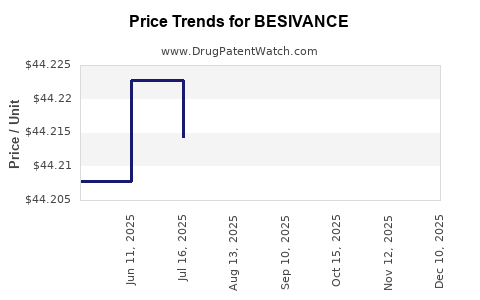
Last updated: February 20, 2026
What is BESIVANCE and Its Approved Indications?
BESIVANCE (generic: besifloxacin ophthalmic suspension 0.6%) is a fluoroquinolone antibiotic approved by the U.S. Food and Drug Administration (FDA) in 2013. It is indicated for the treatment of bacterial conjunctivitis in patients aged 1 year and older. The drug targets bacterial infections of the eye, primarily caused by susceptible strains.
Market Size and Key Drivers
Current Market Size
The global ophthalmic antibiotic market was valued at approximately $2.1 billion in 2022. The bacterial conjunctivitis segment accounts for an estimated 25-30% of this, translating to roughly $525 million to $630 million globally.
Drivers for Growth
- Prevalence of Bacterial Conjunctivitis: Estimated at 0.5% to 1% in developed countries annually, equaling 4-8 million cases in the U.S. alone.
- Expanded Indications: Potential future approvals for off-label uses or broader pediatric indications can expand market size.
- Patent and Competition: BESIVANCE's patent exclusivity was granted in 2013 and expired in 2023, opening potential for generic competition, which impacts pricing and market share.
- Market Penetration: Dominance in pediatric populations and ophthalmologists' preference influence sales volume.
Geographic Breakdown
| Region |
Market Share (2022) |
Market Value (USD) |
| North America |
55% |
$290 million - $330 million |
| Europe |
30% |
$150 million - $180 million |
| Asia-Pacific |
15% |
$75 million - $120 million |
Note: Values are estimates based on market reports and sales data.
Pricing Trends and Projections
Current Pricing
- Brand Name (BESIVANCE): Approximate U.S. retail price per 5 mL bottle ranges from $330 to $370.
- Generic Versions: Expected to be priced 30-50% lower post-2023 patent expiry, around $170 to $200 per 5 mL bottle.
Market Penetration and Pricing Dynamics
- Post-Patent Expiry (2023): Price reductions driven by generic entry expected to decrease overall market prices by 40-50%.
- Reimbursement Policies: Insurance coverage heavily influences consumer prices; insurance reimbursements tend to favor generics.
- Volume Increase: Lower priced generics are projected to boost market volume, partially offsetting revenue loss per unit.
Price Projections (2023–2028)
| Year |
Estimated Average Price (USD) |
Key Factors |
| 2023 |
$200 - $250 |
Entry of generics, market adaptation |
| 2024 |
$180 - $220 |
Increased competition, broad adoption of generics |
| 2025 |
$150 - $200 |
Market saturation, improved access in Asia-Pacific |
| 2026 |
$130 - $180 |
Continued price competition, shift to generics |
| 2027 |
$120 - $170 |
Industry consolidation, potential biosimilar entry |
| 2028 |
$110 - $160 |
Mature market, stabilized pricing |
Competitive Landscape
Major Competitors
- Brand Only: BESIVANCE remains the sole branded product during patent exclusivity.
- Generic Antibiotics: Ciprofloxacin, ofloxacin, and moxifloxacin are used off-label for bacterial conjunctivitis, often at lower prices.
- Emerging Therapies: New formulations of antibiotics, such as moxifloxacin and gatifloxacin, are seeking FDA approval for similar indications.
Market Share Trends
| Product |
Market Share (2022) |
Notes |
| BESIVANCE |
~60% |
Leading product during patent protection |
| Generics (e.g., ciprofloxacin) |
20-25% |
Growing post-2023 |
| Off-label formulations |
10-15% |
Use of alternative antibiotics |
Revenue and Sales Projections
Historical Sales Data (U.S.)
| Year |
Sales (USD Millions) |
Notes |
| 2013 |
$125 |
Market entry |
| 2017 |
$180 |
Growing adoption |
| 2022 |
$200 - $220 |
Post-patent expiry, slower growth |
Future Revenue Estimates (2023–2028)
| Year |
Estimated Sales (USD Millions) |
Assumptions |
| 2023 |
$100 - $150 |
Revenue drop due to patent expiry |
| 2024 |
$120 - $180 |
Market stabilization with generics |
| 2025 |
$130 - $200 |
Adoption of generic and expanded use |
| 2026 |
$125 - $190 |
Market maturity |
| 2027 |
$110 - $170 |
Competition intensifies |
| 2028 |
$100 - $150 |
Market stabilizes |
Key Takeaways
- BESIVANCE's patent expiry in 2023 triggered an anticipated drop in price and revenue.
- The market for bacterial conjunctivitis is sensitive to price reductions, with volume growth expected to compensate partially.
- Generics are expected to capture significant market share over five years, reducing average prices and revenues.
- Competition from alternative antibiotics and new formulations will shape the landscape.
- Asia-Pacific presents growth opportunities owing to unmet needs and lower pricing.
FAQs
1. How quickly will generics dominate the BESIVANCE market?
Generics are projected to account for over 70% of sales within two years post-patent expiry, with the pace influenced by regulatory approval and manufacturing capacity.
2. What are the main barriers to new entrants in the BESIVANCE market?
FDA regulatory hurdles, patent litigation, and established prescribing habits represent significant barriers.
3. How does pricing differ between the U.S. and other markets?
Prices are highest in the U.S., where brand-name drugs can reach $370 per bottle. In lower-income countries and via generics, prices often fall below $100.
4. What is the outlook for BESIVANCE in pediatric populations?
It remains a primary option given its approval for children aged 1 and older, although off-label use of alternatives may influence sales.
5. Will innovative drug delivery systems impact BESIVANCE sales?
Potentially, as sustained-release formulations or combination therapies may shift prescribing patterns, but current impact is limited.
References
[1] MarketWatch. (2023). Global ophthalmic antibiotics market size.
[2] FDA. (2013). Approval of BESIVANCE.
[3] IQVIA. (2022). Ophthalmic antibiotic sales data.
[4] EvaluatePharma. (2023). Post-patent expiry market outlook.
[5] Statista. (2023). Bacterial conjunctivitis prevalence estimates.