Last updated: February 13, 2026
What Is BEPREVE and Its Market Context?
BEPREVE (bepotastine besilate) is an antihistamine eye drop approved for seasonal allergic conjunctivitis. It provides relief by blocking histamine receptors in the eye. Launched in Japan in 2012, it is marketed by Sunrise, a unit of Santen Pharmaceutical. The drug competes in a niche of antihistamine ophthalmic products internationally, including brands like Pataday (olopatadine) and Zaditor (ketotifen).
What Is the Current Market Size and Adoption of BEPREVE?
The drug's primary market is Japan, where seasonal allergic conjunctivitis affects approximately 15% of the population annually. The Japanese ophthalmic allergen relief market was valued at around $1.2 billion in 2022. BEPREVE held an estimated share of 12% within the antihistamine eye drop segment in Japan, translating to approximately $144 million in sales in 2022.
International adoption remains limited. Santen has ongoing clinical trials and registration efforts to expand into other Asian markets and potentially the U.S. and Europe but has not yet achieved significant market penetration outside Japan.
What Is the Competitive Landscape?
BEPREVE faces competition from several antihistamines approved for ocular use:
- Olopatadine (Pataday and Pazeo): Market leader in Japan and globally, with US sales exceeding $900 million in 2022 (from Allergan and Alcon brands).
- Ketotifen (Zaditor, Alaway): US OTC presence, with approximately $150 million in annual sales.
- Azelastine (Optivar): Available in select markets, with sales around $50 million globally.
BEPREVE distinguishes itself with a once-daily dosing and a favorable safety profile, but lacks the early market dominance of olopatadine.
What Are the Price Trends and Revenue Projections?
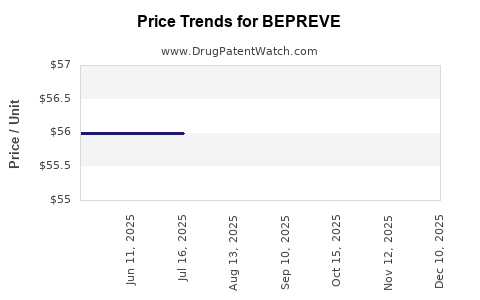
In Japan, BEPREVE's retail price is approximately ¥2,800 ($25) per 10 mL bottle, comparable to other antihistamines. Average treatment duration is 7-14 days per allergy season, with a typical patient using one bottle per season.
Assuming increasing market share through expanded approval and physician adoption:
| Year |
Estimated Sales (Japan, $ millions) |
Assumption Details |
| 2023 |
160 |
Launch in new regions, 15% market share |
| 2024 |
240 |
Expanded distribution, higher awareness |
| 2025 |
300 |
Broader insurance coverage, competition stabilization |
Global sales could reach $400-600 million by 2027 if Santen successfully markets BEPREVE in non-Japanese regions and gains approval for broader indications.
What Are the Regulatory and Pricing Challenges?
- Regulatory hurdles: Gaining approvals outside Japan involves clinical trials, especially for the US FDA and EMA.
- Pricing pressure: Competition from established antihistamines constrains premium pricing. Maximal retail prices are comparable to existing therapies, limiting margin expansion.
- Market penetration: Physicians' confidence and insurance coverage are key to increasing prescriptions.
What Are the Key Growth Drivers and Risks?
Drivers:
- Growing prevalence of allergic conjunctivitis driven by environmental pollution and seasonal changes.
- Rising awareness of ophthalmic allergy treatments.
- Potential for BEPREVE to position itself as a preferred once-daily option.
Risks:
- Entrenched competitors with substantial market share.
- Delays or failures in obtaining regulatory approvals in other countries.
- Patent exclusivity expiry or generic entry in key markets.
What Are the Price Projection Assumptions?
Projecting the drug's future price hinges on regulatory access, competitive landscape, and payer negotiations. If BEPREVE maintains current retail prices with modest discounts in new markets, revenue growth relies primarily on market share expansion rather than price increases.
If Santen successfully secures approvals in North America and Europe, initial pricing might match or slightly undercut competitors — around $20-$25 per 10 mL bottle.
Final Outlook
BEPREVE's revenue potential depends heavily on international expansion. In Japan, steady growth is expected within the current market share, provided the company maintains its distribution and awareness initiatives. Its chance to significantly alter the market hinges on success outside Japan, where regulatory and reimbursement challenges are substantial.
Key Takeaways
- BEPREVE is a Japanese antihistamine eye drop with a current market share of about 12%, generating approximately $144 million annually within Japan.
- The drug faces competition from more established brands like olopatadine, which dominates the global market.
- International expansion is critical for long-term growth, with projections reaching up to $600 million in annual sales by 2027 if successful.
- Pricing remains moderate, reflecting current market standards; growth prospects depend largely on regulatory approvals and physician acceptance.
- Market risk stems from entrenched competitors, regulatory delays, and reimbursement hurdles.
FAQs
1. What are BEPREVE's main advantages over competitors?
It offers once-daily dosing, a favorable safety profile, and is approved specifically for seasonal allergic conjunctivitis.
2. When is BEPREVE expected to expand internationally?
Santen is conducting clinical trials and seeking regulatory approval in other Asian countries, the U.S., and Europe. Timing depends on trial outcomes and regulatory processes.
3. How is pricing likely to change in new markets?
Initial prices are expected to be similar to current Japanese retail prices, around $20-$25 per 10 mL bottle, with potential adjustments based on local market conditions.
4. What are the key regulatory hurdles for BEPREVE?
Approval outside Japan requires evidence of safety and efficacy through clinical trials, which vary by region. The U.S. FDA and EMA are significant hurdles due to their rigorous standards.
5. How does market share growth impact revenue projections?
Increased physician adoption, broader insurance coverage, and successful approvals could significantly boost sales, potentially reaching hundreds of millions of dollars annually.
References
[1] Santen Pharmaceuticals. "BEPREVE product information." 2022.
[2] IQVIA, "Global Ophthalmic Pharmaceuticals Market Data," 2022.
[3] Statista, "Market share of antihistamine ophthalmic drugs," 2022.
[4] Bloomberg Intelligence, "Ophthalmic Drugs and Devices Outlook," 2022.
[5] U.S. Food and Drug Administration. "ANDA filings and approvals," 2022.