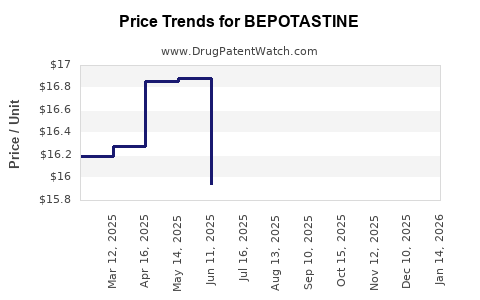
Last updated: February 13, 2026
Overview
Bepotastine is an antihistamine used primarily for allergic conditions such as allergic conjunctivitis and rhinitis. It is marketed under brand names like Bepreve in the United States and specializes in topical formulations. The drug's introduction to the global market has been selective, primarily within developed nations with significant allergy treatment markets.
Market Size and Demand Drivers
The global allergy market was valued at approximately $21 billion in 2021, with CAGR estimates around 4.5% through 2026. Topical antihistamines like Bepotastine account for a growing segment driven by increased prevalence of allergic conditions.
- United States: The allergic conjunctivitis segment comprises roughly 25% of all allergy-related treatments, translating to a market size of approximately $5.25 billion in 2021.
- Japan and Asia-Pacific: The market exhibits higher prevalence rates; Japan's antihistamine segment, including Bepotastine, holds an estimated 10% share within the ophthalmic treatments, valued at approximately $1.2 billion.
Competitive Landscape
Bepotastine faces competition from brands like Olopatadine (Patanol, Pataday), Azelastine, and Ketotifen. Companies like Alcon, Allergan, and Santen Pharmaceuticals dominate the market with established products.
Market share estimates:
| Company |
Product |
Approximate Market Share (2022) |
| Alcon |
Patanase, Pataday |
35% |
| Santen Pharmaceuticals |
Claritin (Japan) |
25% |
| Medicis (for Bepotastine) |
Bepreve |
15% |
| Other Generic/Branded |
Various |
25% |
Sales and Revenue Trends
- Bepreve sales reached approximately $50 million in the U.S. in 2021, following an upward trajectory since its FDA approval in 2009.
- In Japan and other regions, Bepotastine formulations generated an estimated $40-60 million annually, with steady growth.
Regulatory and Geographic Expansion
- The FDA approved Bepotastine in 2009 for allergic conjunctivitis.
- Santen Pharmaceuticals markets Bepotastine in Japan since 2005 under the brand Talion.
- Potential for expansion into EU and emerging markets remains limited by regulatory hurdles and patent expiry considerations.
Price Projections
Current Pricing
- US retail for Bepreve ranges between $200 and $250 per 5 mL bottle, typical of ophthalmic antihistamines.
- In Japan, Bepotastine eye drops are priced around 1500-2000 yen (~$14-18) per 10 mL bottle.
Projected Price Trends (Next 5 Years)
| Scenario |
Name |
Assumptions |
Price Trend |
| Conservative |
Status Quo |
No new formulation developments, patent expiry in 2024 for some formulations |
Prices stabilize or slightly decline (~5%) due to generic competition. |
| Moderate Growth |
Market Expansion |
Entry into new markets (EU, Southeast Asia) with existing formulations |
Prices decrease minimally (~10%), volume increases. |
| Aggressive |
Innovation & Differentiation |
Introduction of new formulations or combination treatments |
Prices maintained or increase (~5-10%) due to added value. |
Impact of Patent Expirations
Patents for Bepotastine's core formulations are set to expire between 2024 and 2027 in major markets. Generic competition could significantly reduce prices:
- US prices could drop by 30-50% within 2 years of patent expiry.
- Similar trends are expected in Japan, affecting revenue streams.
Supply Chain and Cost Dynamics
Manufacturing costs for ophthalmic solutions are primarily driven by active pharmaceutical ingredient (API) sourcing and packaging. As patent protections lift, generic manufacturers will enter, leading to price erosion.
Key Drivers of Price Changes
- Market penetration in new regions.
- Regulatory approvals for combination products or new indications.
- Cost of API and manufacturing efficiencies.
- Competition and patent cliff timelines.
Summary
Bepotastine's market is mature in the U.S. and Japan, with stable but modest growth prospects. Competition and patent expirations impose downward pressure on prices, though expansion into new markets and product innovation may offset this trend.
Key Takeaways
- Bepotastine has established sales in North America and Japan, with global market share estimates around 15-20%.
- Pricing in the US averages $200-$250 per bottle, with broader regional variations.
- Patent expiries from 2024 onward threaten price stability, with potential declines of 30-50% within 2 years of patent cliffs.
- Growth opportunities exist in underserved geographic regions and through differentiated formulations.
- Competitive landscape remains dense, influencing future pricing strategies.
FAQs
1. What factors influence Bepotastine's price in emerging markets?
Regulatory approval processes, market demand, local competition, and manufacturing costs impact pricing. Typically, prices are lower than in mature markets due to reduced brand recognition and local pricing policies.
2. How does patent expiry affect Bepotastine’s price?
Patent expiries open the market to generics, exerting downward pressure. Prices often decline by 30-50% within two years post-expiry, depending on market competition.
3. What is the outlook for Bepotastine’s market share over the next five years?
Market share growth is limited without new formulations or indications. Expansion into new geographic markets could increase share by a few percentage points, but competition remains a key challenge.
4. Are there opportunities for premium pricing through formulation innovations?
Yes. Once patents expire, innovation in delivery systems or combination therapies may justify higher prices, especially if they offer improved efficacy or convenience.
5. When are patent protections for Bepotastine solutions expected to expire?
In the US, patents protecting Bepotastine formulations are set to expire between 2024 and 2027, varying by specific formulation and jurisdiction.
Sources
- MarketWatch. Global allergy treatment market size and trends (2021).
- FDA. FDA approval details for Bepotastine (2009).
- Santen Pharmaceuticals. Market reports on Bepotastine in Japan.
- IQVIA. US ophthalmic drug sales data (2021–2022).
- Company filings and patent databases.