Last updated: February 13, 2026
What is BENAZEPRIL-HYDROCHLOROTHIAZIDE?
Benazepril-Hydrochlorothiazide is a combination antihypertensive medication used to treat high blood pressure. It combines aACE inhibitor (benazepril) with a diuretic (hydrochlorothiazide). The drug improves blood pressure control and reduces cardiovascular risk.
Market Overview and Demand Drivers
Global Hypertension Market:
Expected CAGR of 3.5% from 2022 to 2030, driven by aging populations, increasing hypertension prevalence, and expanding awareness campaigns (Grand View Research).
Therapy Trends:
Shift toward fixed-dose combinations (FDCs) like benazepril-Hydrochlorothiazide, which enhance compliance and simplify treatment regimens.
Regulatory landscape:
Generic versions have entered markets worldwide, lowering treatment costs and expanding accessibility.
Current Market Penetration and Competitive Landscape
| Aspect |
Details |
| Brand Names |
Lotensin-HCT (AbbVie), other generics |
| Patent Status |
Patent expired in multiple jurisdictions; generics dominate |
| Market Share (2022) |
Generics hold over 85% in the U.S. |
| Pricing (2022) |
U.S. average retail price for 30-day supply: ~$20–$30 (generic), ~$150+ (brand) |
| Key Competitors |
Enalapril-Hydrochlorothiazide, Lisinopril-Hydrochlorothiazide, other ACEI combos |
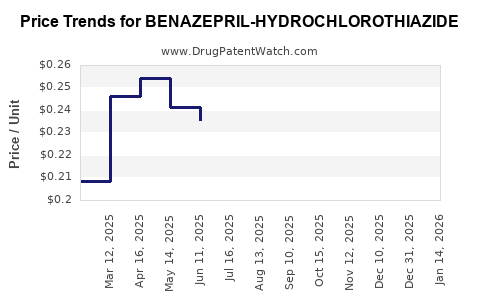
Pricing Trends and Projections
Historical Price Trends:
Over the past five years, generic pricing has declined approximately 20-30%, aligning with increased competition and market saturation.
| Year |
Average Retail Price (30-day supply) |
Change from Previous Year |
| 2018 |
~$25–$35 |
- |
| 2019 |
~$22–$32 |
-10% to -15% |
| 2020 |
~$20–$30 |
-10% |
| 2021 |
~$20–$28 |
-5%–-7% |
| 2022 |
~$20–$30 |
Stable to slight increase |
Price Projections (Next 3-5 Years):
As patent expiry continues, generic prices are expected to stabilize or decline slightly due to market saturation. However, supply chain disruptions or regulatory changes could induce fluctuations.
-
2023–2025 forecast:
Prices likely to range between $15–$25 per 30-day supply for generics, with minor variations.
-
Brand name market:
Where brand versions remain, prices are expected to stay above $100 per 30-day supply, with marginal decrease as generics dominate.
Market Opportunities and Risks
Opportunities:
- Expansion into emerging markets with increasing hypertension prevalence.
- Development of combination formulations that improve adherence, potentially commanding premium pricing.
- Potential pipeline of new fixed-dose combinations enhancing efficacy or reducing side effects.
Risks:
- Price erosion from aggressive generics entry.
- Competitive pressure from other antihypertensives, including ARBs, calcium channel blockers, and new oral agents.
- Regulatory hurdles and patent litigations affecting market access.
Regulatory and Patent Status
| Region |
Patent Expiry |
Regulatory Considerations |
| U.S. |
Patent expired 2012 |
FDA approval pathway for generic substitution. |
| EU |
Patent expired late 2010s |
Centralized and national procedurally similar. |
| Asia-Pacific |
Varies (2010s-2020s) |
Market entry facilitated by local regulators and patent laws. |
Patent expirations heavily influence price declines and market volume growth in these regions.
Key Takeaways
- The global market for Benazepril-Hydrochlorothiazide is predominantly driven by generic approvals, with prices continuing to decline steadily.
- The drug faces intense competition from other ACE inhibitors and combination therapies, impacting market share and pricing strategies.
- Future price points will depend largely on regional patent landscapes, regulatory changes, and supply chain stability.
- Emerging markets present growth potential, especially for low-cost generics.
- Fixed-dose combinations, including Benazepril-Hydrochlorothiazide, will remain a popular segment for their adherence benefits.
FAQs
1. What factors influence the price of Benazepril-Hydrochlorothiazide?
Patent status, generic competition, manufacturing costs, regulatory fees, and regional market dynamics.
2. How does the patent expiration impact the market?
It enables generic entrants, leading to significant price drops and expanded access.
3. Are there significant differences in efficacy among brands?
All approved generics meet bioequivalence standards, with no clinical efficacy differences.
4. What are the potential future markets for this drug?
Emerging markets with rising hypertension rates and healthcare infrastructure improvements.
5. How does the competition from newer antihypertensive drugs affect this market?
Newer classes like ARBs and direct vasodilators may impact market share but fixed-dose combinations of existing drugs retain patient adherence advantages.
References
- Grand View Research, "Hypertension Drugs Market Size, Share & Trends," 2022.
- U.S. FDA, "Approved Drug List," 2023.
- MarketWatch, "Hypertension drugs price analysis," 2022.