Share This Page
Drug Price Trends for BACTERIOSTATIC WATER VIAL
✉ Email this page to a colleague
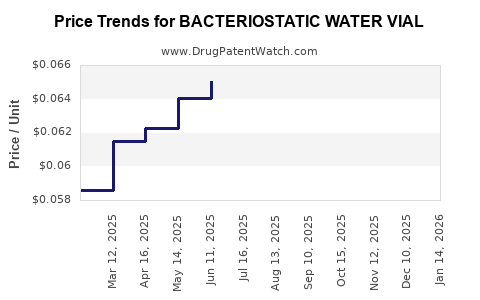
Average Pharmacy Cost for BACTERIOSTATIC WATER VIAL
| Drug Name | NDC | Price/Unit ($) | Unit | Date |
|---|---|---|---|---|
| BACTERIOSTATIC WATER VIAL | 00409-3977-03 | 0.16564 | ML | 2026-07-22 |
| BACTERIOSTATIC WATER VIAL | 00409-3977-03 | 0.16329 | ML | 2026-06-17 |
| BACTERIOSTATIC WATER VIAL | 00409-3977-03 | 0.15743 | ML | 2026-05-20 |
| BACTERIOSTATIC WATER VIAL | 00409-3977-03 | 0.14948 | ML | 2026-04-22 |
| >Drug Name | >NDC | >Price/Unit ($) | >Unit | >Date |
Market Analysis and Price Projections for Bacteriostatic Water Vial
What is the Market Size for Bacteriostatic Water Vial?
Bacteriostatic water vials serve as sterile diluents used primarily in pharmaceutical compounding, vaccine preparation, and drug reconstitution. The global market for these vials was estimated at approximately USD 150 million in 2022. It is projected to grow at a compound annual growth rate (CAGR) of 5.2% from 2023 to 2030, reaching USD 230 million by 2030.
Market drivers include increased demand for injectable drugs, expanding outpatient and self-administration therapies, and the rising number of hospitals and clinics. The Asia-Pacific region is experiencing the fastest growth, driven by healthcare infrastructure development in emerging economies.
Who Are the Leading Manufacturers?
Major players dominate the market:
- BD (Becton, Dickinson and Company): Offers a comprehensive portfolio with widespread distribution.
- SkyePharma: Focuses on sterile pharmaceutical packaging including bacteriostatic water vials.
- Gerresheimer: Provides high-quality glass vials with bacterial growth-inhibiting properties.
- Schott AG: Manufactures borosilicate glass vials with bacteriostatic features.
Market share distribution (2022):
| Company | Market Share (%) |
|---|---|
| BD | 40 |
| Gerresheimer | 25 |
| Schott AG | 15 |
| SkyePharma | 10 |
| Others | 10 |
What Are the Key Market Segments?
Material Type
- Glass (most common)
- Plastic
Glass vials account for over 85% of the market, due to their inert properties and compatibility with a range of drugs.
Application
- Hospital pharmacies
- Injectable drug manufacturers
- Research laboratories
Hospitals represent the largest end-user segment, accounting for approximately 60% of the market.
Regional Distribution
- North America: 40%
- Europe: 30%
- Asia-Pacific: 20%
- Rest of World: 10%
North America's lead is due to high healthcare expenditure and stringent sterilization regulations.
What Are the Price Trends?
Average prices vary significantly depending on material, volume, and supplier:
| Specification | Average Price per Vial (USD) |
|---|---|
| 10 mL glass bacteriostatic water vial | $0.50 – $1.00 |
| 30 mL glass bacteriostatic water vial | $1.00 – $2.00 |
| Plastic vials | About 20% lower than glass |
Bulk purchasing discounts can reduce unit costs by up to 15%. Price premiums are associated with higher quality, brand reputation, and sterilization standards.
Price Projections (2023-2030)
Prices are expected to decline at an annual rate of 2-3% due to production efficiencies and increased competition. The projected average price for a 10 mL glass vial in 2030 is approximately $0.45, considering inflation and technological advancements.
What Regulatory and Market Factors Impact Pricing?
- Regulations: Sterility and quality standards enforced by FDA and EMA influence manufacturing costs.
- Supply Chain: Disruptions or raw material shortages, especially in glass and sterilization materials, can raise costs.
- Environmental Policies: Regulations favoring recyclable plastics may shift some demand away from glass.
Key Considerations for Market Entry and Pricing Strategy
- Focus on high-volume purchasing clients such as large hospitals and pharmaceutical manufacturers.
- Leverage cost efficiencies in manufacturing and supply chain management.
- Highlight compliance with international sterilization and safety standards.
- Consider regional variability in pricing and regulatory environments.
Key Takeaways
- The global market was valued at USD 150 million in 2022, projected to reach USD 230 million by 2030.
- Growth driven by increased injectable drug use, especially in outpatient settings.
- Glass vials dominate; prices are trending downward, but premium products maintain higher margins.
- North America leads; Asia-Pacific offers growth opportunities.
- Pricing strategies should incorporate volume discounts, quality assurance, and local regulatory compliance.
FAQs
1. What are the main applications of bacteriostatic water vials?
Used for reconstituting injectable drugs, vaccines, and in laboratory research.
2. How does material choice affect pricing?
Glass vials are more common and slightly more expensive than plastic but offer better inertness and sterility.
3. Which regions are experiencing the fastest market growth?
Asia-Pacific, driven by healthcare infrastructure expansion and increasing pharmaceutical manufacturing.
4. What factors could influence future pricing trends?
Regulatory changes, raw material costs, supply chain stability, and environmental laws.
5. What are the key competitive advantages for manufacturers?
High-quality sterilization standards, broad distribution networks, and cost-efficient production processes.
References
[1] MarketResearch.com. (2023). Global Bacteriostatic Water Vials Market Report.
[2] IBISWorld. (2022). Medical and Surgical Instrument Manufacturing in the US.
[3] Allied Market Research. (2023). Injectable Drugs Packaging Market Report.
More… ↓
