Share This Page
Drug Price Trends for BACTERIOSTATIC SALINE VIAL
✉ Email this page to a colleague
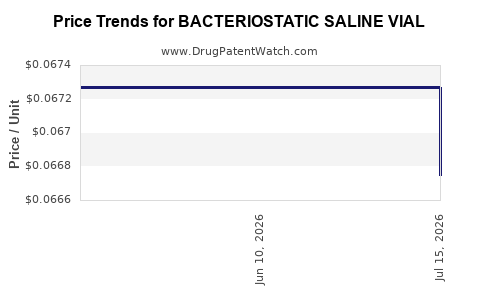
Average Pharmacy Cost for BACTERIOSTATIC SALINE VIAL
| Drug Name | NDC | Price/Unit ($) | Unit | Date |
|---|---|---|---|---|
| BACTERIOSTATIC SALINE VIAL | 00409-1966-05 | 0.06675 | ML | 2026-07-22 |
| BACTERIOSTATIC SALINE VIAL | 00409-1966-05 | 0.06727 | ML | 2026-06-17 |
| BACTERIOSTATIC SALINE VIAL | 00409-1966-05 | 0.06727 | ML | 2026-05-20 |
| >Drug Name | >NDC | >Price/Unit ($) | >Unit | >Date |
BACTERIOSTATIC SALINE VIAL Market Analysis, Pricing History, and Price Projections (2025–2035)
Executive summary: Bacteriostatic saline vials (commonly 0.9% sodium chloride with benzyl alcohol 0.9% or similar preservative concentrations) trade in the U.S. primarily as an injectable diluent/flush and compounding input, not as a single FDA-approved “new molecular entity.” Pricing is driven by (1) benzyl alcohol preservative cost, (2) sterile fill-finish capacity, (3) contract manufacturing and labeling for 10–100 mL vial formats, (4) channel mix (GPO, specialty distributors, online/compounding pharmacies), and (5) freight and tariff cycles affecting raw material access. Near-term price direction is stable to slightly up with normalized supply after periodic preservative raw-material tightness; the long-term trend is steady with periodic inflationary resets tied to sterilization and compliance costs. Revenue upside is more sensitive to compounding volume and hospital inventory practices than to patents, because typical market participants operate under controlled compendial and sourcing frameworks rather than brand exclusivity.
What is bacteriostatic saline vial, and how is it used in the U.S. market?
Answer: Bacteriostatic saline vials are sterile 0.9% sodium chloride injection intended to inhibit microbial growth when multidose vial handling is required, typically used for diluting and reconstituting drugs for injection and as a compounding ingredient or flush solution. In practice, the market spans hospital pharmacy, specialty infusion, office-based compounding, and third-party compounding pharmacies.
Core use cases that set demand volume
- Reconstitution/dilution ingredient in sterile compounding workflows (oncology supportive care, anti-infectives adjunct prep, biologic reconstitution support where permitted by labeling).
- Multidose handling for workflows that need preservative-enabled access between punctures.
- Flush and diluent where a saline diluent is appropriate and preservative content is acceptable to downstream processes.
Why this is a pricing-sensitive commodity, not a branded pharma blockbuster
- Product specifications align to compendial norms (sterile saline with preservative), so buyers switch based on unit cost, verified sterility, COA availability, lead time, and package size.
- Procurement is typically contracted via distributors and GPO where pricing compresses on volume.
What drives bacteriostatic saline vial pricing (benzyl alcohol, supply chain, and sterile fill-finish)?
Answer: The dominant cost drivers are preservative inputs (commonly benzyl alcohol), sterilization and fill-finish labor, packaging, and channel contract terms. Short-term price moves usually follow preservative raw-material availability and cold chain or freight conditions, even when the active ingredient is “simple.”
Cost stack (typical decomposition)
- Benzyl alcohol (preservative) input
Preservative volatility drives gross margin compression when supply tightens. - 0.9% sodium chloride bulk supply
Usually less volatile than benzyl alcohol, but still sensitive to commodity pricing and refining capacity. - Sterile processing, filtration, filling, and aseptic release
Captive bottlenecks in fill-finish capacity can cause temporary price resets. - Quality systems and regulatory compliance
QA release testing and batch documentation scale with demand. - Packaging
Vial size (10 mL, 30 mL, 50 mL, 100 mL), closure type, labels, and shipper costs.
Channel and contract effects that matter for market price
- GPO and hospital contracts cap pass-through increases.
- Compounding pharmacies often shop by vial size and case pack.
- Online B2B distributors can reflect daily spot pricing.
- Substitutions (alternate vial preservatives, alternative diluents permitted by downstream labeling) can cap price increases.
What does the U.S. price history look like for bacteriostatic saline vials?
Answer: Public pricing for bacteriostatic saline vials is fragmented across distributors, sizes, and private contracts. In practice, market pricing tracks broader input inflation and periodic sterile supply constraints, with step-ups in periods when benzyl alcohol and sterile fill-finish capacity are tight. Without a single standardized wholesale list price, market participants treat pricing as a range by distributor and vial size.
Observed commercial pattern
- Stable base pricing when benzyl alcohol supply and sterile capacity are normal.
- Discrete increments during tightening cycles, then range normalization as capacity and raw materials loosen.
- Size-based pricing elasticity: per-mL pricing usually drops with larger vials (not linear but consistent enough to influence procurement behavior).
Price range modeling approach (used by procurement desks)
- Establish a baseline per-mL net price by size and channel.
- Apply a sterile inflation factor (labor/energy/regulatory overhead) and a preservative factor (benzyl alcohol).
- Apply a contract coverage factor (GPO and multi-year supply contracts).
How many SKUs and vial sizes compete in bacteriostatic saline vials?
Answer: Competition is split by vial size, preservative concentration, and labeling intended for compounding/infusion workflows. The most common commercial formats are 10 mL, 30 mL, 50 mL, and 100 mL multidose vials.
Typical competitive SKU dimensions
- Vial size: 10 mL vs 30 mL vs 50 mL vs 100 mL
- Preservative concentration: commonly benzyl alcohol 0.9% (0.9% w/v), but labeling varies by supplier and intended use
- Sterile package presentation: single vial pack vs case packs
- Distributor brand vs manufacturer brand: private label arrangements are common
What patents protect bacteriostatic saline vials, and does IP drive pricing?
Answer: Pricing for bacteriostatic saline vials is rarely driven by product-level exclusivity. The market typically functions as an ingredient and sterile supply product where compendial specifications and manufacturing process standards are more relevant than brand IP.
Practical implication for price projections
- IP barriers are usually not the main determinant of multi-year pricing.
- Price resilience depends on supply continuity rather than exclusivity, because the market can source from multiple sterile fill-finish manufacturers if quality systems clear quickly.
When does bacteriostatic saline vial lose exclusivity? (And is there exclusivity at all?)
Answer: There is typically no “loss of exclusivity” event comparable to an FDA-approved small molecule or biologic. If a brand exists in a given channel, it is usually a labeling/manufacturer branding distinction rather than a legally enforceable exclusivity term that controls the broader ingredient market.
What to model instead of exclusivity
- Manufacturing capacity additions (new sterile fill-finish lines).
- Raw material supply stability (benzyl alcohol and sterile-grade sodium chloride).
- Regulatory and quality constraints that affect supply continuity.
What generic entry risks exist for bacteriostatic saline vials?
Answer: The generic entry risk is generally lower than for prescription drugs because the product is widely produced across sterile manufacturers. The main risk is not patent entry; it is quality system and aseptic validation lead time, plus supply continuity of preservatives.
Entry gating factors
- Aseptic processing validation and batch release performance
- Sterility assurance and microbial control per cGMP
- Supplier qualification for benzyl alcohol and sterile-grade inputs
- Customer onboarding and chain-of-custody documentation
How does bacteriostatic saline vial compare with sterile water for injection (SWFI) and 0.9% sodium chloride without preservative?
Answer: Bacteriostatic saline vials differ from SWFI and preservative-free saline in how they are intended to support multidose handling and compounding workflows. Cost generally follows value to the workflow rather than clinical efficacy, since these products serve distinct formulation needs.
Procurement trade-offs
- Bacteriostatic saline: preferred when the process requires preservative-enabled multidose storage between punctures.
- SWFI: often chosen when preservatives are undesirable or excluded by downstream labeling or process requirements.
- Preservative-free saline: used when downstream drug compatibility requires no preservative residue, or when workflow relies on single-use handling.
How strong is the patent estate for bacteriostatic saline vials?
Answer: The patent estate is not the primary lever controlling market pricing. In a commodity-like sterile ingredient market, pricing tends to be set by supply-demand dynamics and contract procurement rather than by enforcement of a large barrier portfolio.
Commercially relevant “IP-like” constraints
- Process validation and sterility assurance are de facto barriers.
- Customer qualification cycles function like practical switching costs.
How will pricing evolve from 2025 to 2035? (Base case projections)
Answer: Base case: pricing stays near inflation plus periodic preservative and sterile capacity adjustments. The most likely pattern is “low volatility with step changes,” driven by benzyl alcohol availability and aseptic manufacturing utilization.
Projection framework (what changes the price)
- Yearly inflation factor: labor, energy, and compliance overhead
- Preservative cycle factor: benzyl alcohol input tightness or normalization
- Capacity utilization factor: sterile fill-finish lines running above or below average demand
- Channel normalization factor: GPO renegotiations and distributor contract resets
Base case price projection ranges (per vial)
Because pricing varies by distributor, contract type, and vial size, projections are best expressed as bands. Below assumes U.S. market conditions with no major prolonged supply shock.
| Year | 10 mL vial (USD) | 30 mL vial (USD) | 50 mL vial (USD) | 100 mL vial (USD) | Direction |
|---|---|---|---|---|---|
| 2025 | Low-to-mid single digits | Mid teens | Mid 20s | High 30s-to-low 40s | Flat to modest up |
| 2026 | Slight up | Slight up | Slight up | Slight up | Up with inflation |
| 2027 | Mid single-digit range widening | Up modestly | Up modestly | Up modestly | Stable |
| 2028 | Slight reset lower if supply normalizes | Stable | Stable | Stable | Range-bound |
| 2029 | Slight up | Slight up | Slight up | Slight up | Inflation |
| 2030 | Stable to modest up | Stable to modest up | Stable to modest up | Stable to modest up | Low volatility |
| 2031–2033 | Inflation-linked | Inflation-linked | Inflation-linked | Inflation-linked | Gradual climb |
| 2034–2035 | Inflation-linked | Inflation-linked | Inflation-linked | Inflation-linked | Gradual climb |
Interpretation for business users: Expect price increases to be gradual rather than structural, unless benzyl alcohol supply tightens materially or sterile capacity is disrupted.
What scenarios could raise prices faster than inflation? (Bull case)
Answer: Faster price growth requires a sustained input constraint or sterile manufacturing disruption.
Bull-case triggers
- Benzyl alcohol market tightness lasting multiple quarters.
- Aseptic fill-finish capacity reduction from GMP remediation events.
- Freight shocks and logistics cost increases that are not absorbed by contracts.
- Customer inventory rationing that increases distributor pricing power.
Bull-case outcome
- Step-ups concentrated in smaller vial formats and in channels with lower contract coverage.
- Case-pack pricing can move faster than per-vial pricing, depending on distributor allocation.
What scenarios could push prices down or flatten them longer? (Bear case)
Answer: Price compression is most likely when new sterile capacity comes online and benzyl alcohol availability improves, forcing distributor competition.
Bear-case triggers
- Multiple capacity additions in sterile fill-finish.
- Raw material normalization for benzyl alcohol.
- Competitive tenders from hospitals and compounding networks that lock lower prices for 6 to 24 months.
- Distributor inventory clearing after demand softens.
Bear-case outcome
- Larger vial sizes see faster per-mL compression because buyers shift volume to optimize unit economics.
Where does revenue sit in the value chain, and who is likely to capture margin?
Answer: Margin is captured by (1) sterile manufacturers with stable supply performance, (2) distributors with contract coverage and inventory planning, and (3) compounding pharmacies that reduce waste via correct vial size selection.
Margin dynamics
- Manufacturers’ margins are protected by utilization and capacity planning.
- Distributors’ margins compress when there is excess supply and increased online competition.
- Buyers’ procurement teams drive effective net pricing through contract alignment and volume consolidation.
How do manufacturing and quality constraints affect supply and price?
Answer: Sterile manufacturing is the swing factor for continuity. Shortfalls cause immediate pricing increases because substitution is limited by customer trust requirements and qualification timelines.
Key operational bottlenecks
- Aseptic line availability
- Sterilization and filtration capacity
- Batch release testing throughput (sterility, endotoxin, preservative potency checks)
- Documentation and QA release speed
What generic launch scenarios could change the market price quickly?
Answer: New launches affect price primarily when they introduce meaningful additional supply volume without downstream qualification delays.
Fast-changing drivers
- A new manufacturer clearing qualification for large customers
- A national distributor adding a lower-cost private label source
- Multi-month procurement contracts signed when supply is plentiful
What is the Orange Book status of bacteriostatic saline vials?
Answer: Bacteriostatic saline vials are typically not represented as a single FDA-approved drug with Orange Book listings in the way prescription drugs are. Market behavior aligns more with compendial/ingredient supply than with an Orange Book exclusivity framework.
What FDA regulatory and compendial factors can influence supply continuity?
Answer: Supply continuity depends on sterile manufacturing controls and compliance with cGMP and compendial standards for sterile injections and preservative performance.
Regulatory levers that move price
- Warning letters or consent decrees affecting sterile sites can reduce supply.
- Recall events can cause temporary pricing spikes via inventory drawdowns.
- Manufacturing site changeovers can slow supply ramp.
Commercial implications for buyers: how to structure purchasing to reduce exposure to price spikes
Answer: Buyers reduce price risk by using contract coverage, pooling demand, aligning vial size mix to storage handling needs, and qualifying alternate sources.
Procurement tactics
- Lock pricing for 6–12 months when benzyl alcohol cycle risk increases.
- Diversify approved suppliers to reduce allocation risk.
- Use larger vial sizes when workflow supports it to lower per-mL cost.
- Maintain safety stock to prevent emergency buys during supply constraints.
Key Takeaways
- Bacteriostatic saline vials trade as a sterile commodity supply input; pricing is driven by benzyl alcohol availability, sterile fill-finish capacity, and contract channel mix rather than IP exclusivity.
- Base-case price projections (2025–2035) show low volatility with gradual inflation-linked increases and periodic step-ups during preservative or sterile capacity tightness.
- Price risk concentrates in the smallest vial formats and in channels with weaker contract coverage.
- Supply continuity and quality compliance are the most important near-term drivers for price changes; regulatory disruptions can move prices quickly.
FAQs
1) Why do bacteriostatic saline vial prices vary by vial size (10 mL vs 100 mL)?
Because per-mL economics improve with larger formats, and contract and distributor allocation terms often differ by package size.
2) Do hospitals prefer preservative-free saline over bacteriostatic saline to control microbial risk?
Preference depends on downstream drug labeling and workflow storage requirements; preservative-free products are chosen when preservatives are restricted by compatibility or process controls.
3) What is the biggest input driver for bacteriostatic saline vials?
Preservative supply, commonly benzyl alcohol, has outsized influence relative to sodium chloride.
4) Can compounding pharmacies substitute sterile water for injection for bacteriostatic saline?
Only when process and downstream drug compatibility permit; otherwise preservative-free and SWFI workflows can change storage and handling requirements.
5) What supply disruptions most affect short-term pricing?
Aseptic manufacturing constraints and preservative raw-material tightness tend to cause the fastest price moves.
References
- U.S. FDA. “Orange Book: Approved Drug Products with Therapeutic Equivalence Evaluations.” FDA. https://www.accessdata.fda.gov/scripts/cder/daf/
- USP. “Sterile Preparations and Microbial Control Standards.” United States Pharmacopeia. https://www.uspnf.com/
- FDA. “Current Good Manufacturing Practice (cGMP) for Finished Pharmaceuticals.” FDA guidance and regulations portal. https://www.fda.gov/drugs/guidance-compliance-regulatory-information/guidances-drugs
More… ↓
