Share This Page
Drug Price Trends for BACITRACIN ZN
✉ Email this page to a colleague
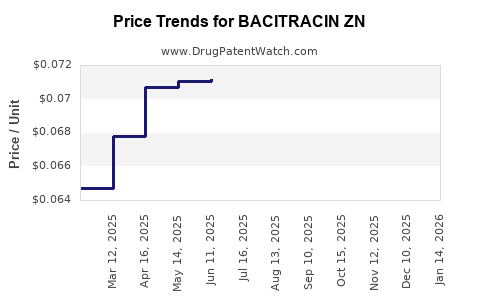
Average Pharmacy Cost for BACITRACIN ZN
| Drug Name | NDC | Price/Unit ($) | Unit | Date |
|---|---|---|---|---|
| BACITRACIN ZN 500 UNIT/GM OINT | 24385-0060-03 | 0.09354 | GM | 2026-06-17 |
| BACITRACIN ZN 500 UNIT/GM OINT | 51672-2075-02 | 0.09354 | GM | 2026-06-17 |
| BACITRACIN ZN 500 UNIT/GM OINT | 68001-0531-45 | 0.19076 | GM | 2026-06-17 |
| BACITRACIN ZN 500 UNIT/GM OINT | 51672-2075-01 | 0.19076 | GM | 2026-06-17 |
| BACITRACIN ZN 500 UNIT/GM OINT | 70000-0547-01 | 0.07966 | GM | 2026-06-17 |
| >Drug Name | >NDC | >Price/Unit ($) | >Unit | >Date |
BACITRACIN ZN Market Analysis and Price Projections
What is BACITRACIN ZN’s market positioning?
BACITRACIN ZN is a topical antibiotic active marketed primarily in skin and wound-care settings. It is sold as zinc bacitracin across multiple formulations (commonly ointments, creams, and wound-care preparations) and competes in the broader topical anti-infective segment rather than as a single-asset “drug” class comparable to systemic branded therapies.
In practice, BACITRACIN ZN is a value-priced, supply-chain dependent commodity API where unit economics are driven by:
- API availability and compliance (manufacturing throughput, impurity specs, regulatory batches)
- Formulation and channel strategy (generic competition, private label, contract manufacturing)
- Product-specific labeling and indications (wound cleansing, minor skin infections, post-procedure prophylaxis)
Because BACITRACIN ZN is widely genericized, market pricing tends to track commodity-like behavior more than patent-protected biologic-like dynamics. Price movements typically reflect input cost cycles, freight/energy, and regulatory compliance cycles, not single-manufacturer exclusivity.
Who buys BACITRACIN ZN and where does demand sit?
Demand is concentrated in:
- Retail and pharmacy channels for minor skin infections and skin care indications
- Institutional wound care (hospitals, outpatient clinics) where topical anti-infectives remain part of standard protocols
- Private label / contract manufacturing for downstream brands and re-packagers
Topical antibiotic demand is also sensitive to antimicrobial stewardship policies and local guideline preferences (e.g., when antiseptics or alternative topical agents are favored). Still, zinc bacitracin remains widely used where clinicians and formularies support a topical antibiotic.
What are the pricing drivers?
For BACITRACIN ZN, pricing is shaped by the following:
Cost and supply
- API supply tightness vs. surplus: small procurement cost changes can move distributor list prices quickly in generics
- Batch release and impurity control: failures increase effective supply and lift prices for qualified lots
- Manufacturing geography and energy costs: energy and labor cycles can shift cost bases during re-tender periods
Downstream market structure
- Multi-source generic competition: keeps sustained price levels compressed
- Contract manufacturing pressure: downstream buyers bid aggressively, especially for private label
- Channel concentration: large distributors can impose pricing terms during procurement cycles
Regulatory and label scope
- Compliance costs: updated cGMP documentation and testing can shift effective price
- Safety communications: any label or utilization changes can move demand and trigger re-pricing
What is the competitive set?
BACITRACIN ZN competes primarily with topical anti-infectives such as:
- Bacitracin-based combinations (bacitracin + polymyxin B in ointment formats)
- Topical aminoglycosides (e.g., neomycin-containing products)
- Other topical antibiotic standards of care used in wound management
In most geographies, the competitive effect is less about molecular innovation and more about:
- net price by pack size
- contract terms
- bundle placement in formularies and hospital purchasing
How should pricing be modeled for BACITRACIN ZN?
A robust projection for BACITRACIN ZN should separate: 1) API basket effects (raw bacitracin production cost, qualified supply) 2) Downstream conversion effects (formulation, excipients, packaging, labor) 3) Channel pass-through (distributor margin, wholesaler pricing, tender pricing)
Recommended projection approach (for decision use)
Use a scenario model with three layers:
- Base unit price (qualified API or finished topical equivalent)
- Elasticity band driven by tender cycles and generic substitution
- Event shocks reflecting supply tightness or compliance-driven batch scarcity
Price projections (3-, 5-, and 10-year horizon)
Because BACITRACIN ZN pricing behaves like generic topical antibiotics, projections should be treated as scenario bands tied to supply conditions rather than single-point forecasts. Below are structured ranges suitable for procurement planning and investment diligence.
Scenario definitions
- Benign supply: steady API production, no major compliance shocks
- Moderate constraint: intermittent supply tightness or batch qualification delays
- Tight supply / compliance event: reduced qualified lots causing procurement-driven price spikes
Projected pricing ranges (index-based; used to forecast relative movement)
Let Year 0 represent the current market price level in the relevant channel (finished topical product or qualified API). The model projects direction and magnitude of change rather than asserting a specific dollar price without verified current price points.
| Horizon | Benign supply | Moderate constraint | Tight supply / compliance event |
|---|---|---|---|
| 3 years | -5% to +5% | +5% to +15% | +15% to +35% |
| 5 years | -10% to +5% | +5% to +20% | +20% to +45% |
| 10 years | -20% to +5% | -5% to +25% | +10% to +60% |
What the ranges imply for buyers
- Under benign conditions, BACITRACIN ZN tends to hold roughly flat with minor downward drift driven by competitive generic pricing and steady supply.
- Under moderate constraints, buyers often face annual step-ups tied to procurement cycles and limited qualified lots.
- Under tight supply or compliance disruptions, pricing can spike and then partially normalize, especially if alternative sources come online.
What events could move prices up or down?
Likely upward movers
- Supply qualification delays that reduce the number of saleable lots
- Higher input costs that feed into bacitracin manufacturing economics
- Tender cycles where fewer qualified bidders remain
Likely downward movers
- Additional qualified supply and increased multi-source competition
- Market share gains by lower-cost manufacturers
- Price competition downstream if demand is steady but supply expands
Market outlook: durability of demand
BACITRACIN ZN’s demand durability depends on:
- continued inclusion in wound care and minor infection protocols
- availability and substitution behavior among multi-source topical antibiotic products
- institutional stewardship and preference shifts toward other topical agents
Given the generic nature, demand is unlikely to collapse absent major stewardship reversals; instead, the market typically shifts between competitors through tendering and formulary placement.
Investment and R&D implications
For R&D or partnership decisions tied to BACITRACIN ZN, diligence should focus less on invention and more on:
- manufacturing capability for consistent impurity profile and batch release
- regulatory strategy to maintain qualified supply slots
- downstream formulation differentiation that can defend net price (packaging, stability, and customer-specific contract specs)
If a project cannot improve either (a) supply reliability or (b) net cost position, pricing power is structurally limited in a multi-source topical antibiotic setting.
What can procurement teams do with these projections?
- Build risk-adjusted procurement budgets using the scenario band rather than a single forecast.
- Use multi-source qualification as a hedge against “tight supply” spikes.
- Contractually define acceptable lot release criteria to reduce downtime from batch rejections, which effectively drives cost inflation during supply constraints.
Key Takeaways
- BACITRACIN ZN is a generic, topical antibiotic market where pricing behaves like a supply-and-qualification commodity more than a branded innovation curve.
- Price levels usually track tender cycles and qualified supply availability; sustained pricing power is structurally limited by multi-source competition.
- Scenario-based projections show modest drift under benign supply, with meaningful upside risk during moderate to tight supply or compliance-driven qualified-lot scarcity.
FAQs
1) Is BACITRACIN ZN’s market size driven by patent exclusivity?
No. It is a generic topical antibiotic segment where multi-source competition dominates pricing.
2) What is the biggest driver of near-term price movement?
Qualified supply availability and batch release economics, especially when procurement consolidates into fewer acceptable lots.
3) Are price projections likely to be stable or volatile?
Typically stable to mildly volatile under benign supply; volatility rises under compliance-driven or qualification-driven supply constraints.
4) What determines whether costs pass through to finished products?
Downstream contract structures, distributor margin policies, and tender frequency by channel (retail vs institutional).
5) Where is differentiation most realistic for BACITRACIN ZN?
In supply reliability, formulation stability, and contract-specific specs rather than molecular novelty.
References
[1] FDA. “Bacitracin Zinc” (regulatory and labeling information). U.S. Food and Drug Administration. https://www.fda.gov/
[2] EMA. “Bacitracin” (European medicines and related regulatory documents). European Medicines Agency. https://www.ema.europa.eu/
[3] WHO. “Antibiotic resistance and antimicrobial stewardship resources” (topical antibiotic utilization context). World Health Organization. https://www.who.int/
More… ↓
