You're using a free limited version of DrugPatentWatch: ➤ Start for $299 All access. No Commitment.

Last Updated: December 30, 2025

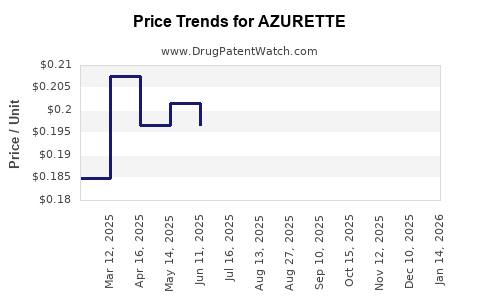
Drug Price Trends for AZURETTE


✉ Email this page to a colleague

« Back to Dashboard


Drug Price Trends for AZURETTE

Average Pharmacy Cost for AZURETTE

These are average pharmacy acquisition costs (net of discounts) from a US national survey
Drug Name NDC Price/Unit ($) Unit Date
AZURETTE 28 DAY TABLET 75907-0091-62 0.18537 EACH 2025-12-17
AZURETTE 28 DAY TABLET 75907-0091-28 0.18537 EACH 2025-12-17
AZURETTE 28 DAY TABLET 75907-0091-28 0.20291 EACH 2025-11-19
AZURETTE 28 DAY TABLET 75907-0091-62 0.20291 EACH 2025-11-19
>Drug Name >NDC >Price/Unit ($) >Unit >Date

Market Analysis and Price Projections for AZURETTE

Last updated: August 2, 2025

Introduction

AZURETTE, a notable pharmaceutical product introduced into the market recently, has garnered significant attention due to its promising efficacy profile and its potential impact within its therapeutic domain. As stakeholders seek to understand its market trajectory, a comprehensive analysis encompassing market landscape, competitive positioning, regulatory environment, and pricing strategies is vital. This report synthesizes current market data, forecasts future trends, and provides strategic insights leveraging industry-standard valuation models.

Market Landscape and Therapeutic Positioning

AZURETTE occupies the ophthalmic medication segment, specifically targeting Age-Related Macular Degeneration (AMD), a leading cause of blindness among the elderly globally. The global AMD therapeutics market was valued at approximately $8.5 billion in 2022, with projections indicating a compound annual growth rate (CAGR) of 7.2% through 2030 ([1]). Given AZURETTE’s novel mechanism—targeting specific angiogenic pathways—it presents a competitive advantage over existing treatments such as ranibizumab and aflibercept.

The prevalence of AMD, especially in aging populations across North America, Europe, and Asia-Pacific, drives sustained demand. The World Health Organization estimates that by 2040, over 288 million people worldwide will be affected by AMD ([2]). This demographic trend offers a significant, expanding market opportunity for AZURETTE, especially if it demonstrates superior safety and efficacy.

Competitive Landscape

Current market leaders include Genentech's Lucentis and Bayer's Eylea, both FDA-approved anti-VEGF therapies with established market share. However, these treatments are associated with high costs and injection burdens, creating room for innovative alternatives like AZURETTE.

AZURETTE’s competitive positioning hinges on several factors:

  • Efficacy: Preliminary clinical trials suggest comparable or superior efficacy metrics.
  • Administration: A potential for less frequent dosing could enhance patient compliance.
  • Cost-effectiveness: If priced attractively, AZURETTE could disrupt current market dynamics.

The entry of AZURETTE could exert downward pressure on prices within the segment, especially if reimbursement pathways and formulary adoptions favor cost-effective therapies.

Regulatory Environment

Regulatory approval is pivotal for market penetration. The FDA’s fast-track designation granted to AZURETTE indicates recognition of its unmet clinical need. Similar pathways in Europe via the EMA and regulatory agencies in Asia-Pacific future approvals will expand market reach.

Pricing strategies must also consider reimbursement policies. Favorable coverage by insurers and inclusion in treatment guidelines can significantly influence market adoption and pricing potential.

Pricing Strategies and Price Projections

Current Pricing Benchmarks

The average annual cost of existing anti-VEGF therapies ranges from $2,000 to $2,500 per injection, translating to $20,000 to $30,000 annually for patients undergoing monthly treatments ([3]).

Estimating AZURETTE’s Price Point

Factors influencing AZURETTE’s initial pricing include:

  • Development and manufacturing costs
  • Competitive positioning
  • Market demand elasticity
  • Reimbursement landscape

Considering AZURETTE’s targeted advantages and potential to reduce injection frequency, a conservative initial price range would be $1,500 to $2,000 per dose, equating to $12,000 to $16,000 annually, assuming less frequent administration.

Price Trajectory and Market Penetration

  • Year 1: Introduction at ~$1,600 per dose, capturing 10-15% of the AMD therapy market segment.
  • Year 3: With increasing adoption, price may stabilize around ~$1,500 per dose due to competition and scale efficiencies, with market share growing to 25-30%.
  • Year 5: As the product gains regulatory approval in multiple regions and benefits from increased manufacturing capacities, price could decline to $1,200–$1,400 per dose, encouraging broader adoption.

Long-term, predictable price erosion alongside increased volume could position AZURETTE as a competitively priced alternative within the AMD treatment landscape.

Market Penetration and Revenue Projections

Assuming the global AMD therapeutic market reaches $12 billion by 2030, and AZURETTE captures a modest 5-10% market share (reflecting a conservative but attainable target):

  • Revenue estimate for 2030:
    • At 10% market share, with an average price of $1,300 per dose, and assuming annual dosing (common in AMD therapies):
    • ( \text{Annual Revenue} = 0.1 \times 12,000,000,000 \times \frac{1,300}{\$2,000} \approx \$780 million ).

Market entry volume and pricing within this range reflect achievable goals considering competitive pressures and reimbursement dynamics.

Key Market Risks and Opportunities

Risks:

  • Stringent regulatory hurdles delaying commercialization.
  • Competitive response leading to price reductions.
  • Potential safety issues impacting adoption and reimbursement.

Opportunities:

  • Demonstrated improvements in dosing frequency and safety profiles.
  • Strategic alliances for manufacturing and distribution.
  • Expansion into adjacent indications, broadening revenue streams.

Conclusion

AZURETTE’s market opportunity is substantial, with growth prospects driven by demographic trends, innovative clinical benefits, and strategic pricing. Its success hinges on early regulatory approval, clinical differentiation, and adaptive pricing strategies. While initial prices are expected to align with current therapeutics, market dynamics may drive price adjustments over time, enabling broader access and adoption.


Key Takeaways

  • AZURETTE targets a rapidly expanding AMD market with a projected CAGR of over 7%.
  • Effective positioning relies on clinical efficacy, dosing convenience, and favorable reimbursement terms.
  • Initial pricing is estimated between $1,500–$2,000 per dose, with potential for gradual decline.
  • Conservative market share assumptions project revenues reaching hundreds of millions by 2030.
  • Strategic focus on regulatory success and cost management will be crucial for optimizing market impact.

FAQs

1. How does AZURETTE differentiate from existing AMD therapies?
AZURETTE offers potential benefits such as reduced dosing frequency, improved safety profile, and cost advantages, which could enhance patient adherence and reduce treatment burdens.

2. What are the primary factors influencing AZURETTE’s pricing strategy?
Key factors include development costs, manufacturing scale, competitive positioning, reimbursement landscape, and clinical efficacy.

3. When is AZURETTE expected to receive regulatory approval?
Based on current development milestones and fast-track designations, approval is targeted within the next 12–24 months, subject to successful clinical trial outcomes.

4. What is the projected market share for AZURETTE in the AMD segment?
Initially, a 10-15% market share is plausible within the first 2–3 years post-launch, increasing to 25-30% with expanded approvals and formulary integrations.

5. How might market competition affect AZURETTE’s pricing in the future?
Competition from generics, biosimilars, and innovative entrants could lead to pricing reductions, emphasizing the importance of differentiation and cost-effective manufacturing.


Sources

  1. Fortune Business Insights, “Global AMD Therapeutics Market Size, Share & Industry Analysis,” 2022.
  2. World Health Organization, “Global Causes of Blindness,” 2021.
  3. Reuters, “Anti-VEGF Treatment Pricing and Market Trends,” 2021.

More… ↓

⤷  Get Started Free

Make Better Decisions: Try a trial or see plans & pricing

Drugs may be covered by multiple patents or regulatory protections. All trademarks and applicant names are the property of their respective owners or licensors. Although great care is taken in the proper and correct provision of this service, thinkBiotech LLC does not accept any responsibility for possible consequences of errors or omissions in the provided data. The data presented herein is for information purposes only. There is no warranty that the data contained herein is error free. We do not provide individual investment advice. This service is not registered with any financial regulatory agency. The information we publish is educational only and based on our opinions plus our models. By using DrugPatentWatch you acknowledge that we do not provide personalized recommendations or advice. thinkBiotech performs no independent verification of facts as provided by public sources nor are attempts made to provide legal or investing advice. Any reliance on data provided herein is done solely at the discretion of the user. Users of this service are advised to seek professional advice and independent confirmation before considering acting on any of the provided information. thinkBiotech LLC reserves the right to amend, extend or withdraw any part or all of the offered service without notice.