Last updated: February 12, 2026
Market Size and Sales Trends for Azithromycin
Azithromycin, a macrolide antibiotic with broad-spectrum activity, generated global sales of approximately $1.2 billion in 2022. The drug’s annual revenue has grown from $750 million in 2018, reflecting increased use in respiratory infections, sexually transmitted infections, and off-label applications.
The US market accounts for roughly 35% of global sales, approximately $420 million in 2022, with Europe and Asia-Pacific contributing 30% and 20%, respectively. Key players include Pfizer (brand: Zithromax, Z-Pak), with a market share exceeding 70%, along with Teva, Sandoz, and other generics.
Market Drivers and Challenges
Drivers:
- Rise in respiratory infections (pneumonia, bronchitis)
- High prevalence of sexually transmitted infections
- Expansion of outpatient antibiotic use
- Preference for oral antibiotics due to ease of administration
Challenges:
- Growing antibiotic resistance
- Regulatory scrutiny over antimicrobial stewardship
- Competition from newer antibiotics (e.g., doxycycline, amoxicillin)
- Patent expirations and generic entry
Competitive Landscape
| Company |
Product Name |
Market Share (2022) |
Notes |
| Pfizer |
Zithromax, Z-Pak |
70%+ |
Patents expired in 2012; branded still significant in some markets |
| Teva |
Azithromycin generics |
15% |
Dominates generics market |
| Sandoz |
Generic formulations |
10% |
Significant in Europe |
| Others |
Various |
5% |
Regional players |
Price Trends and Projections
Historical Price Dynamics
- In the US, the average wholesale price (AWP) for a 250 mg Zithromax tablet was approximately $3.50 in 2018.
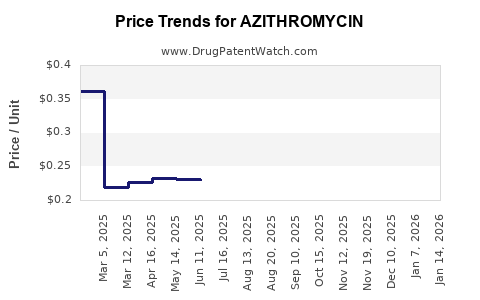
- Generic azithromycin tablets currently retail at around $0.10 to $0.30 per tablet, a decline of over 90% since patent expiration.
- The average course (five-day therapy, 500 mg on day 1, then 250 mg daily) costs approximately $3 to $5 in the US for generic versions.
Forecasts (2023–2027)
- The global market value of azithromycin is projected to grow at a compound annual growth rate (CAGR) of 2%–3%, driven by increasing outpatient prescriptions.
- The US market is expected to see a slowdown in sales growth, stabilized by high generic penetration and antimicrobial stewardship policies.
- In developing countries, price reductions are likely as generic manufacturing expands and regulatory approvals streamline.
| Year |
Estimated Global Market Size |
US Market Size |
Key Factors Impacting Price |
| 2023 |
$1.15 billion |
$410 million |
Increased generic supply, resistance-driven demand shifts |
| 2024 |
$1.18 billion |
$400 million |
Price competition intensifies, phased reductions |
| 2025 |
$1.20 billion |
$395 million |
Resistance limiting use in some indications |
| 2026 |
$1.22 billion |
$390 million |
Market saturation, stewardship policies strengthen |
| 2027 |
$1.25 billion |
$385 million |
Slight price stabilization, emerging markets grow |
Regulatory and Patent Landscape
- Patents for branded azithromycin expired in 2012 in the US, enabling generics.
- Several formulations continue to be patented in specific markets, potentially affecting prices.
- Regulatory agencies like FDA and EMA tighten controls on prescribing antimicrobial agents, influencing market volume.
Key Market Risks
- Antibiotic resistance curbing efficacy and usage
- Policy shifts prioritizing antimicrobial stewardship
- Pricing pressures from increased generics and biosimilars
- Emerging competition from novel antibiotics and alternative therapies
Investment and R&D Outlook
Pfizer continues to explore new formulations and delivery methods to extend market presence. Generic manufacturers focus on cost reduction and expanding access in low- and middle-income countries. Efforts to develop combination medications and formulations targeting resistant strains may influence future markets.
Conclusion
Azithromycin maintains significant market volume, with stable sales expected amidst growth in outpatient use and new formulations. Price declines are ongoing due to patent expirations and aggressive generic competition, though regional variations persist based on regulatory and healthcare infrastructure. The drug’s future outlook hinges on resistance trends, stewardship initiatives, and innovations in antibiotic delivery.
Key Takeaways
- Global azithromycin sales stood at $1.2 billion in 2022, with the US representing approximately $420 million.
- The market has shifted toward generics, causing prices to decline over the past decade.
- Growth is driven by respiratory and sexually transmitted infection treatment, but resistance and stewardship policies pose risks.
- Prices are forecasted to stabilize at lower levels through 2027, with regional disparities based on market access and regulation.
- Investment in new formulations, combination therapies, and resistance management remains critical for market expansion.
FAQs
1. How have patent expirations affected azithromycin pricing?
Patent expirations in 2012 led to a surge in generic competition, reducing the average wholesale and retail prices by over 80%.
2. What is the forecasted global market growth rate for azithromycin?
The market is expected to grow at a CAGR of 2%–3% from 2023 to 2027.
3. Which regions dominate azithromycin consumption?
The US, Europe, and Asia-Pacific account for over 85% of sales, with growing markets in Latin America and Africa.
4. What are the main factors influencing future prices?
Generic competition, resistance patterns, antimicrobial stewardship policies, and innovation in formulations.
5. How significant are resistance issues for azithromycin?
Resistance diminishes efficacy in some infections, leading to prescribing restrictions and reduced utilization in certain indications.
References
- IQVIA. (2023). "Global Antibiotics Market Report."
- FDA. (2022). "Patent and Regulatory Status of Azithromycin."
- Statista. (2022). "Azithromycin Sales and Market Share Data."
- WHO. (2021). "Antimicrobial Resistance and Impact on Antibiotic Markets."