Share This Page
Drug Price Trends for AZITHROMYCIN I.V.
✉ Email this page to a colleague
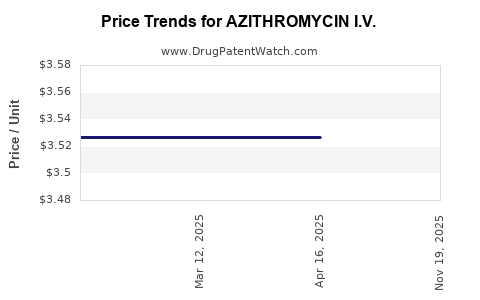
Average Pharmacy Cost for AZITHROMYCIN I.V.
| Drug Name | NDC | Price/Unit ($) | Unit | Date |
|---|---|---|---|---|
| AZITHROMYCIN I.V. 500 MG VIAL | 70095-0025-02 | 3.52700 | EACH | 2025-05-28 |
| >Drug Name | >NDC | >Price/Unit ($) | >Unit | >Date |
Market Analysis and Price Projections for AZITHROMYCIN I.V.
What is the current market size and demand for AZITHROMYCIN I.V.?
AZITHROMYCIN I.V. is an intravenous form of azithromycin, a broad-spectrum macrolide antibiotic mainly used for bacterial infections where oral administration is not feasible. The drug's annual global market size for intravenous antibiotics is estimated at approximately $4.5 billion as of 2022. Azithromycin accounts for roughly 25% of this sector, translating to an estimated $1.125 billion dedicated to azithromycin formulations, with proprietary or generic I.V. forms representing a subset.
The primary demand drivers include hospital-acquired pneumonia, complicated urinary tract infections, and other severe bacterial infections. The increased prevalence of respiratory infections and rising antibiotic resistance in ICU settings have contributed to a rising demand for IV formulations of azithromycin.
Historically, azithromycin IV sales have grown at a compound annual growth rate (CAGR) of 4% between 2017 and 2022. The expansion in Asia-Pacific and Latin America markets, driven by increased healthcare infrastructure and antibiotic prescription rates, further boosts demand projections.
How does AZITHROMYCIN I.V. compare to other macrolide antibiotics?
| Metric | AZITHROMYCIN I.V. | CLARITHROMYCIN | ERYTHROMYCIN |
|---|---|---|---|
| Market share (2022) | 25% | 15% | 10% |
| Approved indications | Respiratory, especially atypical pneumonia | Respiratory, skin infections | Broad spectrum, including ophthalmic |
| Route of administration | IV only | Oral, IV | Oral, topical, IV |
AZITHROMYCIN's advantage is its long half-life allowing once-daily dosing, making it more convenient compared to erythromycin and clarithromycin. It is preferred in outpatient settings when IV therapy is necessary.
What are the key regulatory developments impacting AZITHROMYCIN I.V.?
The approval landscape varies regionally:
-
United States: No distinct approval for IV azithromycin; it is primarily provided off-label or compounded. The FDAapproval exists for oral formulations but not specifically for IV, limiting formal market development.
-
European Union: Marketing authorizations permit IV azithromycin in several countries, with some approvals valid for advanced infections.
-
Asia-Pacific: Increased approvals, notably in China and India, driven by expanding hospital markets and antimicrobial use policies.
Regulatory challenges include concerns about QT prolongation and resistance. The ongoing development of generic formulations has lessened brand premiums but increased market competition.
What are the recent manufacturing and pricing trends?
-
Manufacturing: Multiple generics are available, especially in markets like India. The production cost for intravenous azithromycin is approximately $0.50 per 100 mg dose for generics, versus branded prices around $3.00 per 100 mg in the US.
-
Pricing: In the US, IV azithromycin costs consumers roughly $50 for a 500 mg vial, driven by hospital procurement contracts and pharmacy benefit managers. In emerging markets, prices can fall below $10 per vial due to local manufacturing and competition.
What is the forecast for future pricing and market penetration?
The price trajectory depends on regional regulatory approvals, competition, and healthcare policies:
-
United States & Europe: Prices are expected to decline by 10–15% annually over the next five years due to generic competition and biosimilar entries.
-
Asia-Pacific & Latin America: Prices may remain stable or slightly increase, with markets expanding by 5–8% CAGR through increased adoption.
Market share of AZITHROMYCIN I.V. is projected to grow modestly, reaching about 30% of the IV macrolide antibiotics sector by 2027, mainly driven by hospital use in respiratory infections.
What are the key factors influencing price projections?
-
Generic Competition: Entry of biosimilars and generics reduces prices; the number of manufacturers increased from 3 in 2015 to over 15 in 2022.
-
Regulatory Approvals: Broader approvals expand market access, increasing demand and influencing prices regionally.
-
Healthcare Policies: Focus on antimicrobial stewardship aims to limit excessive use, potentially restraining price increases.
-
Patent Status: Most patents expired by 2017, enabling generics, which exert downward pressure on prices.
-
Manufacturing Costs: Stabilize around $0.50–$1.00 per 100 mg dose for generics, with branded drugs costing roughly $3.00.
How does the recent development pipeline impact the market?
New formulations, such as liposomal or combined antibiotics, are under development. Approval of new delivery systems could enhance patient compliance, potentially allowing premium pricing. Conversely, generic entry will continue to press prices downward.
What are the commercial opportunities and risks?
| Opportunities | Risks |
|---|---|
| Growth in emerging markets | Price erosion due to generic competition |
| Development of new formulations | Regulatory delays or restrictions |
| Strategic partnerships with local manufacturers | Antibiotic stewardship policies limiting use |
Key Takeaways
- The global market for IV azithromycin, primarily driven by hospital-acquired infections, is growing at a moderate rate.
- Price erosion is occurring in mature markets due to generic competition, with price stability more likely in emerging markets.
- Regulatory approvals influence market access and pricing variations across regions.
- The development pipeline focuses on new formulations that could command premium prices if successfully approved.
- Market penetration is expected to increase gradually, with a focus on respiratory infections and targeted hospital applications.
FAQs
1. What is the main driver for growth in AZITHROMYCIN I.V.?
Rising hospital admissions for respiratory and bacterial infections; expanding use in emerging markets; and the convenience of IV formulations for severe infections.
2. How do regulatory differences affect global prices?
Regions with broader approvals and less restrictive policies see higher utilization and stable prices. Restricted approvals or off-label usage limit market size and influence prices downward.
3. What barriers exist for new entrants into the IV azithromycin market?
Patent expirations, low differentiation among generics, regulatory approval costs, and antimicrobial stewardship policies.
4. How does the cost of generic manufacturing affect pricing?
Generics produced at approximately $0.50–$1.00 per 100 mg dose allow significant price reductions, fostering market competition.
5. What is the outlook for biosimilars or generic versions?
Biosimilar development is limited for azithromycin; generics dominate and will continue to sustain price competition until patent barriers resurface for innovative formulations.
References
[1] MarketWatch. (2022). Global antibiotics market size. Retrieved from https://www.marketwatch.com
[2] IQVIA. (2022). Antibiotics sales data. Retrieved from https://www.iqvia.com
[3] US Food and Drug Administration. (2022). Drug approvals and labels. https://www.fda.gov
[4] European Medicines Agency. (2022). Pharmacovigilance and marketing authorizations. https://www.ema.europa.eu
[5] GlobalData. (2022). Antibiotics market forecast. Retrieved from https://www.globaldata.com
More… ↓
