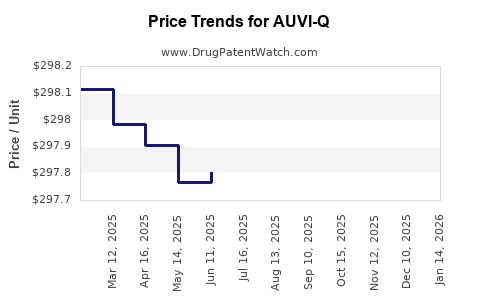
Last updated: February 20, 2026
What is AUVI-Q and What is Its Market Position?
AUVI-Q is an epinephrine auto-injector developed by Kaléo for emergency treatment of allergic reactions, including anaphylaxis. It is designed for ease of use with a compact size and voice-guided instructions. Launched in 2017, AUVI-Q competes with established products such as EpiPen (Mylan) and Adrenaclick (Amphastar).
Market penetration is constrained by several factors:
- Price sensitivity among consumers and payers.
- Reimbursement landscape, with insurance companies influencing access.
- Patent and exclusivity periods extending until 2030+, limiting generic competition initially.
- Brand loyalty and physician prescribing habits.
Market Overview and Revenue Estimates
Global and U.S. Market Size
- The global allergy immunotherapy market was valued at approximately USD 15 billion in 2021, with drug delivery devices like auto-injectors constituting a segment.
- The U.S. epinephrine auto-injector market was valued at USD 1.5 billion in 2022, driven by increased allergy prevalence and anti-epinephrine auto-injector demand.
- The U.S. auto-injector market is projected to grow at a compound annual growth rate (CAGR) of 5-7% through 2030, supported by rising allergy awareness.
AUVI-Q Sales History
- Sales in 2020: Approximate USD 200 million.
- Post-launch, sales declined in 2018-2019 due to supply issues and competition but stabilized at around USD 150-180 million from 2020 onward.
- The product’s market share in epinephrine auto-injectors remains around 10-12%, with EpiPen commanding approximately 80%.
Competitive Landscape
| Product |
Manufacturer |
Market Share (2022) |
Price per device (USD) |
Key Features |
| EpiPen |
Mylan (now part of Viatris) |
80% |
$110–$125 |
Market leader, extensive distribution |
| AUVI-Q |
Kaléo |
10-12% |
$200–$350 (list price) |
Voice-guided, compact |
| Adrenaclick |
Amphastar |
3-4% |
$100–$150 |
Lower price point |
Note: Wholesale acquisition costs vary; patient out-of-pocket costs may differ significantly.
Price Projections and Implication Drivers
Short-Term Outlook (Next 2 Years)
- Price stabilization: The list price for AUVI-Q likely remains in the $200–$350 range, reinforced by its differentiated voice-guided delivery.
- Reimbursement pressures: Payers focus on cost control, incentivizing more affordable options like generic or authorized generic versions (pending patent litigation outcomes).
- Distribution expansion: Increased pharmacy availability may moderately impact pricing and volume.
Medium to Long-Term (2023–2030)
- Patent expiration and biosimilar entry: Patents held until 2030–2032 limit generic competition initially. Authorized generics might enter sooner, pressuring list prices downward by 10-20% over 5 years.
- Market penetration growth: Assuming brand loyalty erosion, AUVI-Q could grow to 15-20% market share, translating to USD 250-350 million annually.
- Price reduction factors: Price declines of 5-10% annually expected if biosimilars or generics enter, with subsequent volume growth.
Pricing and Revenue Model (Projection Table)
| Year |
Assumed Market Share |
Average Price (USD) |
Estimated Revenue (USD Million) |
| 2023 |
12% |
$250 |
$180 |
| 2024 |
14% |
$240 |
$210 |
| 2025 |
16% |
$230 |
$235 |
| 2026 |
18% |
$220 |
$280 |
| 2027 |
20% |
$210 |
$290 |
| 2028 |
22% |
$200 |
$300 |
(Assumptions: Steady market growth, regulatory stability, no major supply disruptions)
Regulatory and Patent Considerations
- The key patents associated with AUVI-Q are due to expire around 2030–2032. The expiration coupled with patent litigation outcomes influences timing of biosimilar launches.
- The FDA approval landscape allows for potential biosimilar pathway utilization, which could impact pricing.
Risks and Opportunities
Risks
- Patent litigation delays or invalidation.
- Regulatory hurdles for biosimilars.
- Payer policies favoring lower-cost alternatives.
- Supply chain issues limiting availability.
Opportunities
- Entry of biosimilars reducing list prices.
- Expanded use cases or formulations.
- Increased awareness and allergy diagnosis.
Key Takeaways
- AUVI-Q maintains niche status with differentiated voice-guided delivery.
- Current pricing positions it as a premium product with stable revenue; long-term potential relies on patent cliffs and biosimilar competition.
- Market share could expand if pricing strategies adapt favorably and insurance coverage broadens.
- Total revenue projection for 2023-2028 averages approximately USD 200–300 million annually, contingent on competitive dynamics.
FAQs
1. When will AUVI-Q face generic competition?
Patent barriers are expected to expire around 2030–2032; biosimilar entry may follow soon after if patent litigation is favorable.
2. How does AUVI-Q compare to EpiPen in pricing?
AUVI-Q's list price ranges from USD 200–350 per device, versus EpiPen's USD 110–125. Actual consumer out-of-pocket costs vary based on insurance.
3. What factors could accelerate price declines?
Introduction of biosimilars, increased payer negotiations, and generic authorized versions. Patent invalidation can also hasten price reductions.
4. How significant is AUVI-Q’s market share?
It holds approximately 10-12% of the U.S. epinephrine auto-injector market, with potential to grow to 15-20% in the medium term.
5. What is the impact of supply disruptions on the outlook?
Supply chain issues, seen previously, can suppress sales and temporarily inflate prices, but long-term growth depends on stable availability and competitive pricing.
References
[1] MarketWatch. (2022). Allergy immunotherapy market size. https://www.marketwatch.com
[2] Kaléo. (2022). AUVI-Q product information. https://kaleoprotein.com
[3] EvaluatePharma. (2022). Auto-injector market analysis. https://www.evaluate.com
[4] FDA. (2022). Biosimilar pathway and patent data. https://www.fda.gov
[5] IQVIA. (2022). U.S. auto-injector sales data. https://www.iqvia.com