Share This Page
Drug Price Trends for ATORVALIQ
✉ Email this page to a colleague
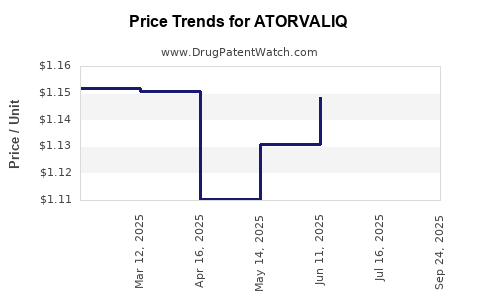
Average Pharmacy Cost for ATORVALIQ
| Drug Name | NDC | Price/Unit ($) | Unit | Date |
|---|---|---|---|---|
| ATORVALIQ 20 MG/5 ML SUSP | 46287-0030-01 | 1.18722 | ML | 2026-07-22 |
| ATORVALIQ 20 MG/5 ML SUSP | 46287-0030-01 | 1.18763 | ML | 2026-06-17 |
| ATORVALIQ 20 MG/5 ML SUSP | 46287-0030-01 | 1.18788 | ML | 2026-05-20 |
| ATORVALIQ 20 MG/5 ML SUSP | 46287-0030-01 | 1.18941 | ML | 2026-04-22 |
| ATORVALIQ 20 MG/5 ML SUSP | 46287-0030-01 | 1.18907 | ML | 2026-03-18 |
| ATORVALIQ 20 MG/5 ML SUSP | 46287-0030-01 | 1.19028 | ML | 2026-02-18 |
| >Drug Name | >NDC | >Price/Unit ($) | >Unit | >Date |
What Is ATORVALIQ?
ATORVALIQ is a branded formulation of atorvastatin, a statin used to lower low-density lipoprotein (LDL) cholesterol and reduce cardiovascular disease risk. It is marketed as a prescription medication targeting hyperlipidemia and cardiovascular event prevention.
Market Size and Growth Potential
Global Statins Market Overview
The global statins market was valued at approximately $23 billion in 2022. It is projected to grow at a compound annual growth rate (CAGR) of 4.5% through 2030, reaching around $35 billion (Source: Grand View Research). Atorvastatin accounts for 55–60% of total statin sales worldwide due to its established efficacy and generic availability.
Market Segments
- Developed Markets (North America, Europe): Comprise 60% of sales, driven by high diagnosis rates and insurance coverage.
- Emerging Markets (Asia, Latin America, Africa): Account for 40%, with growth driven by increasing cardiovascular disease prevalence and improving healthcare infrastructure.
Key Market Drivers
- Rising cardiovascular disease prevalence (over 900 million globally in 2022, WHO).
- Expanding awareness and diagnosis of hyperlipidemia.
- Generic versions lowering prices in mature markets.
- Preference for oral cholesterol-lowering therapies.
Competitive Landscape
Major Players
- Pfizer (Lipitor, generic atorvastatin)
- Mylan (generic)
- Teva Pharmaceuticals (generic)
- Novartis (moderate market share)
- AstraZeneca (earlier branded versions)
Market Share Dynamics
Generic atorvastatin holds approximately 85% of the global market share for atorvastatin drugs, with branded versions, including ATORVALIQ, occupying a niche in specific markets or formulations.
Patent Status
The original Lipitor patent expired in 2011 in the U.S. and 2012 globally, enabling extensive generic competition. ATORVALIQ, as a branded product, may have patent protections or market exclusivity periods varying by country, potentially until 2024–2027, depending on local patent laws.
Pricing Analysis
Current Price Point
In the United States, generic atorvastatin retails for $0.10–$0.20 per tablet. Branded products like ATORVALIQ are priced significantly higher; typical retail prices range from $3 to $10 per tablet depending on formulation, dosing, and insurance coverage.
Regional Price Differences
| Region | Branded Price Range | Generic Price Range |
|---|---|---|
| North America | $5–$10 per tablet | $0.10–$0.20 per tablet |
| Europe | €3–€7 per tablet | €0.30–€0.50 per tablet |
| Emerging Markets | $2–$6 per tablet | $0.05–$0.15 per tablet |
Price Trends
Over the past decade, prices of branded atorvastatin have declined significantly post-patent expiry. Despite this, certain formulations and regions sustain premium pricing due to brand recognition, patent protections, or specialized delivery mechanisms.
Regulatory and Market Entry Factors
- Approval Status: ATORVALIQ has received regulatory approval in select markets, including the European Union and Latin America.
- Pricing Regulations: Government-mandated price controls in countries like India and parts of Europe restrict maximum allowable prices.
- Market Penetration: Availability through pharmacies, hospitals, and direct-to-consumer channels influences pricing and sales volume.
Revenue Projections and Market Opportunities
Short-term Outlook (Next 2–3 Years)
- Stability dominated by existing generic market share.
- Limited upside unless new formulations, patented delivery systems, or combination therapies are introduced.
- Price erosion expected in mature markets, potentially reducing unit prices by 10–15% annually.
Long-term Outlook (3–10 Years)
- Potential growth in emerging markets linked to increasing cardiovascular risk factors.
- Differentiation strategies (e.g., novel delivery, combination with other agents) may sustain premium pricing.
- Patent protections or exclusivities could sustain higher prices for 2–5 years post-approval.
Pricing Strategies
- Premium Pricing: Leverage brand recognition in specific markets with limited generic competition.
- Value-based Pricing: Emphasize improved adherence or combination formulations.
- Tiered Pricing: Adjust based on regional purchasing power and regulatory constraints.
Key Takeaways
- ATORVALIQ operates within a large, mature market with significant generic competition.
- Current prices are substantially higher in branded form but face downward pressure from generics.
- Market growth depends on regional disease prevalence, healthcare infrastructure, and regulatory dynamics.
- Innovation, such as combination therapies or new delivery methods, may sustain or increase profitability.
- Short-term prospects see limited growth; future success hinges on strategic differentiation and market expansion.
FAQs
1. How does ATORVALIQ differ from generic atorvastatin?
It may feature unique formulation, branding, or delivery mechanisms. Regulatory exclusivity or branding efforts can also distinguish it in select markets.
2. What is the patent status of ATORVALIQ?
Patent protections vary by country and may extend until 2024–2027, depending on local patent laws and patent reform history.
3. What are key price drivers for ATORVALIQ?
Brand recognition, exclusivity periods, formulation innovations, and regional regulatory policies influence pricing.
4. Which markets offer the highest revenue potential for ATORVALIQ?
Developed markets with high cardiovascular disease prevalence and less generic penetration, such as some European countries, are most lucrative.
5. What factors could influence future pricing trends?
Patent expirations, increased generic market share, regulatory price controls, and new formulations or combination therapies.
Citations
[1] Grand View Research. "Statins Market Size, Share & Trends Analysis." 2022.
[2] WHO. "Cardiovascular Diseases Fact Sheet." 2023.
[3] U.S. FDA. "Patent Expiration Dates for Lipitor." 2011.
[4] IQVIA. "Global Oncology & Cardiovascular Market Data." 2022.
More… ↓
