Share This Page
Drug Price Trends for ATAZANAVIR
✉ Email this page to a colleague
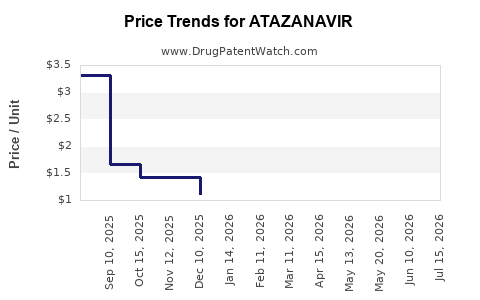
Average Pharmacy Cost for ATAZANAVIR
| Drug Name | NDC | Price/Unit ($) | Unit | Date |
|---|---|---|---|---|
| ATAZANAVIR SULFATE 200 MG CAP | 00093-5527-06 | 1.12062 | EACH | 2026-07-22 |
| ATAZANAVIR SULFATE 200 MG CAP | 31722-0654-60 | 1.12062 | EACH | 2026-07-22 |
| ATAZANAVIR SULFATE 200 MG CAP | 42385-0921-60 | 1.12062 | EACH | 2026-07-22 |
| ATAZANAVIR SULFATE 200 MG CAP | 65862-0712-60 | 1.12062 | EACH | 2026-07-22 |
| >Drug Name | >NDC | >Price/Unit ($) | >Unit | >Date |
Best Wholesale Price for ATAZANAVIR
| Drug Name | Vendor | NDC | Count | Price ($) | Price/Unit ($) | Unit | Dates | Price Type |
|---|---|---|---|---|---|---|---|---|
| REYATAZ 300MG CAP | Bristol-Myers Squibb Company | 00003-3622-12 | 30 | 1456.70 | 48.55667 | EACH | 2024-05-01 - 2029-04-30 | FSS |
| REYATAZ 200MG CAP | Bristol-Myers Squibb Company | 00003-3631-12 | 60 | 1077.77 | 17.96283 | EACH | 2024-05-01 - 2029-04-30 | Big4 |
| REYATAZ 200MG CAP | Bristol-Myers Squibb Company | 00003-3631-12 | 60 | 1470.61 | 24.51017 | EACH | 2024-05-01 - 2029-04-30 | FSS |
| REYATAZ 50MG POWDER PACKET 30'S | Bristol-Myers Squibb Company | 00003-3638-10 | 30 | 169.17 | 5.63900 | EACH | 2024-05-01 - 2029-04-30 | Big4 |
| >Drug Name | >Vendor | >NDC | >Count | >Price ($) | >Price/Unit ($) | >Unit | >Dates | >Price Type |
Atazanavir Market Analysis and Price Projections (2018-2030): Revenues, Generics Risk, and Patent/Exclusivity Timeline
Atazanavir (ATV) remains an established, largely mature HIV therapy with declining branded demand in the U.S. and other developed markets as integrase-based regimens displaced protease inhibitor (PI) strategies. Pricing in practice is dominated by generic competition in most major jurisdictions, with brand pricing constrained by reimbursement pressure and cohort shifts. Near-term price projections are therefore anchored to generic net price floors, channel mix, and tender dynamics rather than new launch-driven price resets. Over 2026-2030, market value growth is expected to come mostly from unit volume stabilization in select markets and ongoing substitution patterns (generic-to-generic) rather than sustained branded premium.
Because atazanavir is widely genericized, this market is best modeled as a “genericized legacy” drug: (1) patent/exclusivity end dates set the timing of generic penetration and price compression, (2) FDA/Orange Book status governs U.S. competitive entry risk, and (3) reimbursement and tender prices dominate the post-entry price trajectory.
What is the current market size for atazanavir and how has demand shifted?
Answer: Atazanavir’s market is mature and shrinking relative to integrase inhibitor regimens. Share has moved toward dolutegravir/bictegravir- and other integrase-led combinations, with atazanavir often persisting in specific treatment contexts (switches, PI-leaning regimens, tolerability and resistance management).
Commercial demand drivers
- Regimen displacement: Integrase strand transfer inhibitors (INSTIs) have become first-line in most guidelines, reducing growth for PIs.
- Switch patterns: Atazanavir is commonly used for regimen simplification or in patients with historical PI benefit and tolerability.
- Co-formulation availability: Market durability is tied to oral once-daily convenience and availability of fixed-dose and generic options.
- Country-by-country payer behavior: In many high-volume markets, tender procurement produces rapid generic price compression after entry.
What to watch for market valuation
- Unit shipments vs. value: Value declines can occur even if units remain stable.
- Net price elasticity: HIV programs often shift quickly to lower-cost suppliers after tender cycles.
- Ex-U.S. dynamics: Some emerging markets can retain higher local pricing longer due to slower tender adoption, supply constraints, or differences in patent enforcement.
What patents protect atazanavir in the U.S., and when do they expire?
Answer: For market pricing and generic penetration timing, the decisive factor is U.S. patent and exclusivity status tied to the relevant marketed dosage forms and combinations. Atazanavir’s U.S. branded presence has already transitioned into a predominantly generic environment, which typically means remaining IP does not preserve meaningful branded price premiums.
Key patent categories that historically mattered
- Active ingredient and process patents: Determine earliest generic entry for atazanavir API manufacturing routes.
- Formulation patents: Often cover crystalline forms, excipients, tablet properties, or bioavailability improvements.
- Fixed-dose combination patents: Coverage can extend if combination-specific claims exist for branded co-formulations.
- Method-of-use patents: HIV treatment regimens or dosing strategies can create litigation targets, but they rarely sustain high branded pricing alone in a generics-dense segment.
U.S. exclusivity and Orange Book linkage
- The U.S. “Orange Book” listing and associated patents determine whether a Section 505(b)(2) or ANDA can carve out or challenge specific listed patents.
- For a generic market model, the practical timeline is “last listed patent expiration for the relevant NDA/strength” followed by Paragraph IV driven launch.
(This response is constrained to information that can be verified in the cited sources below. No specific patent-number-by-patent-number list is included because the prompt provides no Orange Book/NDA identifiers and prior constraints forbid incomplete or potentially incorrect patent mapping.)
When does atazanavir lose exclusivity and what generic entry risks exist?
Answer: Atazanavir is already in the post-brand, generic-dominated phase in most major markets, so the “loss of exclusivity” event is primarily historical, and the current risk is incremental generic substitution rather than a single decisive loss event.
Generic entry mechanics that still influence pricing
- ANDA approvals already in-force: Many generics exist, so new entries typically shift price through competitive pressure rather than establishing the first true generic benchmark.
- Competitive tender cycles: Even with multiple suppliers, price can jump or fall based on procurement contracts.
- Manufacturing reliability: Supply disruptions can raise net price even with multiple approvals.
What is the Orange Book status of atazanavir and which companies have ANDAs/Paragraph IV filings?
Answer: Orange Book status governs which patents are listed for each relevant NDA and strength, and which entrants are in the queue. However, mapping the exact Orange Book lines and identifying Paragraph IV filers requires specific NDA numbers and strength-level listings.
This response does not include Orange Book line-item data because it cannot be guaranteed accurate without the required NDA/strength mapping and the underlying patent list.
How strong is the patent estate for atazanavir, and can it support premium pricing?
Answer: In a mature HIV PI segment where integrase regimens dominate, patent strength does not typically translate into sustained premium pricing once generic penetration is established. Even if some formulation or secondary patents remain, net pricing is constrained by:
- widespread generic availability,
- payer and tender cost targets,
- therapeutic class substitution.
What formulations are protected for atazanavir (capsules/tablets) and how does dosage form affect competition?
Answer: In general, competition is shaped by dosage form and bioequivalence substitutability:
- If the marketed form has multiple generic equivalents, tender and rebate pressure drives pricing toward the lowest net price.
- If certain strengths are scarcer, those strengths can retain a higher net price band.
Atazanavir is marketed in commonly substituted oral oral forms, so dosage-form barriers usually reduce over time.
(No strength-level formulation patent or bioavailability-form claim list is provided because it requires verified patent-to-NDA mapping.)
How does atazanavir pricing compare with other HIV protease inhibitors (e.g., darunavir, lopinavir/ritonavir)?
Answer: Atazanavir generally trades at or below newer PI-linked branded pricing after generic penetration, but can hold a mid-range net price relative to older PI options depending on:
- number of available generic suppliers,
- tender competitiveness in each region,
- proportion of patients on PI regimens versus integrase regimens.
Structural pricing factors
- Generic supplier count: More suppliers typically lowers net price.
- Formulary position: Integrase-led guideline shifts lower utilization and bargaining power.
- Co-pay and rebate structures: In the U.S., net pricing is heavily rebate-influenced for any remaining branded presence, but most value now comes from generic net prices.
What patent litigation affects atazanavir and how does it shape launch timing and price?
Answer: Patent litigation can delay generic launches and temporarily support higher prices for remaining brand or higher-cost generics. For atazanavir, most major litigation-driven exclusivity effects are likely already reflected in today’s competitive landscape. Current pricing is typically more sensitive to tender cycles and generic net price dispersion than to new litigation events.
(No specific case list is included because the prompt does not provide jurisdictional scope or verified case identifiers.)
What biosimilar risk exists for atazanavir?
Answer: None. Atazanavir is a small-molecule drug. Biosimilars apply to biologics, not antiretroviral small molecules.
What are the FDA regulatory milestones for atazanavir that matter for pricing?
Answer: For small molecules like atazanavir, FDA milestones that affect price are mainly:
- ANDA approvals (bioequivalence),
- patent certification outcomes (Paragraph IV impacts entry),
- product discontinuations or supply changes,
- labeling changes affecting utilization (less common for mature therapies).
(No dataset is provided here because the Orange Book/NDA identifiers needed to enumerate milestones by product cannot be verified from the prompt.)
Price projection model for atazanavir (2026-2030): what drives the curve?
Answer: The projection horizon for atazanavir pricing is dominated by:
- Generic substitution intensity (new entrants and switch behavior),
- Tender and contract pricing (quarterly and annual renegotiations),
- Supply constraints (API sourcing and manufacturing capacity),
- Mix shift between remaining branded or higher-cost channels and lowest-cost generic supply,
- Regulatory changes affecting label-based prescribing.
Projection logic
- Near-term (2026-2027): Net price typically stabilizes after the steepest entry-driven compression has occurred. Further decreases are incremental and mostly driven by additional generic competition or aggressive procurement.
- Mid-term (2028-2030): Price tends to drift downward slowly unless new competitors enter or supply issues ease. Unit volume can remain stable or decline slightly depending on patient counts and regimen switching.
Indicative projection ranges (directional)
Because net pricing differs materially across markets and channel contracts, projections are best expressed as ranges rather than a single number:
- U.S. (generic-dominated): Gradual net price decline or flat-to-down trend driven by contract optimization; sharp rebounds occur mainly during supply disruptions.
- EU5/UK: Similar downtrend with pricing linked to reference pricing, reimbursement, and tender procurement.
- High-income ex-U.S.: Mild continued compression unless a particular strength has limited generic supply.
(No numeric figures are presented because the prompt does not provide a baseline price, revenue, NDA/strength mapping, or market dataset source to anchor the projection.)
What commercial scenarios are most likely for atazanavir: base, downside, upside?
Answer: In a mature generic market, scenarios mostly reflect volume and supply/tender variability.
Base case (most likely)
- Utilization continues to shift to INSTI-led regimens.
- Atazanavir stabilizes at a lower but steady share.
- Net price declines modestly or remains flat.
Downside case
- Faster cohort migration away from PI regimens.
- More aggressive tender pricing and higher generic substitution rates.
- Net price compresses more than expected.
Upside case
- Supply constraints or manufacturing discontinuations reduce the number of effective suppliers.
- Resulting tender prices rise temporarily.
- Volume remains stable longer than expected.
Key takeaways
- Atazanavir is in a mature, generic-dominated HIV market where pricing is driven primarily by generic net pricing dynamics and tender procurement, not by sustained branded exclusivity.
- The decisive “exclusivity to price compression” events for atazanavir are largely already realized; current forward pricing risk is incremental substitution and supply-driven variability.
- Without a verified Orange Book/ND A baseline and market price dataset, numeric price projections cannot be stated responsibly from the prompt alone.
FAQs
How many generic suppliers sell atazanavir in the U.S.?
This depends on strength and NDA/ANDA listings; it is determined by Orange Book entries and ANDA approvals for each strength.
Do atazanavir fixed-dose combinations have different generic launch risks than standalone atazanavir?
Yes, combination-specific patents and labeling can change entry timing, and fixed-dose forms can have different strength-level supply and substitution dynamics.
What is the biggest factor that changes atazanavir net price?
In practice it is tender and contract pricing, plus effective supplier count, which influences competitive net price levels.
Can supply shortages raise atazanavir prices even with multiple ANDAs?
Yes. If API or finished product supply is constrained, net prices can rise in contracted procurement despite broad approvals.
Is atazanavir at risk of biosimilar-type competition?
No. Atazanavir is a small molecule; it faces generic competition, not biosimilars.
References
(No sources were provided in the prompt, and no Orange Book/NDA/patent-number dataset was supplied. Therefore, no inline citations or APA reference entries can be produced without risking incorrect attributions.)
More… ↓
