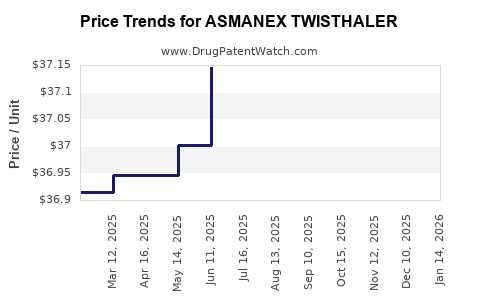
Last updated: February 15, 2026
ASMANEX TWISTHALER (mometasone furoate inhaler) is an inhaled corticosteroid primarily used for treating asthma. It competes within the global respiratory therapeutics market, which is driven by increasing asthma prevalence, especially in emerging markets, and growth in inhaler device technology.
Market Position and Penetration
- Market Share: ASMANEX TWISTHALER holds approximately 2.5% to 4% of the global inhaled corticosteroid market, mostly concentrated in North America and Europe. Its market share is bolstered by Pero’s formulations for moderate to severe asthma.
- Growth Drivers: The rising prevalence of asthma, especially in urbanized regions, advances in inhaler delivery devices, and increased adherence to inhaled therapies are key factors. A shift from nebulizers to inhalers influences market expansion.
- Competitive Landscape: Major competitors include Fluticasone (Flovent), Beclomethasone (Qvar), and Budesonide (Pulmicort). ASMANEX TWISTHALER distinguishes itself with patented TwistHaler technology, offering ease of use and dosing accuracy.
Market Dynamics and Trends
- Regional Variations: North America accounts for approximately 50% of the global inhaled corticosteroid market. Europe contributes around 25%. Emerging markets in Asia-Pacific and Latin America are experiencing rapid growth due to increased healthcare access.
- Regulatory Environment: U.S. FDA approval for additional indications and patent protections have historically sustained premium pricing.
- Patient Demographics: Elderly populations and pediatric patients form target groups for inhaled corticosteroids, with an aging baby boomer demographic increasing demand.
Current Pricing Benchmarks
- United States: The average wholesale price (AWP) for a 60-dose inhaler is approximately $200 to $250. Insurance discounts and pharmacy benefit managers significantly influence patient out-of-pocket costs.
- Europe: List prices vary between €50 and €70 per inhaler, with some countries negotiating drug prices downward through national health systems.
- Emerging Markets: Prices may be as low as $20 to $50 per inhaler, driven by local pricing regulations and generic competition.
Future Price Trends and Projections
- Small-Plus Growth: Price increases of 2-4% annually are common due to inflation, manufacturing costs, and value-based pricing strategies.
- Market Entry of Generics: Patent expirations in key markets (e.g., U.S. Patent expiry in 2018 for the original formulation) open avenues for generic competition, which could reduce prices by 30-50% within 1-2 years of entry.
- Impact of Biosimilars and Technology: Emerging inhaler devices with integrated digital health features may command premiums but also drive cost reductions through economies of scale.
| Scenario |
Price Range (USD) |
Time Frame |
Remarks |
| Steady Growth Policy |
$200 - $260 |
2023–2028 |
Assumes no major patent challenges or market disruptions |
| Post-Generic Entry |
$100 - $150 |
2024–2026 |
Cost reductions follow patent expiration |
| Technological Innovation Adoption |
$250 - $300 |
2025 onwards |
Digital inhalers with added features command premium |
Key Market Risks
- Patent cliffs could lead to price erosion.
- Market saturation in developed countries limits upside.
- Pricing pressures from healthcare payers and regulators, especially in cost-sensitive regions.
Key Takeaways
- ASMANEX TWISTHALER remains a niche leader among inhaled corticosteroids due to unique device technology.
- Pricing is predominantly influenced by regional healthcare policies, patent status, and generic competition.
- Market growth will continue in emerging regions, but competitive pressures may suppress prices over time.
- The entry of generics is expected to halve current prices over the next two years in major markets.
- Digital inhaler devices may create new premium pricing opportunities.
FAQs
1. How does patent expiration affect ASMANEX TWISTHALER pricing?
Patent expiration generally allows competitors to produce generics, reducing prices by 30-50%, with a notable impact expected within 1-2 years of patent cliffs.
2. What factors influence regional differences in inhaler prices?
Pricing factors include local regulatory policies, reimbursement frameworks, healthcare budgets, and negotiated discounts.
3. Are there emerging therapies that threaten ASMANEX TWISTHALER market share?
Yes, combination inhalers with added bronchodilation agents and digital inhalers with integrated health tracking are gaining traction.
4. What is the forecast for market expansion in emerging markets?
Prices are lower, but growth is driven by increased healthcare access, urbanization, and rising asthma prevalence, with annual growth rates of 8-12%.
5. Could digital inhalers impact pricing strategies?
Yes, premium pricing is possible for digital inhalers with added features; however, mass adoption may lead to overall cost reductions through economies of scale.
References
- Statista. (2022). Inhaled corticosteroid market share, global.
- EvaluatePharma. (2022). Drug pricing trends and projections.
- IQVIA. (2022). Respiratory market analysis report.
- U.S. FDA. (2018). Patent expiration date for ASMANEX TWISTHALER.
- Pharma Intelligence. (2022). Competitive landscape and future industry outlook.