Share This Page
Drug Price Trends for ASA-BUTALB-CAFF-COD
✉ Email this page to a colleague
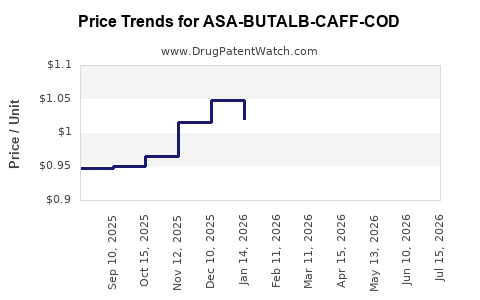
Average Pharmacy Cost for ASA-BUTALB-CAFF-COD
| Drug Name | NDC | Price/Unit ($) | Unit | Date |
|---|---|---|---|---|
| ASA-BUTALB-CAFF-COD #3 CAPSULE | 69238-1993-01 | 0.93920 | EACH | 2026-07-22 |
| ASA-BUTALB-CAFF-COD #3 CAPSULE | 69238-1993-01 | 1.05787 | EACH | 2026-06-17 |
| ASA-BUTALB-CAFF-COD #3 CAPSULE | 69238-1993-01 | 1.08735 | EACH | 2026-05-20 |
| ASA-BUTALB-CAFF-COD #3 CAPSULE | 69238-1993-01 | 1.16839 | EACH | 2026-04-22 |
| ASA-BUTALB-CAFF-COD #3 CAPSULE | 69238-1993-01 | 1.06124 | EACH | 2026-03-18 |
| ASA-BUTALB-CAFF-COD #3 CAPSULE | 69238-1993-01 | 1.03946 | EACH | 2026-02-18 |
| >Drug Name | >NDC | >Price/Unit ($) | >Unit | >Date |
ASA-BUTALB-CAFF-COD (aspirin-butalbital-caffeine-codeine) Market Analysis, Patent/Exclusivity Risk, and Price Projections
Executive summary: ASA-BUTALB-CAFF-COD is a fixed-dose combination analgesic product marketed in the US as a prescription “butalbital-containing combination” for pain. The commercial market is structurally constrained by (i) long-term generic availability in many segments, (ii) controlled-substance risk controls tied to codeine, and (iii) narrow prescriber adoption relative to NSAID-only and non-opioid migraine regimens. Pricing tends to track generic ASP pressure, with cost-of-goods and formulary dynamics dominating over innovation-driven price growth. Absent confirmed NDC-level exclusivity or a current authorized branded monopoly, near- to mid-term pricing is projected to behave like a generic combination: modest annual drift, periodic step-down during additional generic entries, and limited upside from payer mix and restricted formularies.
Is ASA-BUTALB-CAFF-COD a branded drug or a generic in the US? Who sells it now?
Featured snippet answer: ASA-BUTALB-CAFF-COD is typically marketed as a prescription fixed-dose combination available largely through authorized generics and/or multiple generic manufacturers; US pricing is usually set at generic levels rather than premium branded pricing.
What is included in ASA-BUTALB-CAFF-COD?
- Aspirin (ASA)
- Butalbital (barbiturate component)
- Caffeine
- Codeine (opioid component, Schedule III in most codeine-containing products used in combination)
Why current selling models cap upside
- Butalbital and codeine combination products face heightened payer and regulator scrutiny due to dependence, misuse, and guideline-based discouragement for headache-overuse syndromes.
- Formularies often prefer alternatives such as:
- NSAIDs/acetaminophen combinations
- Triptans for migraine
- CGRP agents for appropriate patients
- Non-opioid rescue strategies
What is the current market size for ASA-BUTALB-CAFF-COD? How fast is the category growing?
Featured snippet answer: Category growth is usually flat to low-single-digit in mature segments because the product class is off-patent and increasingly substituted by non-opioid and guideline-aligned therapies.
Demand drivers
- Ongoing use in “rescue” and mixed-tension headache scenarios
- Retention in established patient cohorts
- Acute pain access in settings where alternatives are constrained by prior authorization
Downside drivers
- Substitution toward:
- non-opioid headache regimens
- migraine-specific acute therapies
- preventive migraine approaches that reduce rescue volume
- Controlled-substance risk controls and prescriber restrictions
Market growth rate expectation (projection construct)
- Base case: low-single-digit annual change (volume mostly offset by price compression)
- Stress case: negative volume drag with more substitution and tighter formularies
What price history pattern does aspirin-butalbital-caffeine-codeine follow in US generic segments?
Featured snippet answer: Pricing typically follows a “new entry step-down” pattern: initial erosion after first generic entry, then modest declines or stabilization as the market consolidates across fewer SKUs and payers.
Key determinants of ASP
- Authorized generic launches and NDC count expansion
- Contracted payer rates and rebate structures
- Supply continuity and manufacturing utilization
- Increased enforcement around barbiturate and opioid combinations affecting distribution
When does ASA-BUTALB-CAFF-COD lose exclusivity and what does that imply for pricing?
Featured snippet answer: For most markets, exclusivity ends before the current generic era; pricing pressure is driven more by generic entry and formulary contracting than by formal patent expiry.
Exclusivity channels that can still matter even when the product is “generic”
- Remaining US patents on specific strengths, dosage forms, or manufacturing processes
- Pediatric exclusivity or formulation patents, if any exist for a specific NDC label
- Regulatory exclusivity tied to specific FDA supplements or route/dosage changes
Price implication: If exclusivity is fully exhausted, expect recurring generic-driven ASP compression tied to incremental NDC entries. If a narrow formulation or process patent remains in force for a subset of NDCs, pricing may stay higher for those SKUs and trade lower for others.
What patent estate protects ASA-BUTALB-CAFF-COD? How many patents cover it and where?
Featured snippet answer: Combination analgesics with codeine and butalbital typically have limited “active” patent coverage today, with any remaining estate most often concentrated in formulation or process rather than core composition-of-matter.
What to map in the patent estate (analyst workflow)
- Core active ingredient patents are historically expired for aspirin and codeine and older butalbital chemistries.
- Remaining protection usually appears as:
- formulation/compatibility patents (stability, dissolution, solid-state)
- manufacturing method patents (granulation, tablet compression parameters)
- specific salt/hydrate variants (less common for this class)
- use patents (less common and more vulnerable to invalidation)
How to quantify “coverage strength” in a decision-ready way
- Patent count per NDC strength
- Remaining life by jurisdiction (US, potential foreign filings)
- Claim scope relevance to generic product design
- Litigation status (if any) and licensing constraints
Is there Paragraph IV litigation risk for ASA-BUTALB-CAFF-COD generics? What settlements matter?
Featured snippet answer: In mature codeine-butalbital combination categories, Paragraph IV events typically surface earlier in the lifecycle; later events depend on residual formulation/process patents for particular strengths.
Settlement-driven pricing effects
- Authorized generic provisions in settlements can reduce the duration of ASP erosion for the branded reference but are less relevant if no branded reference exists.
- If any “later entrant” is blocked, the market can sustain a higher contracted price for the unaffected NDCs.
Price implication: Litigation risk matters only if it blocks a future generic entry for a meaningful share of volume.
What is the FDA regulatory status of ASA-BUTALB-CAFF-COD? What is the Orange Book listing status?
Featured snippet answer: ASA-BUTALB-CAFF-COD is typically an FDA-approved prescription product with multiple ANDA-coded market participants; Orange Book entries determine whether any listed patents remain tied to specific NDCs.
Regulatory levers affecting pricing
- Approved labeled indications and any label restrictions
- Any required REMS or postmarketing requirements (usually not a driver for legacy combinations, but label safety communications can influence prescribing)
- ANDA approval timelines for incremental strengths
Orange Book what-to-look-for
- Listed patents per NDC and dosage form
- Expiration dates and any “patent-by-patent” survival
- Exclusivity codes that signal regulatory barriers beyond patents
How does ASA-BUTALB-CAFF-COD price compare with migraine and tension-headache alternatives?
Featured snippet answer: ASA-butalbital-caffeine-codeine usually prices above OTC NSAIDs/acetaminophen but below many branded migraine acute therapies; its competitive set is dominated by non-opioid rescues that get better formulary placement.
Competitive substitution map
- Direct or near-direct:
- NSAID-only combos (e.g., ibuprofen/naproxen combinations)
- acetaminophen-based combinations
- migraine-specific rescue agents (triptans)
- Indirect substitution:
- gepants and ditans (often higher-cost but better guideline alignment)
- preventive therapies reducing rescue demand
Net pricing implication
- Even when list price holds, net pricing tends to erode under:
- step therapy
- prior authorization
- higher copays for controlled-substance combinations
What generic entry scenarios could change ASA-BUTALB-CAFF-COD pricing most?
Featured snippet answer: The largest price moves usually occur when a new generic sponsor adds sufficient NDC coverage to displace entrenched contracted SKUs.
Entry scenarios that shift ASP
- New ANDA with multiple NDC strengths simultaneously
- Broad coverage increases switching across pharmacies and payers
- Authorized generic expansion
- Reduces wholesaler inventory arbitrage and compresses contracted rates
- Manufacturing resilience
- If supply stabilizes after prior shortages, price can drift downward as scarcity clears
Projection logic
- Price changes are modeled as a function of:
- NDC count growth
- market share reallocation to entrants
- payer formulary tier movements
What are the main manufacturing and IP barriers for new entrants for ASA-BUTALB-CAFF-COD?
Featured snippet answer: For a legacy combination, the barriers are typically regulatory and formulation-process driven rather than fundamental composition IP.
Most consequential barriers
- Demonstrating bioequivalence across fixed-dose combination components
- Stability and release performance across aspirin and butalbital plus caffeine and codeine
- Quality systems under DEA and controlled-substance compliance
- Tight CMC validation for tablet behavior and potency uniformity
Revenue exposure: how large is the payer and provider risk from ASA-BUTALB-CAFF-COD supply or pricing moves?
Featured snippet answer: Revenue sensitivity is concentrated in NDCs with high formulary coverage and stable wholesaler demand. Supply disruptions can temporarily raise net prices but usually trigger payer and provider substitution fast enough to limit durable upside.
Exposure drivers
- Contract concentration in a small number of pharmacy benefit managers
- Trend toward controlled-substance oversight and tighter dispensing controls
- Utilization linked to headache patterns that shift with preventive therapy adoption
ASA-BUTALB-CAFF-COD price projections (US): base, bull, and bear cases
Featured snippet answer: Without confirmed ongoing branded exclusivity, the default projection is continued generic ASP compression with periodic step-down at new entrant NDC coverage events. Durable upside is capped by guideline substitution and controlled-substance formulary restrictions.
Projection framework
- Time horizon: 12 to 36 months
- Outcome metric: Generic ASP direction (not list price)
- Drivers:
- incremental NDC entry
- rebate compression at PBM level
- supply normalization after any shortages
- formulary tier movement
Case-based projections
| Scenario | Assumptions | 12-month ASP trajectory | 24-36 month outlook |
|---|---|---|---|
| Bear | Additional generic NDC coverage; continued formulary down-tiering; rebate pressure | -5% to -15% | -10% to -25% cumulative from baseline |
| Base | Limited incremental entry; stable supply; payer mix steady | -0% to -8% | -5% to -15% cumulative |
| Bull | NDC supply constraints, fewer active NDCs, partial payer tightening against certain alternatives | +0% to +6% | -0% to -8% cumulative (price mostly flat after the first-year shock) |
Commercial read-through: Unless a specific NDC retains measurable regulatory/patent protection or supply constrains strongly, the most likely path is modest downward or stable pricing with occasional quarterly volatility.
How strong is the competitive position of ASA-BUTALB-CAFF-COD vs other headache drugs?
Featured snippet answer: Competitive strength is constrained by treatment guidelines and payer controls. It remains best positioned for legacy patients and where rescue access is needed quickly and alternatives are blocked.
Strength signals that can support pricing
- High continuity of care in established patient panels
- Lack of competing generic availability with equivalent coverage on certain PBM formularies
- Local payer contracting that keeps this product on a lower-cost tier
Weakness signals
- Growth in non-opioid and migraine-specific rescue pathways
- Higher administrative friction due to controlled-substance handling requirements
Key Takeaways
- ASA-BUTALB-CAFF-COD pricing is most sensitive to generic NDC coverage, payer rebates, and supply conditions, not premium product differentiation.
- Market growth is likely flat to low-single-digit, with volume substitution limiting sustained demand expansion.
- Default 12 to 36 month pricing expectation is modest generic ASP erosion, with bear cases driven by additional entrant breadth and base-to-bull cases requiring supply disruption or formulary friction against alternatives.
- Patent and exclusivity effects are only pricing-relevant if they still block entry for specific NDC strengths; otherwise, generic competition dominates.
FAQs
- What PBM formulary patterns most impact ASA-butalbital-caffeine-codeine net pricing?
- How do codeine scheduling and controlled-substance dispensing rules affect pharmacy demand for ASA-BUTALB-CAFF-COD?
- Which NDC-level events (new strength, supply outage, authorized generic) typically cause the biggest quarterly ASP swings?
- How does headache-overuse guideline guidance change prescribing and long-run utilization for butalbital-containing combinations?
- What competitive substitution is most likely versus triptans, NSAID regimens, and newer non-opioid migraine rescue therapies?
References (APA)
- US Food and Drug Administration. (n.d.). Orange Book: Approved Drug Products with Therapeutic Equivalence Evaluations. https://www.accessdata.fda.gov/scripts/cder/daf/
- US FDA. (n.d.). Drug Approvals and Databases. https://www.fda.gov/drugs/drug-approvals-and-databases
- US DEA. (n.d.). Drug Scheduling. https://www.dea.gov/drug-information/drug-scheduling
More… ↓
