Share This Page
Drug Price Trends for AROMASIN
✉ Email this page to a colleague
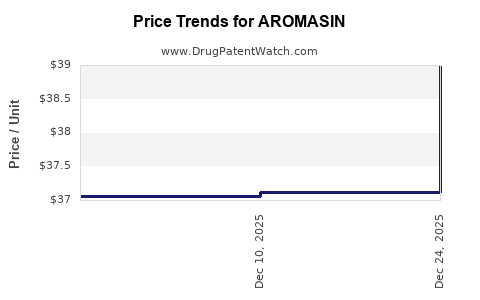
Average Pharmacy Cost for AROMASIN
| Drug Name | NDC | Price/Unit ($) | Unit | Date |
|---|---|---|---|---|
| AROMASIN 25 MG TABLET | 00009-7663-04 | 38.97921 | EACH | 2026-01-01 |
| AROMASIN 25 MG TABLET | 00009-7663-04 | 37.12306 | EACH | 2025-12-17 |
| AROMASIN 25 MG TABLET | 00009-7663-04 | 37.06500 | EACH | 2025-11-19 |
| >Drug Name | >NDC | >Price/Unit ($) | >Unit | >Date |
Market Analysis and Price Projections for Aromasin (Exemestane)
Summary
Aromasin (exemestane) is a second-generation aromatase inhibitor used primarily for hormone receptor-positive breast cancer treatment in postmenopausal women. The drug's global market is influenced by breast cancer prevalence, patent expirations, competitive landscape, regulatory changes, and healthcare policies. Price projections indicate downward pressure due to generic entry, with potential for regional variations following patent challenges and market penetration rates.
What Is the Current Market Landscape for Aromasin?
Therapeutic Use and Indications
Aromasin is approved for:
- Adjuvant treatment of early-stage hormone receptor-positive breast cancer in postmenopausal women
- Extended therapy to reduce recurrence risk
Market Size and Trends
- The global breast cancer drug market was valued at approximately USD 17.5 billion in 2022, with aromatase inhibitors accounting for about 50% of hormone therapy segments [1].
- Aromasin’s share stems from its efficacy in secondary prevention and extended therapy, especially as patents for competing drugs expire.
Key Competitors
- Letrozole (Femara)
- Anastrozole (Arimidex)
- Generics of these drugs have eroded Aromasin’s market share since 2015.
Patent and Regulatory Timeline
- Aromasin’s patent expired globally between 2014 and 2018, enabling entry of generics in multiple geographies.
- The US FDA approved multiple generic equivalents in 2014.
- EU market saw generic approvals starting in 2015.
What Are the Drivers and Constraints in Aromasin’s Market?
Drivers
- Increasing breast cancer incidence in postmenopausal women (approx. 2.3 million new cases globally in 2020) [2].
- Long-term adjuvant therapy of up to 5 years promotes sustained demand.
- Rising adoption of aromatase inhibitors over tamoxifen for postmenopausal hormone receptor-positive cases.
Constraints
- Availability of generics limits pricing power.
- Competition from cheaper alternatives (letrozole, anastrozole).
- Evolving treatment guidelines favor combination therapies, which may dilute monotherapy markets.
- Regulatory pressures in different geographies can influence pricing and market access.
What Are Price Trends and Projections?
Historical Pricing Data
- North America (pre-generic): Retail price for a 30-tablet pack (25 mg) was approximately USD 300–400.
- Post-generic entry: Retail prices have declined by approximately 50–70% in key markets.
- For example, generic exemestane costs range USD 50–100 per 30-tablet pack.
Forecasted Market Prices (2023–2028)
-
United States:
- A 10–20% decline in retail prices year-over-year through 2027.
- Expected to stabilize around USD 50–70 per pack after 2026 due to market saturation.
-
Europe:
- Similar decline patterns, with prices dropping from EUR 60–70 to EUR 30–40 per pack within 3 years of generic entry.
-
Emerging Markets:
- Prices remain higher relative to local income levels but tend to follow global trends, stabilizing at USD 30–60 per pack by 2028.
Factors Modulating Price Trajectories
- Patent litigation and legal challenges can temporarily stabilize prices or lead to further reductions.
- Healthcare policies encouraging generics and biosimilars push prices lower.
- Volume-based discounts and tendering processes influence actual transaction prices in large markets.
What Are Key Factors Impacting Future Market and Price Development?
-
Patent Litigation and Patent Challenges:
- Potential delays in generic market penetration could sustain higher prices temporarily.
- Some regions see extended patent protections or secondary patents.
-
Regulatory Approvals:
- Entry of biosimilars or alternative treatments may shift demand and pricing.
-
Market Penetration by Generics and Biosimilars:
- Generic sales projected to account for over 85% of aromatase inhibitor volume by 2026 in major markets [3].
-
Reimbursement Policies:
- Shifts toward value-based care promote generics and lower prices.
What Are the Implications for Stakeholders?
-
Pharmaceutical Companies:
- Market share gains likely to diminish for branded Aromasin; focus shifts toward differentiated offerings or combination therapies.
-
Investors:
- Revenue streams will decline as patent expirations lead to price erosion; valuation of Aromasin-based portfolios decreases unless innovation emerges.
-
Healthcare Systems:
- Cost savings from generic options will influence treatment guidelines and formulary decisions.
Key Takeaways
- Aromasin's global sales declined after patent expiration, with generics capturing most of the market in the last decade.
- Retail prices have decreased significantly, with projections indicating continued downward trends through 2028.
- Price stabilization is unlikely until market saturation and generic competition plateau.
- Regional differences in patent enforcement, regulatory acceptance, and healthcare policy influence pricing dynamics.
- Future growth will depend on clinical adoption, new therapeutic indications, and potential biosimilar entries.
FAQs
Q1: How much has Aromasin’s price declined since patent expiry?
A1: Prices dropped by approximately 50–70% following generic entry, shifting from USD 300–400 to USD 50–100 per pack in key markets.
Q2: What regions are most affected by generic competition?
A2: North America and Europe saw the earliest and most significant price declines due to patent expirations and widespread generic approvals.
Q3: Will Aromasin regain market share over competitors?
A3: Unlikely, as generics dominate the aromatase inhibitor segment, though branded drugs may see niche use in specific populations or indications.
Q4: How do regulatory activities influence Aromasin's pricing?
A4: Patent litigation and challenges can delay generic entry, temporarily stabilizing prices. Conversely, streamlined approvals facilitate rapid price declines.
Q5: What potential developments could impact future pricing?
A5: Introduction of biosimilars, new combination therapies, and regulatory policies favoring generics will likely continue downward pricing pressures.
References
[1] IQVIA, "Global Oncology Drugs Market Report," 2022.
[2] World Health Organization, "Breast Cancer Fact Sheet," 2022.
[3] EvaluatePharma, "Oncology Market Trends," 2022.
More… ↓
