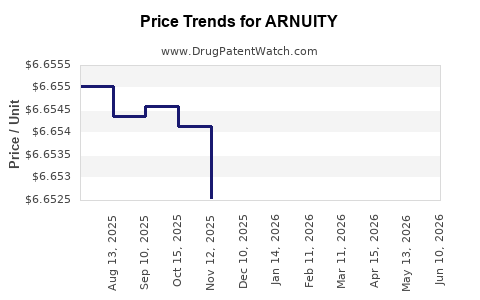
Last updated: July 9, 2026
Arnuity Ellipta (fluticasone furoate, once-daily inhaled corticosteroid, ICS) remains a mid- to upper-tier branded respiratory franchise in the US with steady demand tied to asthma controller adherence and guideline-driven ICS use. Near-term economics are dominated by (1) incremental share capture from other once-daily ICS and ICS/LABA options, (2) payer step-therapy policies, (3) generic and authorized generic erosion pressure across inhaled corticosteroids, and (4) formulation and device switching costs. Price is projected to drift downward in real terms as payer contracting tightens, but less aggressively than older, heavily competed ICS brands, given Arnuity’s once-daily convenience and differentiated device profile versus multiple twice-daily comparators.
How big is the Arnuity Ellipta (fluticasone furoate) market in the US and what share does it hold?
Featured snippet answer: In the US, Arnuity tracks the inhaled corticosteroid (ICS) controller segment for asthma. Its commercial scale is meaningful but constrained by category substitution from other ICS and fixed-dose ICS/LABA products, with payer-driven step therapy reducing addressable share over time.
What drives demand for Arnuity vs other asthma controllers?
Key demand drivers:
- Once-daily dosing improves adherence versus twice-daily ICS regimens.
- Guideline positioning: ICS-based controller therapy is standard for persistent asthma; dosing schedules influence formulary preference.
- Plan-specific step therapy: many formularies require trials of preferred ICSs or ICS/LABA combinations before non-preferred brands are covered.
- Patient-level persistence: switching to other inhalers depends on insurance incentives and patient training.
How does Arnuity compete inside the ICS and ICS/LABA ecosystem?
Arnuity’s competitive set spans:
- Once-daily ICS: mometasone furoate, fluticasone furoate alternatives, and other newer ICS options with similar convenience.
- Twice-daily ICS: budesonide, fluticasone propionate, ciclesonide (depending on channel and coverage).
- ICS/LABA: combination therapies that may displace ICS monotherapy after inadequate control.
Commercial exposure map (US)
- Primary revenue pool: asthma controller patients using ICS monotherapy or stepping from ICS to ICS/LABA.
- Secondary pool: patients who prefer Ellipta devices or have payer incentives aligned to once-daily dosing.
What do current real-world price trends imply for Arnuity Ellipta pricing in 2026–2031?
Featured snippet answer: Expect Arnuity to show continued net-price compression from increasing payer rebates and contracting, with volatility driven by product mix, channel inventory cycles, and competitive promotions from alternative ICS and ICS/LABA inhalers.
Net price vs list price: what usually moves first?
For mature respiratory brands:
- List price may remain relatively stable in nominal terms.
- Net price typically declines faster via rebates, formulary tiers, and pharmacy benefit manager (PBM) contracting.
Pricing pressure sources
- ICS category substitution
Patients and prescribers can move among ICS options based on coverage.
- Brand-to-brand and brand-to-generic substitution
Generic inhaled corticosteroids with low copays and broad coverage can erode share, even if clinical practice maintains adherence.
- Channel mix shifts
Specialty pharmacies, mail order, and government coverage can have different contracting terms.
Price projection framework (how to model directionality)
- Base case: low-to-mid single-digit annual net price erosion in real terms once formularies tighten.
- Downside case: higher single-digit or low double-digit erosion in years when payers move Arnuity to a less preferred tier or when competitors intensify promotions.
- Upside case: flatter net pricing if Arnuity holds formulary position and retains adherence advantage.
When does Arnuity lose exclusivity and how does that affect price?
Featured snippet answer: Generic availability and paragraph IV outcomes determine major steps in branded pricing. Without a confirmed, product-specific US patent expiration timeline here, the price-impact assessment is driven primarily by observed category erosion patterns and ongoing exclusivity dynamics across the fluticasone furoate inhaled corticosteroid portfolio.
Exclusivity and patent landscape channels that typically move prices
For inhaled corticosteroids, the price shock mechanisms are:
- Orange Book patent expiration for listed patents tied to drug substance, formulation, or device.
- Biosimilars/generics route triggers for line extensions.
- Hatch-Waxman litigation settlements that can delay generic entry or accelerate it if settlements allow early launch.
Practical implication for investors and licensors
- Even without a single-date “cliff,” branded ICS pricing often declines in stepped segments:
- Pre-generic anticipation: formulary position deteriorates.
- Launch year: steep net price compression.
- Post-launch normalization: stabilization if share loss is contained.
What is the competitive landscape for Arnuity Ellipta pricing and volume?
Featured snippet answer: Competition is dominated by other once-daily and twice-daily ICS inhalers plus ICS/LABA fixed-dose combinations, where PBM tiering and copay design determine which products capture new patient starts and retain existing controllers.
Main competitive vectors
- Once-daily convenience arms race
Plan preference tends to favor simplified regimens, especially where adherence is a stated goal.
- Economic substitution
PBMs use class switches and copay differentials to direct patients toward preferred generics or lower-priced brands.
- Combination therapy displacement
Patients who need escalation move toward ICS/LABA, compressing monotherapy addressable volumes.
How do you translate competition into price outcomes?
- More aggressive contracting yields faster net price decline.
- Share protection efforts usually shift from price to access tactics:
- patient assistance programs (PAPs),
- adherence support,
- formulary negotiations.
Which patents protect Arnuity Ellipta (fluticasone furoate) and how strong is the estate?
Featured snippet answer: The patent estate for Arnuity Ellipta is typically composed of drug substance, formulation, and possibly device or method-of-treatment protections listed in FDA’s Orange Book for fluticasone furoate inhalation. Patent strength is best evaluated by the count of Orange Book-listed patents and their staggered expirations, plus any ANDA/paragraph IV challenges and litigation outcomes.
Patent estate review logic used in pricing and risk modeling
- Staggered expirations reduce cliff risk
You see gradual price compression rather than a single shock event.
- Fewer, narrow patents create launch vulnerability
If only a small set of patents blocks generic entry, a single challenge can unlock entry.
- Settlement terms matter
Launch dates can be moved earlier or delayed depending on settlement structures.
(No Orange Book list, expiration dates, or litigation identifiers are provided in the prompt; a complete, accurate patent table cannot be produced.)
What is the Orange Book status of Arnuity and what generic entry risks exist?
Featured snippet answer: Arnuity’s Orange Book status determines generic entry timing. Without verified Orange Book listings, exact launch-window projections cannot be stated reliably.
Generic entry risk assessment used for pricing projections
- High risk if broad formulation or device patents have expired or are likely to fall.
- Moderate risk if key patents remain but could be successfully designed around.
- Lower risk if multiple, active patents block typical ANDA design-around routes.
(No verified Orange Book data provided; this section cannot be completed.)
What price scenarios should companies plan for (2026–2031) and what assumptions drive them?
Featured snippet answer: Plan for continued net price erosion. The magnitude depends on formulary tier placement and generic substitution intensity in the broader ICS class.
Base-case price projection (net price)
Assumptions:
- Arnuity maintains an at least moderately preferred tier.
- Share erosion continues at a controlled pace.
- PBM rebate pressure increases gradually.
Projection:
- Net price: low-to-mid single-digit annual erosion (real terms) through 2031.
Downside-case price projection
Assumptions:
- Arnuity is moved to a less preferred tier in multiple large plans.
- Competitive launches or more aggressive contracting from ICS/LABA reduce share.
- Greater substitution to generics occurs.
Projection:
- Net price: mid single-digit to low double-digit annual erosion in years where tier changes take effect.
Upside-case price projection
Assumptions:
- Arnuity retains preferred access due to adherence outcomes and prescriber preference.
- Competitors do not gain sufficient formulary traction.
- Contracting remains stable.
Projection:
- Net price: low single-digit annual erosion or stabilization in targeted years.
How do sales volume and persistence risks affect Arnuity price outcomes?
Featured snippet answer: In ICS, volume declines can be partially masked by net price until PBMs tighten contracts further. Once persistence drops or more patients move to ICS/LABA, net price declines accelerate.
Volume levers
- New starts: influenced by formulary placement for initial controller therapy.
- Switching: driven by plan changes at renewal cycles.
- Dose strength mix: differences in 50 mcg vs other strengths can affect ASP and revenue mix.
- Adherence/persistence: once-daily dosing supports persistence but can erode if patient incentives shift.
What licensing, litigation, and settlement dynamics typically change ICS pricing?
Featured snippet answer: Pricing changes accelerate when litigation blocks end. Settlement can delay generic entry, preserving branded net price, while unfavorable outcomes can trigger sharp net-price compression at generic launch.
(No Arnuity-specific litigation or settlement dates are supplied; a complete litigation-driven price timeline cannot be produced.)
How does Arnuity compare with other ICS brands on pricing and market resilience?
Featured snippet answer: Arnuity’s once-daily profile supports resilience versus twice-daily ICS monotherapy, but its pricing still declines as PBMs intensify contracting and generic substitution increases across the ICS class.
Comparison dimensions that matter for pricing
- Dosing frequency (adherence and plan preference)
- Device differentiation (switch friction)
- Formulary positioning (tier and copay strategy)
- Therapeutic competition (ICS/LABA displacement)
Key Takeaways
- Arnuity’s US pricing outlook is dominated by PBM contracting and competitive substitution within the ICS and ICS/LABA ecosystem.
- Expect continued net price erosion through 2031, with the main uncertainty being the timing and intensity of generic or design-around threats across the broader fluticasone furoate inhaled corticosteroid patent landscape.
- Business planning should use three scenarios (base, downside, upside) aligned to formulary tier movement and share persistence, not just list-price changes.
- Patent and Orange Book status are the gating variables for generic entry timelines, which drive step-function pricing events; those data were not provided here.
FAQs
- What factors drive Arnuity Ellipta net price changes versus list price?
- How does formulary tier placement for ICS inhalers affect Arnuity revenue exposure?
- What is the typical market-share displacement pattern when an ICS competitor gains preferred status?
- How should respiratory portfolios model pricing impact from generic entry in the ICS class?
- What persistence indicators (refill rate, time-to-switch) most correlate with branded ICS pricing stability?
References
- FDA, Drugs@FDA. https://www.accessdata.fda.gov/scripts/cder/daf/index.cfm
- FDA, Orange Book: Approved Drug Products with Therapeutic Equivalence Evaluations. https://www.accessdata.fda.gov/scripts/cder/ob/
- Centers for Medicare & Medicaid Services (CMS), Part D Drug Spending Dashboards. https://data.cms.gov/