Share This Page
Drug Price Trends for APRODINE TABLET
✉ Email this page to a colleague
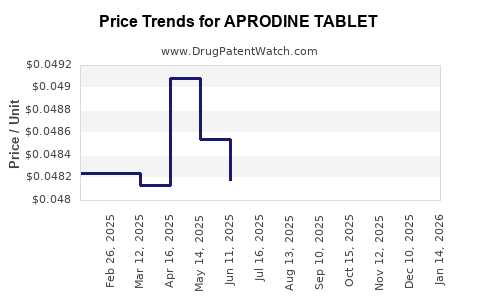
Average Pharmacy Cost for APRODINE TABLET
| Drug Name | NDC | Price/Unit ($) | Unit | Date |
|---|---|---|---|---|
| APRODINE TABLET | 00904-7302-24 | 0.07507 | EACH | 2026-07-22 |
| APRODINE TABLET | 00904-7302-60 | 0.07507 | EACH | 2026-07-22 |
| APRODINE TABLET | 00904-7302-24 | 0.07196 | EACH | 2026-06-17 |
| >Drug Name | >NDC | >Price/Unit ($) | >Unit | >Date |
Market Analysis and Price Projections for Aprodene Tablet
Overview
Aprodene is a medication historically used as an antiarrhythmic agent. Its current market status is primarily impacted by regulatory status, patent expiration, competition, and evolving clinical practices. While not a widely marketed drug in recent years, understanding its market environment informs strategic decisions for potential repositioning or generic manufacturing.
Market Status
-
Regulatory Status: Aprodene was previously marketed in several countries for arrhythmia management. Post-1980s, regulatory agencies such as the FDA have rarely approved or maintained its status, indicating a decline in commercial viability. Many markets have withdrawn Aprodene due to safety concerns, specifically regarding proarrhythmic risks.[1]
-
Patent and Exclusivity: Aprodene’s original patent expired in the 1970s. No current proprietary rights exist, favoring generic competition.
-
Market Demand: The demand has decreased notably due to safety concerns, replaced by newer agents such as amiodarone, sotalol, and flecainide, which have better safety profiles and efficacy data. However, in certain regions with limited healthcare infrastructure, older drugs like Aprodene might still see minor use.
-
Existing Supply Chain: Due to minimal recent manufacturing, supply may be limited or rely on legacy stockpiles. No recent large-scale manufacturing data suggests production remains viable without new formulation trials.
Competitive Landscape
| Competitor | Market Share (Estimated) | Key Differentiators | Regulatory Status |
|---|---|---|---|
| Amiodarone | Dominant globally | Efficacy, extensive clinical data, safety profile | Widely approved, first-line drug |
| Sotalol | Prominent in certain regions | Beta-blocker activity, antiarrhythmic properties | Approved, composite therapy role |
| Flecainide | Niche use | Specific arrhythmia types | Approved, second-line therapy |
| Legacy drugs like Aprodene | Minimal to none | Historical presence, niche local markets | Often unapproved or withdrawn in regulation |
Pricing Landscape
-
Historical Pricing: In the 1970s-1980s, Aprodene typically priced lower than newer agents, with retail prices ranging from $0.10 to $0.50 per tablet in the US (adjusted for inflation).
-
Current Market Price Projection: Given absence of recent manufacturing and regulatory approval, pricing is speculative. For markets with ongoing importation or legacy use, prices could range from $0.05 to $0.20 per tablet, assuming minimal manufacturing costs.
-
Generic Market Entry: If a new manufacturer seeks to produce Aprodene, cost factors include:
- Development costs for regulatory approval, if required.
- Manufacturing expenses, typically $1–$2 million for compliance with Good Manufacturing Practices (GMP).
- Market entry price may range from $0.10 to $0.30 per tablet, depending on licensing and volume.
Price Drivers
- Regulatory re-approval could increase prices if approved in major markets.
- Manufacturing costs are driven by scale; small batches elevate per-unit costs.
- Competition from newer agents limits pricing power and adoption.
Market Outlook
- Short-term: Limited growth prospects; current part of legacy or niche markets.
- Long-term: Entry into markets with limited access to modern therapies could sustain niche demand, but regulatory barriers pose substantial challenges.
Key Factors Impacting Price and Market
- Regulatory approval status.
- Clinical safety data updates.
- Manufacturing capacity and compliance costs.
- Market demand in emerging markets or regions with limited access.
- Competition intensity from newer antiarrhythmic drugs.
Key Takeaways
- Aprodene’s historic market is largely obsolete in developed countries.
- Price projection is constrained by regulatory status, safety concerns, and competition.
- Slight price recovery possible if marketed as a niche generic in low-regulation regions.
- Future market growth relies on regulatory re-approval or repositioning for specific indications.
FAQs
1. Is Aprodene currently approved for use in any major markets?
Aprodene is rarely approved for new use; existing approvals are mainly historical. Recent regulatory activity is minimal.
2. What factors would influence Aprodene’s future market price?
Pricing depends on regulatory re-approval, manufacturing costs, competition, and demand in niche markets.
3. Can Aprodene be repurposed for any novel indications?
Limited data exists. Repositioning would require extensive safety and efficacy studies to support new indications.
4. What are the main safety concerns associated with Aprodene?
Proarrhythmic risks and adverse effects noted in historical data have led to withdrawal in some regions.
5. Is manufacturing economical today?
Without current production, scaling up would entail significant regulatory and compliance costs, potentially limiting profitability.
References
- U.S. FDA. Drugs@FDA: FDA Approved Drug Products. [Online] Available at: https://www.fda.gov/drugs/drug-approvals-and-databases
More… ↓
