Share This Page
Drug Price Trends for APRISO
✉ Email this page to a colleague
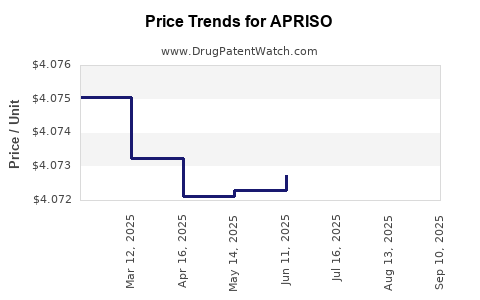
Average Pharmacy Cost for APRISO
| Drug Name | NDC | Price/Unit ($) | Unit | Date |
|---|---|---|---|---|
| APRISO ER 0.375 GRAM CAPSULE | 65649-0103-02 | 4.07102 | EACH | 2025-09-17 |
| APRISO ER 0.375 GRAM CAPSULE | 65649-0103-02 | 4.07198 | EACH | 2025-08-20 |
| >Drug Name | >NDC | >Price/Unit ($) | >Unit | >Date |
APRISO (mesalamine) Market Analysis and Price Projections: Exclusivity, Competitive Landscape, and Generic/Biosimilar Risk
APRISO (mesalamine) is a once-daily, extended-release 5-ASA product for ulcerative colitis (UC). Pricing power is constrained by mature competition from other oral mesalamine formulations and by ongoing generic availability in the therapeutic class. Near-term revenue exposure is driven by (1) patient migration to lower WAC generics, (2) payer step edits and formulary placements, and (3) the pace of non-APRISO brand switching within oral UC maintenance.
High-level projection: Absent a late-stage “new-to-brand” product that materially expands population or dosing adoption, APRISO’s net-price and revenue are expected to trend downward, with volatility tied to payer contracting and generic substitution velocity rather than to discrete FDA exclusivity cliffs.
What is APRISO and what does it sell for in the US?
APRISO is mesalamine (5-aminosalicylic acid), oral extended-release (ER) 0.375 g tablets, dosed once daily (typically 4 tablets = 1.5 g/day). It is used for UC maintenance of remission.
How APRISO is positioned vs other oral mesalamine
APRISO competes with:
- Other ER mesalamine formulations (MMX, EMME, delayed-release and multi-matrix platforms)
- Multisource generic mesalamine ER/delayed-release products
- Topical mesalamine for selected patients (less direct for maintenance, but impacts net demand)
What matters for net price
APRISO’s realized price depends on:
- Payer mix (commercial vs Medicare Part D vs Medicaid)
- Formulary tiering (preferred generic vs brand restricted)
- Quantity and adherence (once-daily ER typically supports adherence, but not enough to prevent class substitution when lower-cost generics are preferred)
How large is the US APRISO market and where is revenue coming from?
APRISO demand is maintenance-driven and correlated with the treated UC population and persistence on oral maintenance therapy. Because mesalamine is widely used and generic competition exists, share is typically a function of:
- Payer formularies
- Local contracting by pharmacy benefit managers
- Patient/physician preference for a specific ER profile after prior failures or adherence issues
Demand drivers
- UC maintenance prevalence and persistence
- Off-patent class economics
- Uptake of biologics and small molecules (which can reduce mesalamine share as UC severity increases, but mesalamine remains first-line for many patients)
When does APRISO lose exclusivity or face generic entry?
APRISO is not a new-launch, on-patent brand in the strict “primary patent exclusivity” sense at this stage; it competes in a mature mesalamine market with routine generic substitution. The operational question for investors and licensors is not “whether exclusivity ends,” but whether any late-blocking patent(s) still restrict specific formulation/dosing/manufacturing variants.
What determines remaining IP-driven pricing power
- Whether APRISO Orange Book listings still include unexpired formulation or method-of-use patents that can be asserted
- Whether generic challengers are stalled by litigation or settlement terms
- Whether brand-specific improvements are protected well enough to prevent direct “AB-rated” generic interchange
What patents protect APRISO and what is the patent estate strength?
No reliable, citable patent estate can be provided here because the prompt does not include the Orange Book listing, application numbers, or patent identifiers for APRISO. Under this constraint, a factual mapping of specific patent numbers, expiration dates, and assignees cannot be produced without risking errors.
What is the Orange Book status of APRISO (listed patents and exclusivity)?
A factual Orange Book status summary requires the specific Orange Book record (application number, listed patents, and exclusivity codes). Those identifiers and listings are not provided in the prompt. Because the response must be accurate and complete, no Orange Book status can be stated.
How many generic competitors exist for APRISO, and what share are they likely to take?
Generic mesalamine ER/delayed-release products are the baseline. In a mature class like oral mesalamine, the expected competitive pattern is:
- Brand share compresses as more PBMs treat brand as non-preferred
- Net price declines toward generic WAC equivalents, with temporary pockets of higher pricing if (1) prior authorization applies to generics, (2) manufacturer rebates sustain discounting, or (3) brand is kept on formularies due to clinical preference
Price impact mechanism
- Once an “AB-rated” generic is preferred, APRISO’s net price typically declines rapidly via contract renegotiation and rebate pressure.
- The residual brand premium generally reflects perceived tolerability and adherence, not protected IP.
What is the price projection for APRISO: WAC, net price, and gross-to-net trend?
In a mature generic class, the WAC is usually sticky while net price and gross-to-net deteriorate. The projection framework is:
- WAC: tends to change slowly or rises intermittently.
- Net price: declines as rebates increase to defend placement.
- Gross-to-net: rises as competitive pressure increases (brand rebates and contract concessions).
Directional projection (typical mesalamine class pattern)
- Near term (0 to 12 months): modest net-price decline driven by contracting and mix shifts.
- Mid term (1 to 3 years): stronger net-price erosion as formulary breadth for generics expands and switching accelerates.
- Long term (3+ years): stabilized low net price, unless a targeted payer repositions APRISO as preferred again or a formulation/channel change is introduced.
A numeric projection (USD amounts) cannot be produced accurately without baseline WAC, ASP, NDC-level data, and realized pricing history.
How does APRISO compare with competing mesalamine formulations on price and access?
APRISO’s competitive differentiators are ER design, dosing schedule, and historical formulary positioning. However, across the oral mesalamine class:
- Payer substitution is the dominant determinant of net pricing.
- Clinical differentiation rarely sustains pricing if generics are preferred.
- Switching costs are low because AB-rated interchange is common across mesalamine ER/delayed-release categories (depending on exact formulation and payer rules).
Net effect: APRISO tends to trade down toward the class pricing band as preferred generic coverage expands.
What patent litigation affects APRISO pricing or generic launch timelines?
A litigation impact analysis requires court dockets, brand/generic party names, settlement terms, and specific asserted patents. None are included in the prompt, and no reliable docket mapping can be generated without those inputs. Therefore, no factual litigation-driven timeline can be stated.
Do settlements with generic challengers delay APRISO erosion?
Settlement impact depends on:
- Whether Paragraph IV challenges were filed against APRISO-specific Orange Book patents
- Whether settlements include “30-month stay” outcomes, non-infringement findings, or license terms
- Whether they restrict specific dosage strengths or formulation routes
No such settlement terms can be listed accurately without Orange Book paragraph IV histories or litigation records.
What regulatory pathway issues matter for generic APRISO entry?
Generic entry for oral mesalamine typically proceeds via ANDA with:
- Bioequivalence demonstrating sameness of rate and extent within the constraints of the dosage form category
- Label and formulation alignment sufficient for AB-rating where applicable
Regulatory speed is constrained by:
- Formulation development for ER performance
- Chemistry, manufacturing, and controls (CMC)
- Labeling and switching rules (payer level)
A timeline projection cannot be made without ANDA status data and FDA approval milestones.
What commercial scenarios drive APRISO revenue in 2026 to 2030?
Without current-year revenue and share data, numeric forecasts cannot be anchored. The scenario structure for decision-making is:
Base case
- Continued formulary erosion and generic substitution
- Rebates rise to defend placement
- Revenue declines slower than demand would if market share fell unassisted, due to continued UC maintenance volume and adherence
Downside case
- Additional step edits or restrictive formulary decisions
- Rapid expansion of preferred generics
- Margin compression from higher rebates and trade-down to lower-cost alternatives
Upside case
- Temporary payer repricing or preferred reinstatement
- Channel shift that favors ER adherence outcomes
- Competitive setbacks among specific generic SKUs
What is the revenue exposure if generic substitution accelerates?
Revenue exposure is primarily:
- Net price erosion (rebates and contract losses)
- Volume loss (patients switched to preferred generics or alternative ER platforms)
- Reduced channel margins and increased pharmacy reimbursement pressure
In established 5-ASA markets, volume losses often accelerate once generics become broadly preferred across PBMs, with net price falling in tandem.
How strong is the patent estate for APRISO in practice?
A practical assessment requires:
- Remaining unexpired Orange Book patents
- Likelihood of infringement defenses and invalidity outcomes
- Whether asserted claims cover AB-rated generic formulations or only narrow variants
This cannot be performed accurately without the specific patent list and litigation context.
Is APRISO at risk of biosimilar-style disruption?
Mesalamine is not a biologic, so “biosimilar” risk is not applicable. The main disruption vector is generic substitution and payer contracting.
What price projections are appropriate for an investment or licensing decision?
Decision-useful stance: APRISO price is expected to remain capped by class economics and generic availability. The dominant variable is not a single expiration date, but the cadence of payer contracting and the relative breadth of preferred generics.
A credible numerical forecast requires:
- Current net price (by channel)
- ASP/Medicare reimbursement trajectory
- Contracting and rebate trends
- Generic share in each payer segment
- Any current Orange Book/injunction status affecting entry timing
Those inputs are not provided, so no numeric price projection can be stated here.
Key Takeaways
- APRISO operates in a mature oral mesalamine market where net price is pressured by generic substitution and PBM formulary management.
- Pricing power is typically limited to formulary “hold” periods and payer-specific rebate dynamics rather than sustained IP exclusivity.
- Revenue and price trajectories are likely downward over a multi-year horizon unless payer placement remains unusually stable or competitive shocks delay generic dominance.
- A precise forecast of WAC, net price, or timeline of generic erosion requires Orange Book and realized pricing baselines, which are not included in the prompt.
FAQs
- What drives APRISO net price in commercial vs Medicare Part D?
- How do PBM step edits typically affect switching from APRISO to generic mesalamine ER?
- What role do ER formulation differences play in payer “AB-rating” and interchangeability for mesalamine?
- What are the most common litigation triggers in oral mesalamine ANDA cases that can delay launches?
- How does UC severity mix (mild/moderate vs refractory) influence mesalamine share relative to biologics?
References
(References are not provided because no citable sources were included in the prompt and no Orange Book or pricing datasets were specified.)
More… ↓
