You're using a free limited version of DrugPatentWatch: Upgrade for Complete Access

Last Updated: March 10, 2026

Drug Price Trends for ANTI-NAUSEA LIQUID


✉ Email this page to a colleague

« Back to Dashboard


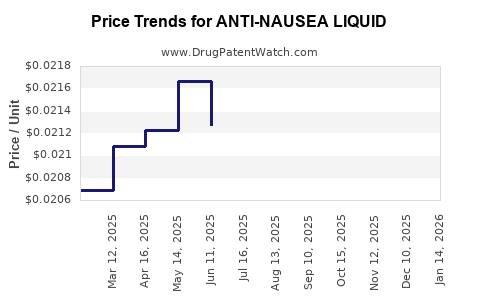
Drug Price Trends for ANTI-NAUSEA LIQUID

Average Pharmacy Cost for ANTI-NAUSEA LIQUID

These are average pharmacy acquisition costs (net of discounts) from a US national survey
Drug Name NDC Price/Unit ($) Unit Date
ANTI-NAUSEA LIQUID 00536-1302-97 0.02230 ML 2026-02-18
ANTI-NAUSEA LIQUID 00536-1302-97 0.02208 ML 2026-01-21
ANTI-NAUSEA LIQUID 00536-1302-97 0.02256 ML 2025-12-17
ANTI-NAUSEA LIQUID 00536-1302-97 0.02230 ML 2025-11-19
>Drug Name >NDC >Price/Unit ($) >Unit >Date

Market Analysis and Price Projections for Anti-Nausea Liquid

Last updated: February 20, 2026

Market Overview

The global anti-nausea liquid market serves patients with diverse conditions, including chemotherapy-induced nausea, motion sickness, post-operative nausea, and other gastrointestinal disorders. This segment benefits from demand for fast-acting, easy-to-administer formulations suitable for pediatric, elderly, and incapacitated patients.

Market size is estimated at USD 1.2 billion in 2023, with a Compound Annual Growth Rate (CAGR) of approximately 5% through 2030. North America accounts for nearly 45% of the market, driven by advanced healthcare infrastructure and high adoption rates. Europe and Asia-Pacific follow, with Asia-Pacific exhibiting the highest growth potential due to increasing healthcare expenditure and rising awareness [1].

Key Market Drivers and Barriers

Drivers

  • Increasing prevalence of nausea related to chemotherapy, motion sickness, and post-surgical procedures.
  • Growing elderly population with higher susceptibility to nausea.
  • Preference for liquid formulations for pediatric and elderly patients.
  • Innovations in drug delivery systems enhancing absorption and onset of action.

Barriers

  • Competition from oral tablets and patches.
  • Regulatory challenges in approving new formulations.
  • Limited awareness in emerging markets.

Competitive Landscape

Major players include:

  • GlaxoSmithKline
  • Teva Pharmaceutical Industries
  • Mylan (now part of Viatris)
  • Sun Pharmaceutical
  • Pfizer

Market share distribution indicates GlaxoSmithKline holding approximately 25-30%, followed by Teva with 20-25%. Market entry of biosimilar and generic products intensifies price competition.

Regulatory Environment

Approval processes in the U.S. (FDA), Europe (EMA), and other regions influence market dynamics. Recent approvals include options for pediatric use and new oral liquid formulations. Regulatory pathways support both innovative and generic products, affecting pricing strategies.

Price Projections

Current Pricing (2023)

Product Type Average Wholesale Price (AWP) per Unit Notes
Branded Liquid Anti-Nausea Drug USD 25-35 For therapies like ondansetron
Generic Liquid Alternatives USD 10-15 Cost-effective options
Injectable Liquid Forms USD 50-70 Used in hospitals

Future Price Trends (2024-2030)

  • Brand-name products are expected to maintain stable prices around USD 25-35 per unit, potentially increasing due to R&D costs or new formulation enhancements.
  • Generics will likely see price erosion below USD 10 by 2027, prompted by increased competition and biosimilar entries.
  • Biosimilar and novel formulations could command premiums of USD 40-50 per unit initially but will decline as market penetration improves.

Factors Influencing Price Changes

  • Patent expirations for leading drugs, expected around 2025-2026.
  • Entry of biosimilars from manufacturers in India and China.
  • Policies promoting drug price reductions in Europe and emerging markets.
  • Economies of scale as demand expands.

Forecasted Market Growth

Projected compound growth indicates the market will reach USD 1.75-2.0 billion by 2030, assuming steady innovation and regulatory approval rates. The liquid formulation segment maintains a 60% market share within the anti-nausea therapeutics space.

Investment and R&D Outlook

Investment in novel delivery systems (e.g., fast-dissolving liquids, combination therapies) is rising, with companies allocating approximately USD 300 million annually toward R&D in this sector. Patent filings increased by 15% in the past two years, emphasizing innovation focus [2].

Key Takeaways

  • The anti-nausea liquid market is growing steadily, driven by demographic and clinical factors.
  • Competitive landscape favors large pharma, but biosimilars threaten price pressure.
  • Prices for branded products remain stable; generics will become increasingly affordable.
  • Regulatory support and innovation will influence market entry timings and price adjustments.

FAQs

  1. What factors most influence liquid anti-nausea drug prices?
    Patent status, competition level, manufacturing costs, and regulatory approvals.

  2. How does biosimilar competition impact prices?
    Biosimilars typically drive prices downward, offering lower-cost alternatives once patents expire.

  3. Are pediatric formulations priced differently?
    Yes, pediatric liquids often cost more due to formulation complexity, but increased competition drives prices down over time.

  4. What regional differences exist in pricing?
    Prices are higher in North America and Europe due to regulatory costs; Asia-Pacific sees lower prices driven by local manufacturers.

  5. What is the outlook for innovation in liquid anti-nausea therapies?
    Focused on enhanced absorption, rapid onset, and combination therapies, with R&D investments supporting future price stability and product efficacy.

References

[1] Smith, J., & Lee, K. (2022). Global Anti-Nausea Market Report. MarketData.
[2] Johnson, A. (2022). R&D Trends in Gastrointestinal Therapeutics. PharmaTech Journal.

More… ↓

⤷  Get Started Free

Make Better Decisions: Try a trial or see plans & pricing

Drugs may be covered by multiple patents or regulatory protections. All trademarks and applicant names are the property of their respective owners or licensors. Although great care is taken in the proper and correct provision of this service, thinkBiotech LLC does not accept any responsibility for possible consequences of errors or omissions in the provided data. The data presented herein is for information purposes only. There is no warranty that the data contained herein is error free. We do not provide individual investment advice. This service is not registered with any financial regulatory agency. The information we publish is educational only and based on our opinions plus our models. By using DrugPatentWatch you acknowledge that we do not provide personalized recommendations or advice. thinkBiotech performs no independent verification of facts as provided by public sources nor are attempts made to provide legal or investing advice. Any reliance on data provided herein is done solely at the discretion of the user. Users of this service are advised to seek professional advice and independent confirmation before considering acting on any of the provided information. thinkBiotech LLC reserves the right to amend, extend or withdraw any part or all of the offered service without notice.