Last updated: February 14, 2026
Market Overview and Pricing Trends for Anti-Gas Drugs
Anti-Gas drugs, primarily containing simethicone or other anti-foaming agents, are over-the-counter (OTC) remedies used for relief of bloating, indigestion, and flatulence. The global market for anti-gas medications has experienced consistent growth over recent years, driven by increasing consumer awareness of digestive health and aging populations susceptible to gastrointestinal issues.
Market Size and Growth
Global Market Valuation
- 2022: Estimated at $1.3 billion.
- Compound annual growth rate (CAGR) (2022-2027): Approximately 4.2%.
- Drivers include rising consumer healthcare expenditure, expanded OTC sales channels, and greater inclusion of these drugs in product portfolios by multinational OTC companies.
Regional Breakdown
| Region |
2022 Market Share |
Growth Rate (2022-2027) |
Key Drivers |
| North America |
39% |
3.8% |
High OTC penetration, aging population, manufacturing strength |
| Europe |
28% |
4.4% |
Growing awareness, dietary supplement integration |
| Asia-Pacific |
22% |
5.2% |
Population size, increasing health consciousness |
| Latin America |
7% |
4.0% |
Market penetration, urbanization |
Market Trends
- Increased regulation of prescription gastrointestinal drugs shifts demand toward OTC products.
- Expansion into emerging markets enhances revenue streams.
- Growing consumer preference for natural and complementary digestive health products influences formulation trends.
Key Players and Product Landscapes
Major companies include Johnson & Johnson, Bayer, GlaxoSmithKline, and Novartis, which dominate OTC anti-gas markets via brand portfolios such as Gas-X, Mylicon, and Mylanta.
New entrants focus on niche formulations, including natural extracts and combination products targeting specific customer segments.
Regulatory Environment and Impact
- U.S. FDA classification: Generally recognized as safe (GRAS) for OTC use.
- European Medicines Agency (EMA): Allows OTC status with strict manufacturing and labeling demands.
- Emerging markets: Regulatory pathways vary, often leading to delayed or limited product launches.
Price Projections
Current Pricing Metrics (2022):
| Product Type |
Average Retail Price (USD) |
Packaging Size |
Price per Dose (USD) |
| Simethicone capsules |
$8.50 |
100 capsules |
$0.085 |
| Chewable tablets |
$6.50 |
50 tablets |
$0.13 |
| Suspensions |
$7.75 |
150 mL |
$0.05/mL |
Projection (2022-2027):
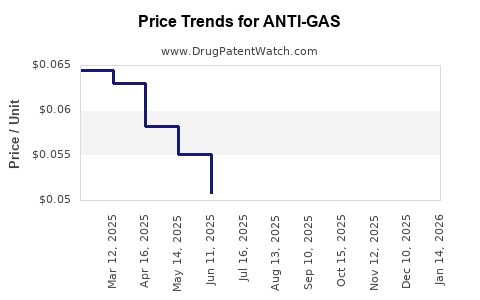
- Price per dose is expected to decline slightly, at an average rate of 1-1.5% annually, due to increased competition and manufacturing efficiencies.
- Larger pack sizes and multi-dose formulations will maintain or slightly increase overall pack costs, skewing consumer expenditure upward.
Forecasted Market Pricing Trends:
| Year |
Estimated Price per Dose |
Expected Retail Price Change |
Key Influencers |
| 2023 |
$0.085 – $0.13 |
Stable to slight decrease |
Price competition, import tariffs |
| 2025 |
$0.08 – $0.12 |
1% decrease |
Digital marketing, private labels |
| 2027 |
$0.075 – $0.11 |
1.5% decrease |
Manufacturing consolidation, R&D shifts |
Competitive Pricing Strategies
- Companies optimize supply chains to lower manufacturing costs.
- Brand differentiation through natural ingredients or added features influences pricing.
- Discounting and value packs gain popularity in price-sensitive regions.
Key Takeaways
- The anti-Gas drug market is valued at over $1.3 billion globally, with steady CAGR of 4.2% through 2027.
- North America remains the largest market, but Asia-Pacific shows the fastest growth, driven by population and rising health awareness.
- Prices per dose are expected to decline modestly over the next five years due to increased competition and efficiencies.
- Major players maintain dominance through brand recognition and distribution strength.
- Regulatory environments influence market entry speed, with emerging markets facing variable challenges.
FAQs
1. What factors drive price changes in anti-gas drugs?
Market saturation, manufacturing costs, regulatory changes, and competitive pricing strategies influence retail prices.
2. Are natural ingredients impacting market pricing?
Yes, products with natural or herbal ingredients often command higher prices due to sourcing and perceived value.
3. How does regional regulation affect pricing?
Stricter regulatory requirements increase compliance costs, which can be passed on to consumers, affecting pricing strategies.
4. What is the outlook for new entrants?
Entry barriers include regulatory approval and distribution channels; however, niche natural formulations provide opportunities.
5. How do inflation trends impact future pricing?
Rising raw material and labor costs may temper the downward pricing trend, particularly in emerging markets.
References
- Market Research Future. "Digestive Health Market Report," 2022.
- Statista. "Over-the-counter (OTC) Digestive Disorder Medications," 2022.
- U.S. Food and Drug Administration. "OTC Drug Review," 2022.
- European Medicines Agency. "Regulation of OTC Drugs," 2022.
- IBISWorld. "Pharmaceuticals and Biotechnology Global Market," 2022.