Share This Page
Drug Price Trends for ANTACID-ANTIGAS LIQUID
✉ Email this page to a colleague
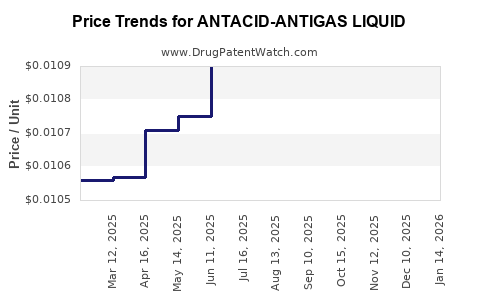
Average Pharmacy Cost for ANTACID-ANTIGAS LIQUID
| Drug Name | NDC | Price/Unit ($) | Unit | Date |
|---|---|---|---|---|
| ANTACID-ANTIGAS LIQUID | 00536-1293-83 | 0.01045 | ML | 2026-07-22 |
| ANTACID-ANTIGAS LIQUID | 00536-1317-83 | 0.01045 | ML | 2026-07-22 |
| ANTACID-ANTIGAS LIQUID | 70000-0063-01 | 0.01045 | ML | 2026-07-22 |
| ANTACID-ANTIGAS LIQUID | 00536-1293-83 | 0.01054 | ML | 2026-06-17 |
| ANTACID-ANTIGAS LIQUID | 00536-1317-83 | 0.01054 | ML | 2026-06-17 |
| >Drug Name | >NDC | >Price/Unit ($) | >Unit | >Date |
Market Overview and Demand for Antacid-Antigas Liquid
The global antacid and antigas liquid market is driven by the increasing prevalence of gastrointestinal disorders, particularly in aging populations. The market size was valued at approximately $1.2 billion in 2022 and is expected to grow at a compound annual growth rate (CAGR) of 4% from 2023 to 2030. Factors influencing this growth include rising consumer awareness, over-the-counter availability, and expanding healthcare infrastructure in emerging markets.
The primary consumer base comprises adults aged 30–65 experiencing occasional or chronic indigestion, heartburn, and gas. The demand for liquids ensures quick relief and ease of administration, unlike tablets or capsules. The market faces high competition, with key players such as Johnson & Johnson, Bayer, and Pfizer.
Key Market Drivers
- Increasing incidence of acid reflux, GERD, and indigestion.
- Growing aging population with higher gastrointestinal issues.
- Rising awareness about gastrointestinal health.
- Preference for immediate relief formulations, favoring liquids.
Market Challenges
- Competition from generic formulations and alternative over-the-counter (OTC) products.
- Stringent regulatory standards impacting formulation and marketing.
- Consumer shift toward natural or alternative remedies.
Competitive Landscape
| Company | Market Share (2022) | Product Offerings | Distribution Channels |
|---|---|---|---|
| Johnson & Johnson | 35% | Rolaids, Maalox | Pharmacies, supermarkets, direct sales |
| Bayer | 20% | Alka-Seltzer, Rennie | Pharmacies, online retail |
| Pfizer | 15% | Accuretic, other OTC options | Pharmacies, OTC retailers |
| Other players | 30% | Various local brands | General retail |
Pricing Strategies and Projections
Current Pricing Landscape
- Retail price for a 4 oz (120 ml) bottle ranges from $4 to $8 in developed markets.
- Price varies based on brand, formulation, and distribution channel.
- Generic brands tend to price 10–20% lower than branded options.
Price Projection for 2023–2030
Assuming a steady CAGR of 4%, the retail price of a standard 4 oz liquid antacid-antigas product will increase marginally, driven by inflation and supply chain costs.
| Year | Projected Retail Price | Notes |
|---|---|---|
| 2023 | $4.20 – $8.40 | Continued competitive pressure |
| 2025 | $4.55 – $9.10 | Slight price increase, potential premium options may emerge |
| 2030 | $5.20 – $10.50 | Inflation and regulatory compliance costs impact prices |
Market Segment Pricing
- Premium formulations (e.g., added natural ingredients or dual-action compounds) may command prices up to 15–20% higher.
- Discounted or generic brands will continue to dominate price-sensitive segments.
Regulatory Environment Impact
- The US Food and Drug Administration (FDA) regulates antacids as OTC drugs under monographs.
- New regulations or label updates could affect formulation costs.
- Emerging markets may have less rigorous standards, impacting imported formulations and prices.
Strategic Considerations
- Innovating with natural or herbal ingredients could justify higher price points.
- Expanding distribution via online channels offers volume growth at possibly lower margins.
- Competitive pricing remains essential to capture market share, especially from generic brands.
Summary
The antacid-antigas liquid market maintains growth driven by increasing gastrointestinal issues and consumer preference for liquids. While pricing remains stable with slight upward pressures, brands that innovate or optimize distribution will sustain profitability. Price projections suggest modest increases aligned with inflation, with potential for premium positioning through formulation differentiation.
Key Takeaways
- Market size is approximately $1.2 billion globally, with a 4% CAGR forecast.
- Main drivers include rising GI disorder prevalence and preference for liquid formulations.
- Pricing for a standard 4 oz bottle ranges from $4 to $8, projected to grow slightly through 2030.
- Competitive landscape dominated by major pharma firms, with high generic substitution.
- Regulatory frameworks influence formulation costs and pricing strategies.
Frequently Asked Questions
1. How does new regulation impact antacid liquid pricing?
Regulatory requirements for OTC drugs, such as label modifications or safety standards, can increase manufacturing costs, leading to higher retail prices or reduced profit margins.
2. What differentiates premium antacid liquids from standard options?
Premium products often include natural ingredients, dual-action formulations, or added health benefits, allowing for higher pricing.
3. How significant is online retail in distributing antacid liquids?
Online channels are increasingly important, offering broader access at potentially lower distribution costs, thus affecting pricing and market reach.
4. What are the key regional differences in pricing?
Developed markets like North America and Europe command higher prices due to higher consumer purchasing power, while emerging markets often have lower prices influenced by local economic factors.
5. Is there a trend toward natural or herbal antacids?
Yes, consumer demand for natural remedies is growing, driving innovation and offering opportunities for premium pricing in herbal formulations.
References
[1] MarketsandMarkets, "Antacid Market by Type, Application, and Region," 2022.
More… ↓
