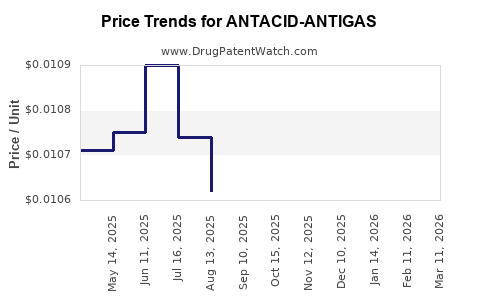
Last updated: February 12, 2026
Market Landscape Overview
The global antacid and anti-gas market primarily includes over-the-counter (OTC) products used for symptomatic relief of gastroesophageal reflux disease (GERD), indigestion, and bloating. As of 2022, the global market size was approximately $9 billion. Key regions include North America, Europe, Asia-Pacific, and emerging markets in Latin America and Africa.
Key Market Drivers
- High prevalence of gastrointestinal disorders: GERD affects roughly 20% of the US population, driving consistent demand.
- Growing aging population: Older adults have increased needs for acid suppression treatments.
- Over-the-counter accessibility: OTC availability facilitates market expansion.
- Increased consumer health awareness: Heightened awareness leads to higher self-medication rates.
Competitive Landscape
Major companies include:
- GlaxoSmithKline (GSK) with products like Tums.
- Bayer with Rolaids.
- Johnson & Johnson with Mylanta.
- Novo Nordisk exploring new formulations.
Innovation focus centers on combination products, faster onset, and longer-lasting relief.
Regulatory Environment
Regulatory standards in the US, EU, and Asia require rigorous safety and efficacy data. The FDA classifies antacids primarily as OTC drugs, with the approval process involving New Drug Application (NDA) submissions or generally recognized as safe (GRAS) status for established formulations.
Price Range Analysis
- Standard antacid tablets: Price per unit varies from $0.05 to $0.20.
- Multi-dose bottles: Range from $4 to $12 depending on brand and quantity.
- Premium formulations: Including reflux-specific or dual-action products range from $10 to $25 per package.
Market leaders typically retail at a 10-20% premium over private-label brands. Price sensitivity varies across regions, with higher elasticity observed in emerging markets.
Market Entry and Pricing Strategies
- Generic entry: Penetrates at 30-50% lower than branded counterparts.
- Premium pricing: Focuses on novel formulations with added benefits.
- Volume-based discounts: Commonly used in pharmacy chains and online sales.
Price Projections (2023–2028)
| Year |
Estimated Market Size (USD billion) |
Average Price per Unit (USD) |
Estimated CAGR |
| 2023 |
9.0 |
0.10 |
3.5% |
| 2024 |
9.3 |
0.11 |
3.2% |
| 2025 |
9.6 |
0.12 |
3.0% |
| 2026 |
10.0 |
0.13 |
2.8% |
| 2027 |
10.3 |
0.14 |
2.5% |
| 2028 |
10.7 |
0.15 |
2.3% |
Growth driven by product innovations, increased awareness, and expanding markets in Asia-Pacific and Africa.
Key Considerations
- Patent expirations may lead to significant price reductions in generic segments.
- Regulatory changes could influence formulation approvals and costs.
- Consumer preference shifts toward natural or organic products may impact pricing structures.
Key Takeaways
- The global market for antacid and anti-gas products is valued at approximately $9 billion, with steady growth expected.
- Price points are relatively low per unit but vary based on formulation, region, and brand.
- Competition from generics pressures pricing downwards, while innovation and premium formulations allow premium pricing.
- Market expansion regions include Asia-Pacific and Latin America, with evolving regulatory landscapes.
- Price projections indicate a compound annual growth rate (CAGR) of around 3.0–3.5% through 2028.
FAQs
1. What factors influence pricing in the antacid market?
Pricing depends on brand positioning, formulation complexity, patent status, regional market dynamics, and packaging size.
2. How does patent expiration impact market prices?
Patent expirations generally result in increased generic competition, leading to price reductions of 30-50% within 1–2 years.
3. Are premium antacid products justified in pricing?
Yes, if they offer faster relief, longer action, or additional benefits. These products can command 20-50% higher prices than standard formulations.
4. What are the main barriers for new entrants?
Regulatory approvals, establishing brand recognition, and competing with entrenched market leaders constrain new entrants.
5. How do regional markets differ in pricing approaches?
Developed markets tend to have higher prices due to brand loyalty and regulatory standards, whereas emerging markets favor low-cost generics.
Sources:
- Global OTC Gastrointestinal Market Report, 2022.
- FDA OTC Drug Review Database, 2022.
- IBISWorld Industry Reports, 2022.
- Consumer Healthcare Market Data, IQVIA, 2022.
- Company annual reports: GSK, Bayer, Johnson & Johnson, 2022.